
DIHOOM Wireless Security Camera NVR (Recorder Unit)
DIHOOM Wireless Security Camera NVR Instruction Manual
Model: Wireless Security Camera NVR (Recorder Unit Only)
Brand: DIHOOM
1. Introduction
This instruction manual provides detailed information on the setup, operation, and maintenance of your DIHOOM Wireless Security Camera NVR. This NVR (Network Video Recorder) unit is designed to work with DIHOOM wireless surveillance cameras, supporting up to 8 cameras with 5-megapixel resolution. It features H.265+ compression for efficient storage and supports both local and remote monitoring via smartphone or PC.

Image: Front view of the DIHOOM Wireless Security Camera NVR unit, showing its compact design and two antennas.
2. Product Overview and Components
Familiarize yourself with the various ports and indicators on your NVR unit.

Image: Diagram illustrating the components and ports of the DIHOOM NVR. Key components include: (1) Power Lamp, (2) HDD Lamp, (3) RUN Lamp, (4) Antennas, (5) USB Port, (6) VGA Port, (7) Switch Button, (8) Power Port, (9) LAN Port, (10) HDMI Port.
- Power Lamp: Indicates the power status of the unit.
- HDD Lamp: Indicates the status of the hard disk drive.
- RUN Lamp: Indicates the operational status of the NVR.
- Antennas: For wireless communication with cameras.
- USB Port: For connecting a mouse or external storage.
- VGA Port: For connecting to a monitor via VGA cable.
- Switch Button: Power on/off switch.
- Power Port: For connecting the power adapter.
- LAN Port: For wired network connection to a router.
- HDMI Port: For connecting to a monitor via HDMI cable.
3. Setup Guide
The DIHOOM NVR is designed for easy setup with minimal configuration required for wireless cameras.

Image: Visual guide for NVR setup. Steps include: 1. Powering on the camera and connecting the NVR to a router. 2. Downloading the mobile application. 3. Viewing recordings.
3.1 Initial Wireless Connection
- Power On Cameras: Ensure all DIHOOM wireless cameras are powered on and within range of the NVR.
- Power On NVR: Connect the power adapter to the NVR's power port and plug it into an electrical outlet. The NVR will power on automatically.
- Connect to Display: Connect the NVR to a monitor or TV using either the HDMI or VGA port.
- Automatic Pairing: The NVR will automatically detect and pair with powered-on DIHOOM wireless cameras. Live feeds should appear on the connected display.
3.2 Wired Connection (Optional)
For improved signal strength or specific network configurations, individual cameras can be connected to the NVR via an Ethernet cable.
- Connect one end of an Ethernet cable to the camera's LAN port.
- Connect the other end of the Ethernet cable to an available LAN port on the NVR.
- The NVR will automatically switch the camera's connection to wired mode.
3.3 Remote Monitoring Setup
To enable remote viewing via smartphone or PC, the NVR must be connected to your home network.
- Connect NVR to Router: Use an Ethernet cable to connect the NVR's LAN port to an available port on your internet router.
- Download App: Download the official DIHOOM monitoring application from your smartphone's app store (App Store for iOS, Google Play for Android).
- Register/Login: Follow the in-app instructions to register an account and add your NVR device using its unique ID or QR code.
- PC Client: For PC monitoring, download the dedicated client software from the official DIHOOM website.
4. Operating the NVR
4.1 Live View and Playback (Local Operation)
When connected to a display, you can perform real-time viewing, playback, and system settings directly on the NVR using a USB mouse.
- Real-time Viewing: Displays live feeds from all connected cameras.
- Playback: Access recorded footage stored on the installed HDD.
- Settings: Configure various NVR parameters, including recording modes, network settings, and user management.
4.2 Recording Modes
The NVR supports three primary recording modes to suit different surveillance needs.
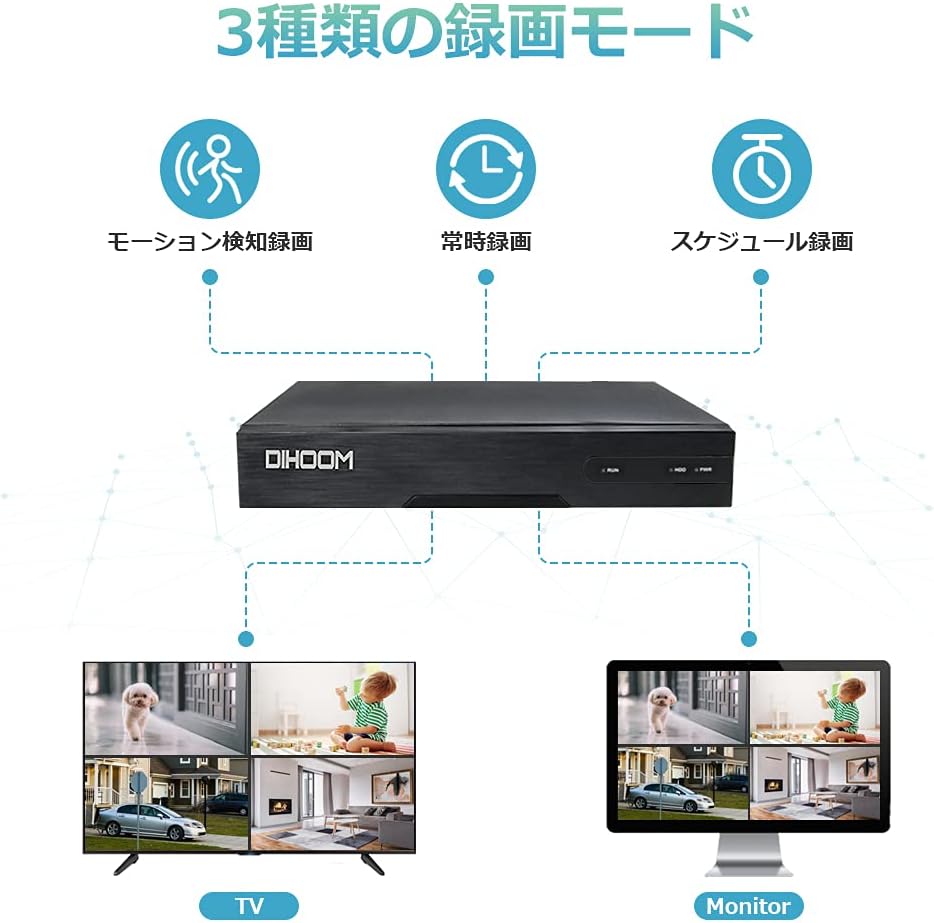
Image: Diagram illustrating the three recording modes: Motion Detection Recording, Continuous Recording, and Schedule Recording. Below are examples of multi-camera views on a TV and a monitor.
- Continuous Recording: Records 24/7 without interruption.
- Schedule Recording: Allows you to set specific times for recording.
- Motion Detection Recording: Records only when motion is detected, saving storage space. When abnormal movement is detected, the NVR will trigger a buzzer alarm and send notifications to your smartphone.

Image: Illustration of the motion detection feature, showing a camera detecting human movement and the NVR unit emitting an alarm sound.
5. Key Features
- 5 Megapixel Resolution Support: The NVR's default resolution is 5MP (2560x1920), providing clear and detailed images. It supports five different resolution settings for monitoring systems.
- H.265+ High Compression Technology: Adopting H.265+ compression technology, this NVR saves approximately half the HDD capacity compared to conventional H.264. This also reduces bandwidth usage, resulting in smoother video playback.

Image: Comparison of H.264, H.265, and H.265+ compression, showing H.265+ offers significantly longer recording times for the same storage capacity (e.g., 27 days vs. 9 days for 1TB HDD).
- Supports up to 8 Cameras: This NVR can be expanded to support up to 8 wireless security cameras, allowing for comprehensive surveillance coverage.
- Local and Remote Operation: The NVR supports local operation (real-time viewing, playback, settings) without an internet connection when connected to a display. For remote monitoring via smartphone or PC, a wired LAN connection to a router is required.
6. Maintenance
Proper maintenance ensures the longevity and optimal performance of your DIHOOM NVR.
- Cleaning: Regularly wipe the NVR unit with a soft, dry cloth. Do not use liquid cleaners or aerosols.
- Ventilation: Ensure the NVR is placed in a well-ventilated area to prevent overheating. Do not block ventilation openings.
- Firmware Updates: Periodically check the DIHOOM official website for firmware updates to ensure your system has the latest features and security patches.
- HDD Health: If an HDD is installed, monitor its health through the NVR's system settings to prevent data loss.
7. Troubleshooting
This section addresses common issues you might encounter with your DIHOOM NVR.
| Problem | Possible Cause | Solution |
|---|---|---|
| No image on display. | Loose cable connection, incorrect input source on monitor, NVR not powered on. | Check HDMI/VGA cable connection. Ensure monitor input is set correctly. Verify NVR power lamp is on. |
| Cameras not showing up. | Cameras not powered on, out of range, interference, or not paired. | Ensure cameras are powered. Reduce distance between NVR and cameras. Try wired connection for problematic cameras. Re-pair cameras if necessary (refer to NVR settings). |
| Remote viewing not working. | NVR not connected to router, network issues, incorrect app settings. | Verify NVR is connected to router via LAN cable. Check router's internet connection. Ensure correct device ID/QR code is entered in the app. |
| Recording not happening. | No HDD installed, HDD full, incorrect recording schedule, motion detection not triggered. | Install a compatible HDD (up to 6TB). Check HDD status and free space. Verify recording schedule or motion detection settings. |
8. Specifications
| Feature | Detail |
|---|---|
| Brand | DIHOOM |
| Model Type | Wireless Security Camera NVR (Recorder Unit) |
| ASIN | B09362BY11 |
| UPC | 631851245137 |
| Connectivity Technology | Wi-Fi (Wireless), Ethernet (Wired) |
| Channel Count | 8 (Supports up to 8 cameras) |
| Max Resolution | 5 Megapixels (2560x1920) |
| Video Compression | H.265+ |
| HDD Support | Up to 6TB (HDD not included) |
| Package Dimensions | 50 x 46 x 39 cm |
| Package Weight | 13.6 kg |
9. Warranty and Support
DIHOOM is committed to providing high-quality products and excellent customer support.


Image: Left: DIHOOM customer support representatives ready to assist. Right: DIHOOM's quality control process, ensuring each product is inspected before shipment.
- Quality Assurance: Products undergo rigorous inspection before shipment.
- Technical Support: Professional technical support is available for assistance with product setup, operation, and troubleshooting.
- Contact Information: For support inquiries, please refer to the contact details provided on the DIHOOM official website or your purchase documentation.
Related documentsWireless Security Camera NVR (Recorder Unit)

Ask a question about this manual
Ask about setup, troubleshooting, compatibility, parts, safety, or missing instructions. Manuals+ will review the question and use this page’s manual context to help answer it.