
1. Important Safety Instructions
Please read all instructions carefully before using the Gevi Espresso Machine. Keep this manual for future reference.
- Ensure the machine is placed on a stable, level surface.
- Do not immerse the machine, power cord, or plug in water or other liquids.
- Unplug from the outlet when not in use and before cleaning.
- Do not operate any appliance with a damaged cord or plug.
- Use only cold, fresh water in the water tank.
- Avoid contact with hot surfaces, such as the steam wand and portafilter.
- This appliance is for household use only.
2. Product Overview
The Gevi Espresso Machine ECMN0-WH0A1 is designed to deliver high-quality espresso with features like precise pressure control, dual displays for real-time monitoring, and a powerful steam wand for milk frothing.
Key Features:
- OPV (Over Pressure Valve) and 3-way Solenoid Valve: Ensures stable extraction pressure between 9-12 bar.
- Dual Display: Real-time monitoring of extraction pressure, time, and temperature.
- PID+NTC Temperature Control: Offers three precise temperature options (197.6℉/92℃, 201.2℉/94℃, 204.8℉/96℃).
- 58mm Commercial-Grade Portafilter: For even coffee grounds distribution and thorough extraction.
- Semi-Automatic Steam Wand: Features a three-hole nozzle with two steam options (Mild/Strong Mode).
3. Setup and First Use
3.1 Unpacking
Carefully remove all packaging materials and ensure all components are present. The package should include:
- Gevi Espresso Machine (1)
- 58mm Portafilter (1)
- Tamper (1)
- Stainless Steel Milk Frothing Pitcher (1)
- Cleaning Needle (1)
- Single Wall 1 Cup Filter Basket (1)
- Single Wall 2 Cup Filter Basket (1)
- Cleaning Brush (1)
- Spoon (1)
3.2 Initial Cleaning
Before first use, wash the water tank, portafilter, filter baskets, and milk frothing pitcher with warm soapy water. Rinse thoroughly and dry. Wipe the exterior of the machine with a damp cloth.
3.3 Filling the Water Tank
The machine features a 77.7oz (2.3 liter) removable water tank for easy refilling and maintenance.
- Lift the water tank from the back of the machine.
- Fill the tank with fresh, cold water up to the MAX line.
- Place the water tank back into its position, ensuring it is seated correctly.
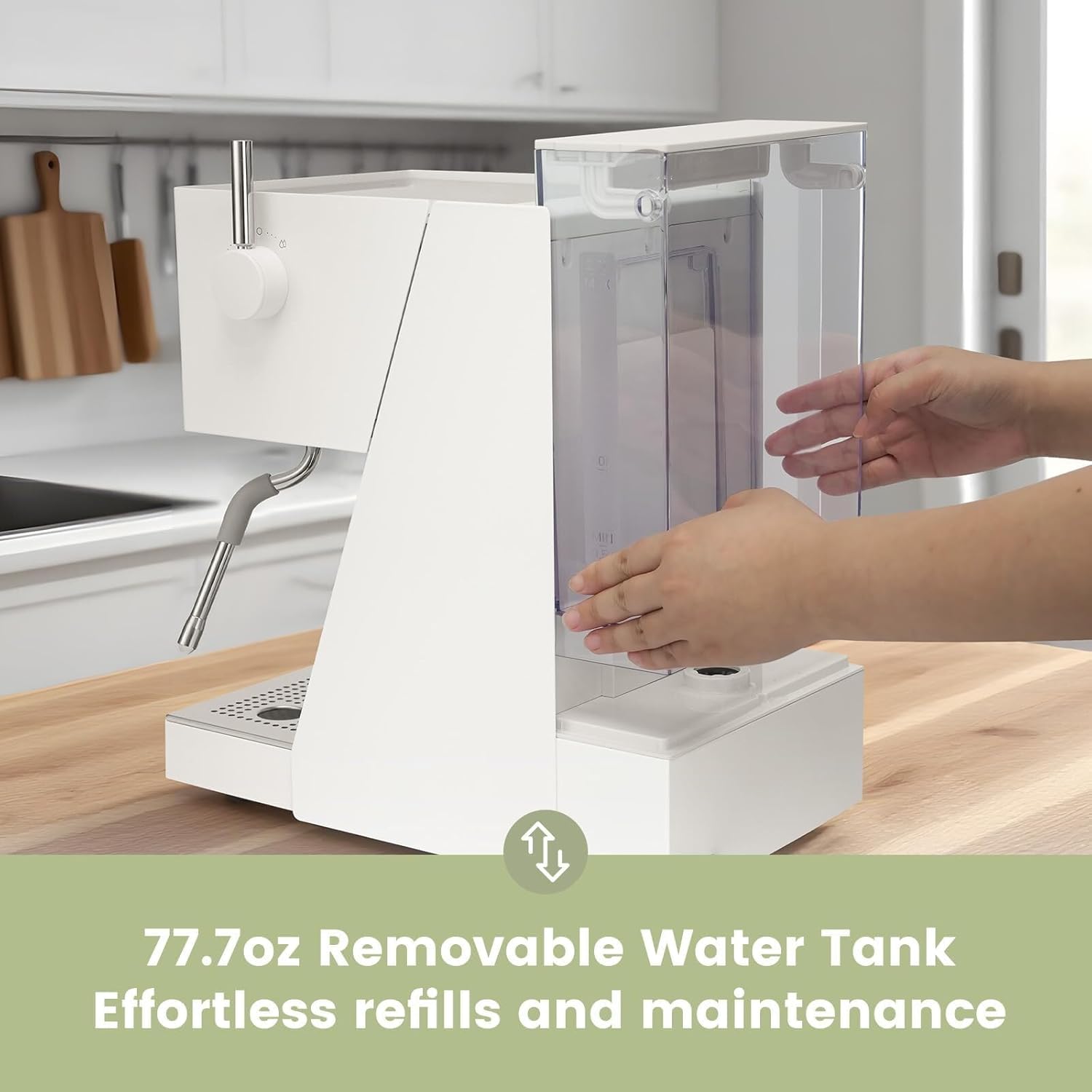
Image: The 77.7oz removable water tank, shown being inserted into the back of the espresso machine for easy refills and maintenance.
3.4 Priming the Machine
Before brewing, prime the machine to ensure water flows through the system.
- Plug the machine into a grounded electrical outlet.
- Press the power button to turn on the machine.
- Place a cup under the brew head and another under the steam wand.
- Run a shot of hot water through the brew head without coffee.
- Open the steam valve to release steam for a few seconds until water flows steadily. Close the valve.
4. Operating Instructions
4.1 Making Espresso
Follow these steps to brew a perfect shot of espresso:
- Preheat: Ensure the machine is preheated. The dual display will indicate when it's ready.
- Grind Coffee: Grind fresh coffee beans to a fine consistency suitable for espresso.
- Fill Portafilter: Place the desired filter basket (1-cup or 2-cup) into the 58mm portafilter. Fill with ground coffee.

Image: A detailed view of the 58mm commercial-grade portafilter with ground coffee, ready for brewing. This larger diameter allows for more even coffee distribution.
- Tamp: Use the tamper to press the coffee grounds firmly and evenly.
- Attach Portafilter: Insert the portafilter into the group head and twist firmly to lock it into place.
- Place Cup: Position your espresso cup(s) under the portafilter spouts.
- Brew: Select your desired shot volume or press the brew button to start extraction. The dual display will show extraction pressure and time. The OPV system maintains optimal pressure between 9-12 bar for balanced flavor.

Image: An internal diagram illustrating the Smart OPV Pressure Control system, showing the pressure gauge indicating an optimal 9 Bar extraction for balanced flavor.

Image: The intuitive LED display of the Gevi espresso machine, showing precise time and temperature control during the brewing process.

Image: Two cups of espresso being quickly extracted by the 20 Bar Italian ULKA Pump, producing a full-bodied coffee.
4.2 Frothing Milk
The semi-automatic steam wand allows you to create microfoam for lattes and cappuccinos.
- Prepare Milk: Fill the stainless steel milk frothing pitcher with cold milk (dairy or non-dairy).
- Purge Steam Wand: Briefly open the steam valve to release any condensed water. Close the valve.
- Position Wand: Immerse the three-hole nozzle of the steam wand just below the surface of the milk.
- Steam Milk: Open the steam valve. You can choose between Mild Mode and Strong Mode for different steam strengths. Angle the pitcher to create a swirling motion.
- Monitor Temperature: Continue steaming until the milk reaches the desired temperature and texture (typically 140-150℉ / 60-65℃).
- Clean Wand: Immediately after frothing, wipe the steam wand with a damp cloth and briefly purge steam again to clear any milk residue.

Image: The powerful steam wand of the Gevi espresso machine, featuring a 3-hole nozzle and a control knob for selecting two steam strengths, effortlessly producing smooth microfoam.
5. Maintenance and Cleaning
Regular cleaning ensures optimal performance and extends the lifespan of your espresso machine.
5.1 Daily Cleaning
- Portafilter and Filter Baskets: After each use, remove the portafilter, discard coffee grounds, and rinse the portafilter and filter basket under hot water.
- Steam Wand: As mentioned in section 4.2, clean the steam wand immediately after frothing milk.
- Drip Tray: Empty and rinse the drip tray daily. The removable design makes this easy.
- Exterior: Wipe the exterior of the machine with a soft, damp cloth. Do not use abrasive cleaners.
5.2 Water Tank Cleaning
Periodically clean the water tank to prevent mineral buildup.
- Remove the water tank from the machine.
- Wash with warm soapy water and rinse thoroughly.
- Ensure it is completely dry before refilling and placing it back.
5.3 Descaling
Over time, mineral deposits can build up inside the machine, affecting performance. Descale your machine every 2-3 months, or more frequently if you have hard water.
- Use a commercial descaling solution designed for espresso machines, following the product's instructions.
- Fill the water tank with the descaling solution and water mixture.
- Run the solution through the brew head and steam wand as if making coffee and steaming milk, without actual coffee or milk.
- Rinse the machine by running several cycles of fresh water through it after descaling.
6. Troubleshooting
If you encounter issues with your Gevi Espresso Machine, refer to the following common problems and solutions:
| Problem | Possible Cause | Solution |
|---|---|---|
| No water flow from brew head | Water tank empty or not properly seated; machine not primed; clogged filter basket. | Refill/reseat water tank; prime the machine; clean filter basket. |
| Espresso extracts too slowly or not at all | Coffee ground too fine; too much coffee in portafilter; coffee tamped too hard; machine needs descaling. | Use coarser grind; reduce coffee amount; tamp lighter; descale the machine. |
| Espresso extracts too quickly | Coffee ground too coarse; not enough coffee in portafilter; coffee tamped too lightly. | Use finer grind; increase coffee amount; tamp firmer. |
| No steam from steam wand | Steam wand clogged; machine not at steaming temperature. | Clean steam wand with cleaning needle; allow machine to reach steaming temperature. |
| Machine leaking water | Water tank not properly seated; drip tray full; gasket issue. | Reseat water tank; empty drip tray; inspect and clean group head gasket. |
If the problem persists, please contact Gevi customer support.
7. Specifications
Detailed specifications for the Gevi Espresso Machine ECMN0-WH0A1:
| Feature | Detail |
|---|---|
| Brand | Gevi |
| Model Name | ECMN0-WH0A1 |
| Capacity | 2.3 liters (77.7 oz) |
| Color | White |
| Product Dimensions (D x W x H) | 15.55"D x 9.05"W x 14.17"H |
| Item Weight | 21.6 Pounds |
| Coffee Maker Type | Espresso Machine |
| Operation Mode | Semi-Automatic |
| Wattage | 1350 watts |
| Voltage | 120 Volts |
| Output Pressure | 9-12 Bars (OPV controlled) |
| Human Interface Input | Touchscreen |
| Material | Stainless Steel |
| Special Features | 58mm Commercial-Grade Portafilter, PID & NTC Dual Temperature Control, Adjustable Brew Temperature and Shot Volume, Commercial Pre-Infusion System |

Image: Diagram showing the product dimensions: 9.05"W x 14.17"H x 15.55"D.

Image: An exploded view illustrating the 1.2mm thick stainless steel construction with nanometer-level protective layer and oxidation protective payer, designed to reduce vibration and noise.
8. Warranty and Support
8.1 Warranty Information
Gevi products are manufactured to high-quality standards. For specific warranty details, including coverage period and terms, please refer to the warranty card included with your product or visit the official Gevi website.
8.2 Customer Support
If you have any questions, require technical assistance, or need to report an issue with your Gevi Espresso Machine, please contact our customer support team:
- Website: Visit the official Gevi website for FAQs and support resources.
- Email: Refer to your product packaging or warranty card for customer service email.
- Phone: Refer to your product packaging or warranty card for customer service phone number.


