1. Introduction
This manual provides essential information for the correct installation, safe use, and maintenance of your Kinderkraft Endura Safe Car Seat. Please read these instructions carefully before first use and keep them for future reference. Incorrect installation or use can compromise the safety of your child.
2. Safety Information
- Always ensure the car seat is correctly installed according to the instructions provided.
- Never leave a child unattended in the car seat.
- Ensure the harness is properly adjusted and snug against the child's body, with no slack.
- Do not use the car seat if it has been involved in an accident, even if there is no visible damage. Internal damage may have occurred.
- Follow the weight and height limits specified for each configuration of the car seat.
- Regularly check all components for wear or damage. Discontinue use if any part is compromised.
- The car seat is designed for use in vehicles equipped with ISOFIX and Top Tether or vehicle seat belts, depending on the installation method. Refer to your vehicle's owner's manual for compatible seating positions.
3. Product Components
The Kinderkraft Endura Safe Car Seat system includes the following main components:
- Car Seat Base with ISOFIX connectors and support leg
- Infant Carrier (for newborns up to 87 cm)
- Toddler/Child Seat (for children from 61 cm up to 150 cm)
- Removable inserts and padding
- 5-point harness system (for infant carrier and toddler seat up to 105 cm)

Image: The Endura Safe Modular System, illustrating the infant carrier, the toddler/child seat, and the ISOFIX base as separate components that work together.
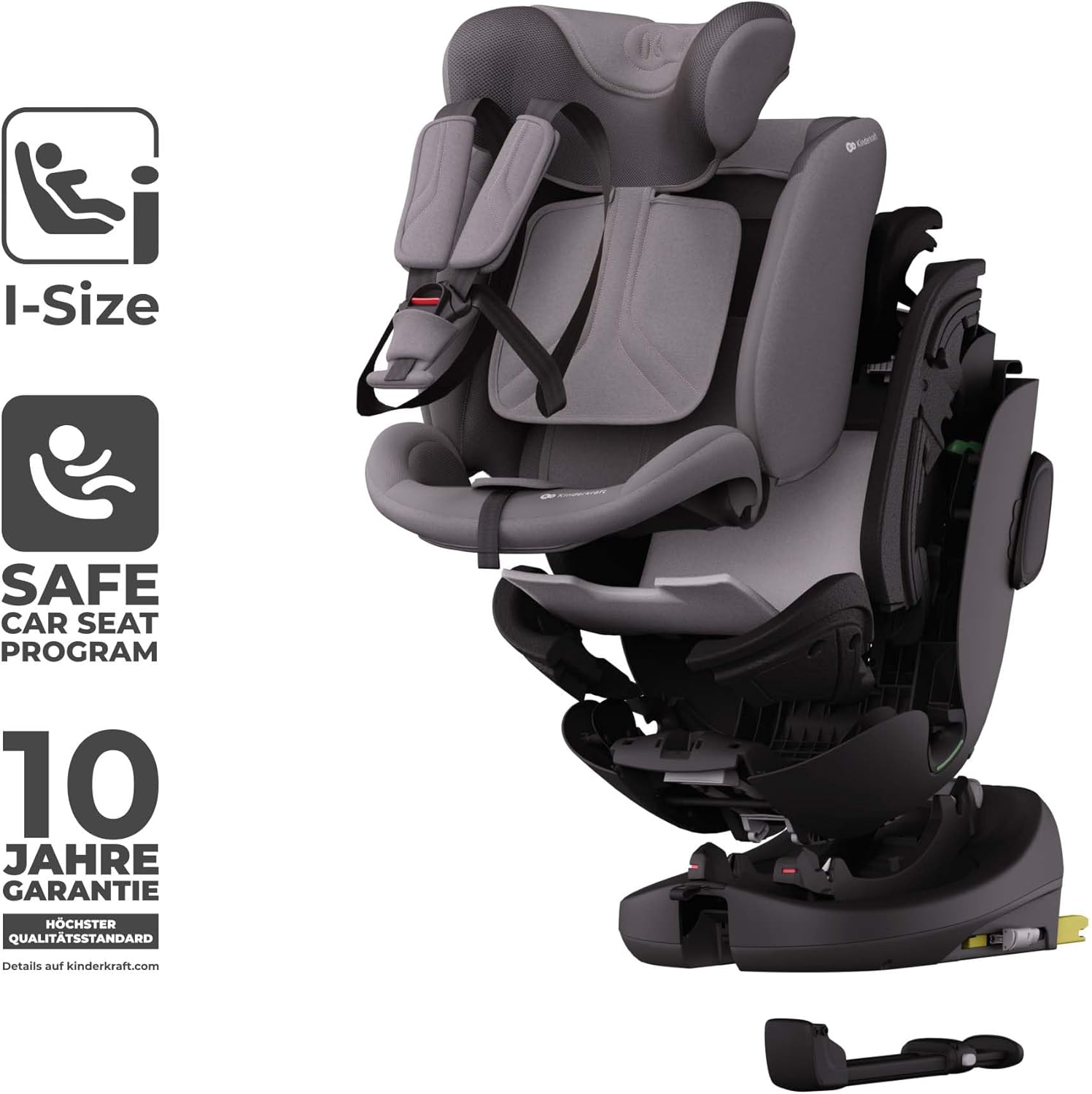
Image: An exploded view of the car seat, highlighting its internal structure, padding, and harness system, indicating I-Size compliance and a 10-year warranty.
4. Setup and Installation
4.1 Base Installation (ISOFIX)
- Position the car seat base on the vehicle seat.
- Extend the ISOFIX connectors by pressing the release buttons (usually located on the front or sides of the base).
- Align the ISOFIX connectors with the ISOFIX anchor points in your vehicle and push firmly until they click into place. Green indicators should appear, confirming correct attachment.
- Push the base firmly against the vehicle seat back to ensure a tight fit.
- Adjust the support leg to the vehicle floor. Ensure it is fully extended and stable, with the indicator showing green.
4.2 Attaching the Infant Carrier
- Once the base is securely installed, place the infant carrier onto the base.
- Push down firmly until you hear a click, indicating it is locked into place. Check for a green indicator on the base.
- Ensure the infant carrier is in the rear-facing position for children from birth up to 87 cm (RWF 40-87 cm).
4.3 Attaching the Toddler/Child Seat
- For children from 61 cm, remove the infant carrier from the base.
- Place the toddler/child seat onto the base. Push down firmly until it clicks and the indicator shows green.
- For children from 61-105 cm, the seat can be used rear-facing (RWF 61-105 cm).
- For children from 76-150 cm, the seat can be used forward-facing (FWF 76-105 cm with harness, FWF 100-150 cm with vehicle belt).

Image: Visual guide to car seat configurations from birth up to 12 years, detailing rear-facing (RWF 40-87 cm, RWF 61-105 cm) and forward-facing (FWF 76-105 cm, FWF 100-150 cm) positions based on child height.
5. Operating Instructions
5.1 Harness Adjustment
The 5-point harness system is used for children up to 105 cm (approximately 4 years old). Ensure the shoulder straps are at or just below the child's shoulders when rear-facing, and at or just above the shoulders when forward-facing. Tighten the harness until it is snug, and you cannot pinch any slack at the child's collarbone.
5.2 Headrest and Harness Height Adjustment
The headrest and harness height can be adjusted simultaneously to ensure a proper fit as your child grows. Locate the adjustment lever (usually at the top of the headrest or back of the seat) and lift it to move the headrest up or down. Release the lever to lock it in the desired position.
5.3 Reclining Positions
The car seat offers multiple reclining positions for your child's comfort and safety. Locate the recline adjustment handle (typically at the front or side of the seat) and pull it to select the desired recline angle. Ensure the seat is securely locked in the chosen position.

Image: Illustration of the car seat's reclining system, demonstrating various recline angles for optimal comfort and safety.
5.4 Rotation Function
The Endura Safe car seat features a rotation function for easier child placement and removal. The infant carrier can rotate 90 degrees towards the car door, and the toddler/child seat can rotate 360 degrees on the base.
- To rotate, locate the rotation release lever (usually at the front of the base).
- Pull the lever and rotate the seat to the desired position.
- Ensure the seat clicks and locks into place before driving. The 90-degree rotation is for stationary use only, not for travel.

Image: The car seat demonstrating its 90-degree rotation feature for the infant carrier and 360-degree rotation for the toddler seat, facilitating child placement.

Image: Close-up of the infant carrier rotated 90 degrees on its base, illustrating the convenience for placing or removing a child.
6. Maintenance
6.1 Cleaning the Fabric Covers
The fabric covers are removable and can be hand-washed with mild soap and cold water. Do not machine wash, bleach, tumble dry, or iron. Allow to air dry completely before reattaching to the seat frame.
6.2 Cleaning the Frame and Harness
Wipe the plastic and metal parts of the car seat frame with a damp cloth and mild soap. Do not use abrasive cleaners or solvents. Clean the harness straps with a damp cloth; do not immerse them in water, as this can weaken the webbing.
6.3 Air Flow System
The car seat features an Air Flow System for improved ventilation. Ensure the ventilation channels are not blocked by debris or excessive padding.
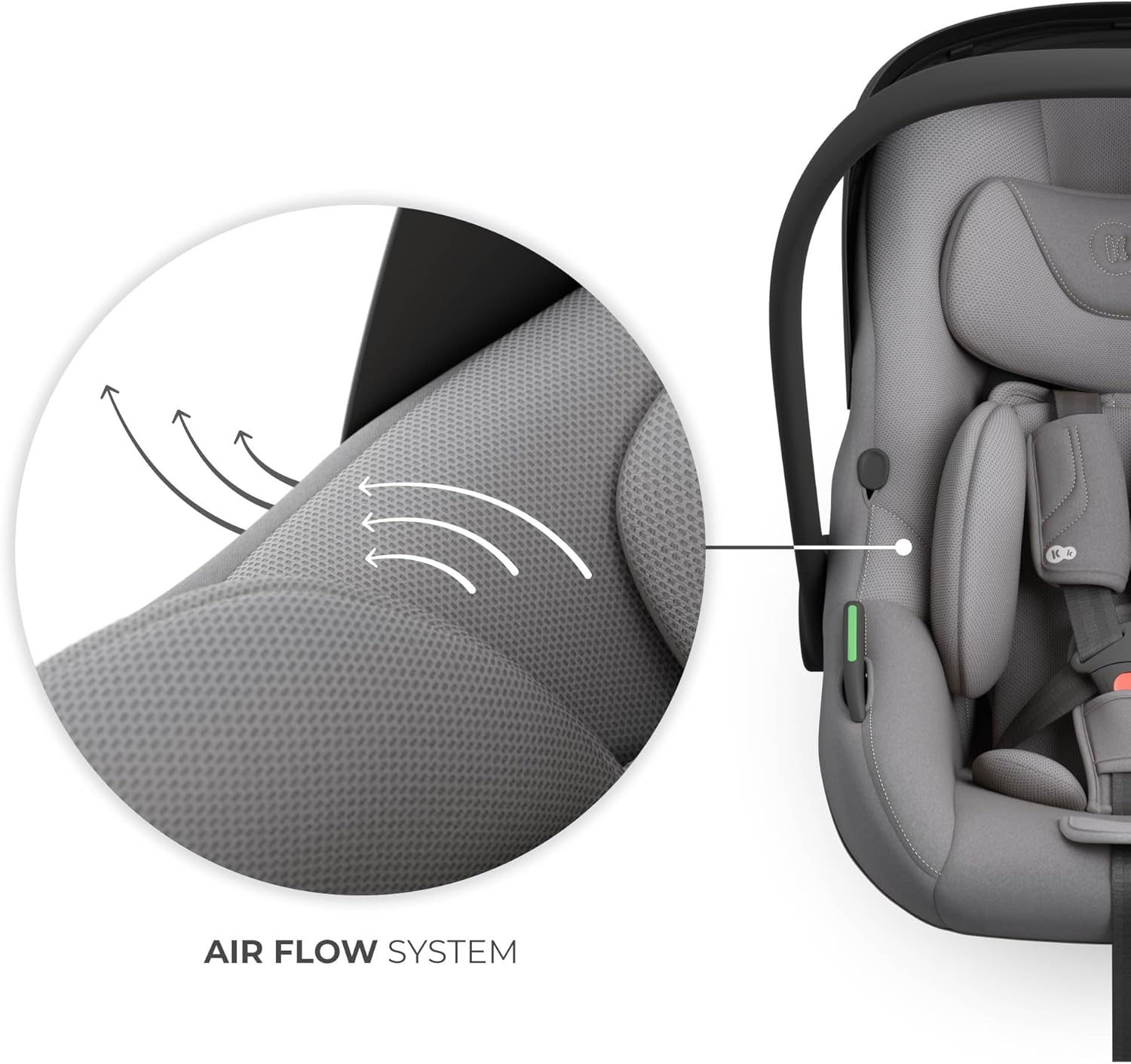
Image: Detailed view of the car seat's fabric, highlighting the integrated Air Flow System designed for enhanced ventilation and child comfort.
7. Troubleshooting
- Car seat feels loose after installation: Recheck ISOFIX connectors and support leg for green indicators. Ensure the base is pushed firmly against the vehicle seat back.
- Harness is difficult to tighten/loosen: Check for twists in the harness straps. Ensure no fabric is obstructing the tightening mechanism.
- Seat not rotating: Ensure the rotation release lever is fully engaged. Check for any obstructions preventing movement.
- Indicators not showing green: This means the component is not correctly installed. Re-read the relevant installation section and repeat the steps carefully.
If you encounter persistent issues not covered here, please contact Kinderkraft customer support.
8. Specifications
| Feature | Detail |
|---|---|
| Model Number | KCENSA00GRY3000 |
| Product Dimensions | 22.5 x 43 x 66.5 cm (D x W x H) |
| Item Weight | 15 kg |
| Maximum Weight Recommendation | 36 kg |
| Material Composition | 100% Polyester |
| Number of Reclining Positions | 12 |
| Orientation | Rear Facing (RWF) and Forward Facing (FWF) |
| Harness Type | 5-Point |
| Installation Type | ISOFIX with Support Leg (Latch) |
| Color | Grey |

Image: Detailed dimensions of the toddler/child car seat component, including height, width, and depth measurements.
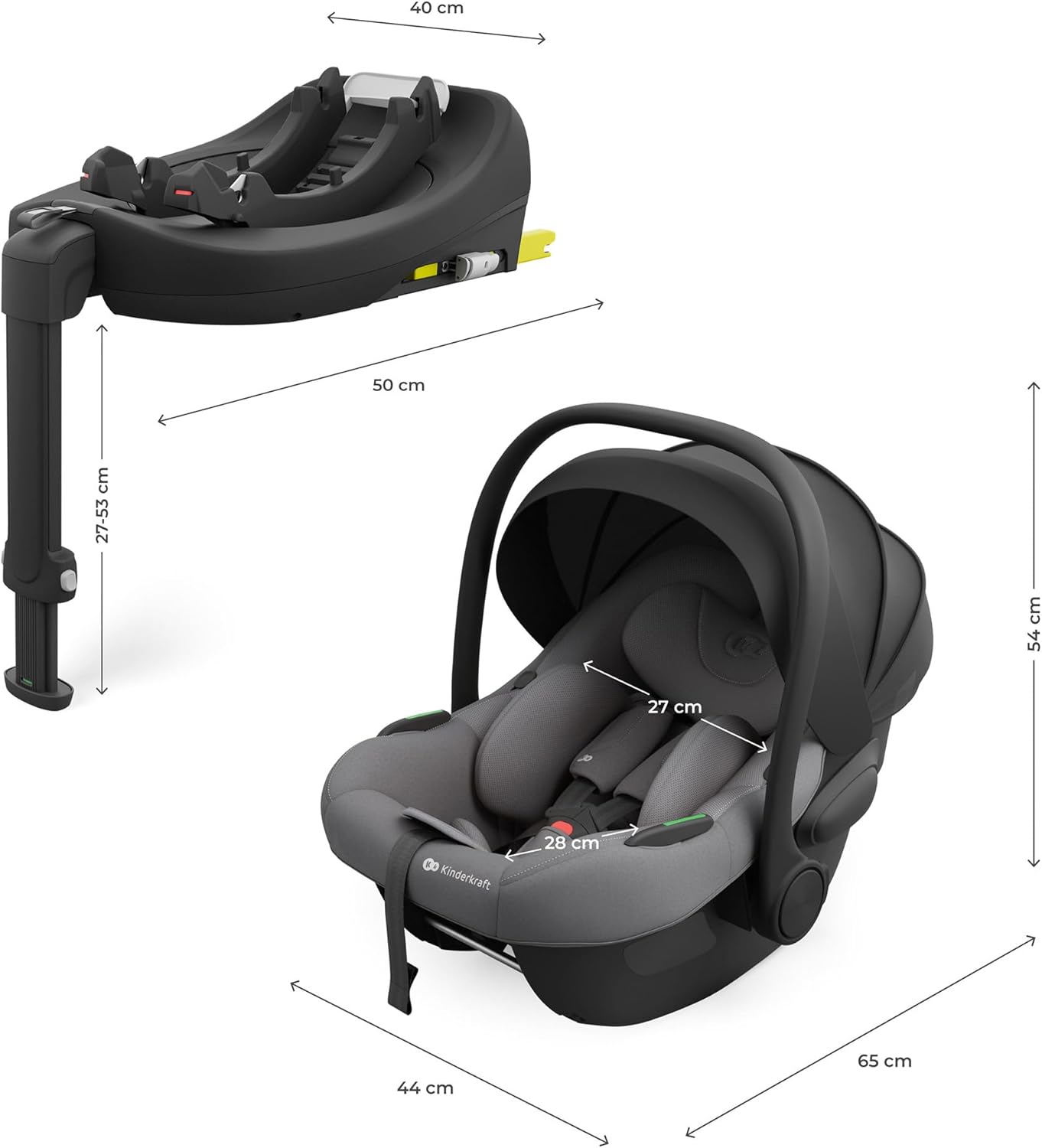
Image: Detailed dimensions of the infant carrier and the ISOFIX base, including height, width, and depth measurements for both components.
9. Warranty and Support
Kinderkraft offers a 10-year warranty on the Endura Safe Car Seat, reflecting a high standard of quality. For warranty claims, technical support, or any questions regarding your product, please contact Kinderkraft customer service through their official website or the retailer where the product was purchased. Please retain your proof of purchase for warranty validation.
For more details, visit the official Kinderkraft website.


