
1. Important Safety Information
Operating a remote-controlled helicopter requires skill and adherence to safety guidelines. Failure to operate this product safely can result in injury or property damage. This product is not a toy and is intended for experienced users.
- Expert Guidance: Beginners are strongly advised to seek guidance from experienced RC helicopter pilots for assembly, setup, and initial flights.
- Pre-Flight Checks: Always perform thorough pre-flight inspections to ensure all components are securely attached and functioning correctly.
- Operating Environment: Fly in open areas, away from people, animals, buildings, and power lines. Avoid flying in strong winds or adverse weather conditions.
- Battery Safety: Handle batteries with care. Use only compatible chargers and follow manufacturer guidelines for charging, discharging, and storage.
- Rotor Blades: The main and tail rotor blades can cause serious injury. Always maintain a safe distance from the helicopter when the rotors are spinning.
- Emergency Procedures: Familiarize yourself with emergency shutdown procedures for your remote control and the helicopter.
2. Product Overview
The FlyWing Bell 206 is a 6-channel scale RC helicopter designed for enthusiasts. It features a realistic Bell 206 body made from glass and steel, a brushless motor, carbon fiber propellers, and is equipped with the H1 Intelligent Flight Control System for stable and versatile flight.
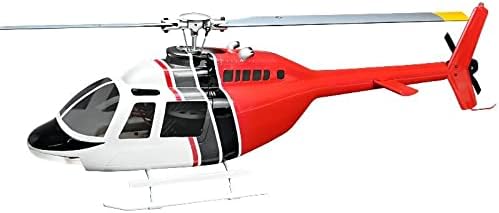
Image 2.1: The FlyWing Bell 206 Scale RC Helicopter, showcasing its detailed red and white fuselage and two-blade rotor system.
Key Features:
- Scale Design: Authentic Bell 206 restoration with a smooth, bright finish.
- H1 Flight Control System: High-precision inertial guidance with omnidirectional GNSS positioning for accurate attitude resolution.
- Flight Modes: Supports pure manual, GPS fixed point and height, semi-autonomous flight, and one-key return.
- Brushless Motor: Provides efficient and powerful performance.
- Carbon Fiber Propeller: Durable and lightweight for optimal flight characteristics.
- Integrated Body Structure: Designed for quick and easy installation.
3. Specifications
Detailed specifications for the FlyWing Bell 206 RC Helicopter.

Image 3.1: Diagram illustrating key dimensions and parameters of the FlyWing Bell 206 helicopter.
| Parameter | Value |
|---|---|
| Brand | FlyWing |
| Product | Bell 206 RC Helicopter |
| Channel | 10CH |
| Battery (Recommended) | 4S 52WH Battery (5000mAh, 14.8V, XT60 Discharge Plug) |
| Body Length | 750mm |
| Body Width | 170mm |
| Body Height | 220mm |
| Main Rotor Diameter | 810mm |
| Main Blade Length | 370mm |
| Tail Rotor Diameter | 125mm |
| Motor Gear | 12T |
| Drive Gear | 70T |
| Tail Drive | Brushless Motor |
| Weight (no battery) | 869g |
| Flight Time (approx.) | 15 minutes |
| Flight Distance (approx.) | 1000m |
| Materials | Glass, Steel, Carbon Fiber |
| Product Dimensions | 73.66 x 17.02 x 21.84 cm |
| Product Weight | 907.18 g |
4. Setup and Assembly
This product is a Bind-N-Fly (BNF) version, meaning it comes without a remote control, receiver, charger, or battery. These components must be acquired separately and be compatible with the H1 Flight Controller system.

Image 4.1: Various components of the FlyWing Bell 206, including the fuselage, main rotor assembly, tail fin, and landing gear.
4.1 Unpacking and Inspection
- Carefully remove all components from the packaging.
- Inspect for any signs of damage during transit. Contact your retailer immediately if any damage is found.
- Verify all listed components are present.
4.2 Required Additional Equipment (Not Included)
- Remote Control (Transmitter): A compatible 10-channel remote control.
- Receiver: A compatible receiver for your remote control.
- Battery: A 4S 52WH (14.8V, 5000mAh) LiPo battery with an XT60 discharge plug.
- Battery Charger: A compatible LiPo battery charger.
- Tools: Basic RC assembly tools, such as screwdrivers.
4.3 Assembly Steps
The integrated body structure facilitates straightforward assembly. Refer to the H1 Flight Controller manual for detailed wiring and binding instructions.
- Landing Gear Installation: Securely attach the landing gear to the helicopter fuselage.
- Tail Fin Assembly: Attach the tail fin and ensure the tail rotor is free to rotate.
- Main Rotor Blades: Install the main rotor blades onto the rotor head. Ensure they are balanced and secured according to the H1 Flight Controller manual.
- Receiver Installation: Install your compatible receiver and connect it to the H1 Flight Controller as per the H1 manual.
- Battery Connection: Connect the 4S LiPo battery to the XT60 connector. Ensure correct polarity.
- Pre-Flight Configuration: Follow the H1 Flight Controller's specific instructions for initial setup, calibration, and binding with your remote control. This typically involves gyro calibration, ESC calibration, and flight mode configuration.

Image 4.2: Close-up view of the H1 Flight Controller unit, showing its connections and compact design within the helicopter frame.
5. Operating Instructions
Before your first flight, ensure all safety checks are complete and you are in a suitable flying environment. Always refer to your remote control's manual for specific control stick functions.

Image 5.1: The FlyWing Bell 206 helicopter in stable flight over a grassy area, demonstrating its aerodynamic capabilities.
5.1 Pre-Flight Checklist
- Ensure the helicopter battery is fully charged.
- Ensure your remote control battery is fully charged.
- Check all screws and fasteners for tightness.
- Inspect main and tail rotor blades for any damage or cracks.
- Verify all control surfaces (swashplate, tail pitch) move freely and correctly with remote input.
- Confirm the H1 Flight Controller has initialized correctly and GPS lock is acquired (if using GPS modes).
5.2 H1 Flight Controller Modes
The H1 Flight Controller offers several flight modes to suit different pilot skill levels and flight scenarios:
- GPS Fixed Point and Height Mode: In this mode, the helicopter maintains its position and altitude automatically. Pushing the control stick will move the helicopter, and releasing it will cause it to stop and hold its position. This allows pilots to focus on directional control without constant altitude adjustments.
- Pure Manual Mode: Provides full manual control over the helicopter, suitable for experienced pilots.
- Semi-Autonomous Flight: Offers assisted flight capabilities, balancing manual control with stability features.
- One-Key Return to Flight: Initiates an automatic return to a pre-defined home point. Ensure GPS signal is strong for this feature.
5.3 First Flight Recommendations
- Start in a large, open area free of obstacles.
- Begin with the GPS Fixed Point and Height mode for initial familiarization and stable hovering.
- Gradually increase throttle to lift off slowly.
- Practice gentle control inputs.
- Land before the battery is fully depleted to prevent damage.

Image 5.2: The FlyWing Bell 206 helicopter resting on a paved surface, ready for flight, highlighting its detailed fuselage and landing skids.
6. Maintenance
Regular maintenance is crucial for the longevity and safe operation of your FlyWing Bell 206 helicopter.
- Post-Flight Inspection: After each flight, inspect the helicopter for any loose parts, damage to the fuselage, landing gear, or rotor blades.
- Blade Inspection: Check main and tail rotor blades for cracks, nicks, or deformation. Replace damaged blades immediately.
- Motor and ESC: Ensure the brushless motor and Electronic Speed Controller (ESC) are free from debris and show no signs of overheating.
- Battery Care: Store LiPo batteries at a storage voltage (typically 3.8V per cell) if not used for extended periods. Do not overcharge or over-discharge.
- Cleaning: Use a soft, dry cloth to clean the helicopter. Avoid using solvents or harsh chemicals.
- Lubrication: Periodically check moving parts for smooth operation and apply appropriate lubricant if necessary, as specified in the H1 Flight Controller or motor manuals.
7. Troubleshooting
This section provides solutions to common issues you might encounter.
- Helicopter Does Not Power On:
- Check if the battery is charged and properly connected.
- Ensure the power switch on the helicopter (if present) is in the ON position.
- No Response from Remote Control:
- Verify the remote control is powered on and its battery is charged.
- Ensure the remote control is properly bound to the receiver. Refer to your remote control and H1 Flight Controller manuals for binding procedures.
- Check for interference in the operating environment.
- Unstable Flight/Drifting:
- Recalibrate the H1 Flight Controller's gyros and accelerometers.
- Check for bent or damaged rotor blades.
- Ensure the center of gravity is correctly balanced.
- Verify all servo linkages are free and correctly adjusted.
- GPS Not Locking:
- Ensure you are in an open outdoor area with a clear view of the sky.
- Wait for a few minutes for the GPS module to acquire satellites.
- Avoid flying near tall buildings or dense foliage that can block GPS signals.
- Short Flight Time:
- Ensure the battery is fully charged before flight.
- Check the battery's health; older batteries may have reduced capacity.
- Avoid aggressive flying, which consumes more power.
8. Warranty and Support
Specific warranty information for the FlyWing Bell 206 RC Helicopter is not provided in this manual. Please refer to your purchase documentation or contact your retailer for details regarding warranty coverage and technical support.
For technical assistance related to the H1 Flight Controller, please consult the dedicated H1 Flight Controller manual or the manufacturer's support channels.


