
1. Introduction
This instruction manual provides detailed information on the installation, operation, and maintenance of your QIACHIP DC 12V 24V 4-Channel 10A Wireless RF Remote Control Relay Receiver. Please read this manual thoroughly before use to ensure proper functionality and safety.
The QIACHIP wireless remote control relay receiver is designed to provide convenient control over various electrical devices such as lighting systems, garage doors, and motors. It operates on a 433MHz frequency and comes with two RF transmitters for flexible control.
2. Safety Information
- Ensure the power supply is disconnected before any wiring or maintenance.
- This device operates with DC 12V or 24V. Verify your power source matches the device's requirements.
- Do not exceed the maximum current rating of 10A per channel.
- Installation should be performed by qualified personnel if you are unsure about electrical wiring.
- Keep the device away from water and extreme temperatures.
3. Product Overview
The QIACHIP wireless relay receiver system consists of a receiver board and two remote control transmitters.

Figure 3.1: Receiver Board Components. This image shows the QIACHIP KR1204B receiver board with key components labeled, including the antenna, indicator light, learning button, NO (Normally Open), COM (Common), NC (Normally Closed) terminals for relays, and power supply terminals (+V, -V).

Figure 3.2: Detailed Receiver Board. A closer look at the receiver board, highlighting the antenna, indicator, learning button, relays, and terminal blocks for NO, COM, NC connections, and power input.
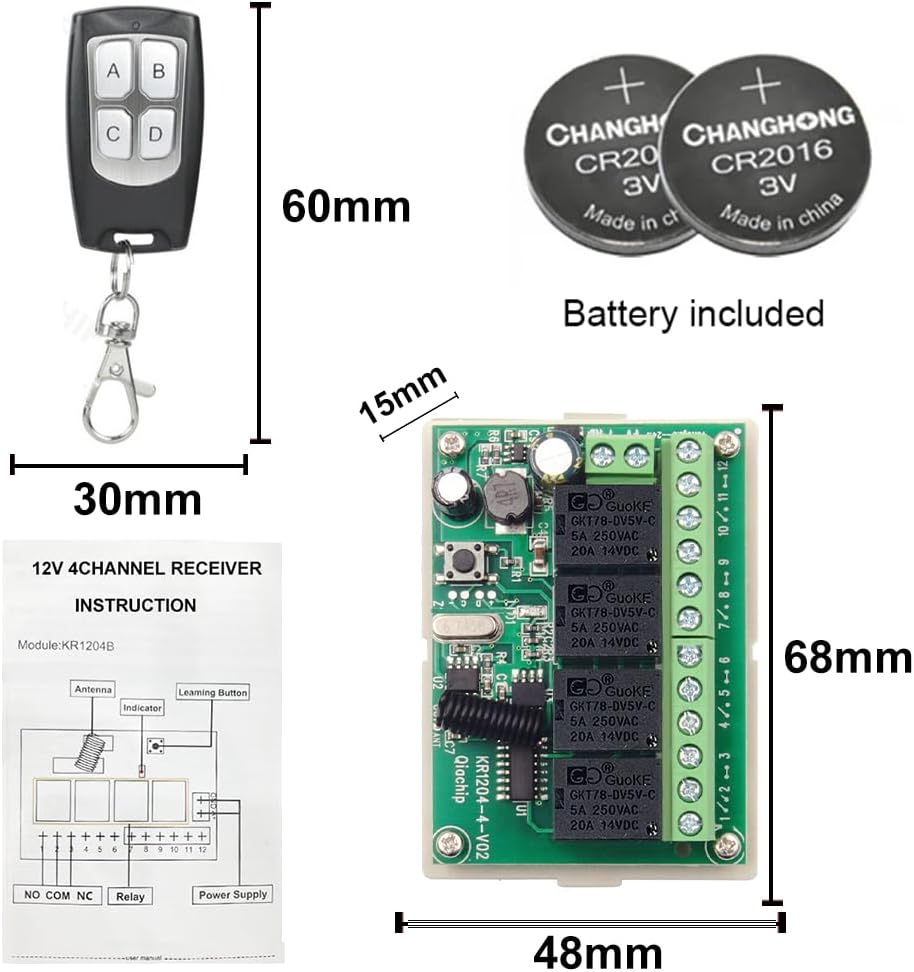
Figure 3.3: Remote Control and Batteries. This image displays the compact 4-button remote control transmitter and the CR2016/CR2032 button cell batteries required for its operation.
4. Specifications
| Feature | Specification |
|---|---|
| Model Number | KR1204B |
| Input/Output Voltage (Relay Contacts) | 1V~250V |
| Work Voltage (Receiver) | DC 6V~30V (Typically 12V/24V) |
| Rated Current | 10 Ampere (per relay) |
| Contact Type | Normally Open (NO), Common (COM), Normally Closed (NC) |
| Contact Material | Silver Alloy |
| Wireless Frequency | 433MHz |
| Remote Control Range | Up to 40 meters (without obstacles) |
| Dimensions | 6 x 4 x 2 cm (Receiver board) |
| Weight | 120 g |
| Transmitter Battery | 1 CR2032 battery (included) |
5. Setup and Wiring
The receiver board has terminals for power input and relay outputs. Ensure correct polarity for DC power. The relays provide Normally Open (NO), Common (COM), and Normally Closed (NC) contacts for flexible wiring with various devices.
5.1 Power Connection
Connect your DC 12V or 24V power supply to the +V and -V terminals on the receiver board. Observe correct polarity.
5.2 Device Wiring Examples
The following diagrams illustrate common wiring configurations for different applications. Always ensure the power to the device being controlled is off before making connections.

Figure 5.1: Typical Wiring Diagrams. This image shows various wiring configurations for the 4-channel relay receiver, including connections for multiple lamps, a curtain motor, and a garage motor. Note the separate power inputs for the receiver (DC 5V-30V) and the controlled devices (1V-250V).
- For Lights: Connect the light's power line through the NO and COM terminals of a relay. When the relay is activated, the circuit closes, and the light turns on.
- For Motors (e.g., Curtain or Garage Door): Motors often require polarity reversal for direction control. Use two relays for this, connecting one for forward and one for reverse, or use a specific motor control module if available. Refer to the diagram for specific motor wiring.
6. Operating Modes and Programming
The receiver supports three operating modes: Momentary, Toggle, and Latched. You can program each channel independently.
6.1 Clearing Existing Codes (Reset)
Before programming a new mode or remote, it is recommended to clear any previously learned codes.
- Press the "Learning Button" on the receiver board 8 times.
- The indicator light will flash several times, then turn off, indicating that all stored codes have been cleared.

Figure 6.1: Clear Code Function. This diagram illustrates the process of clearing all learned remote control codes from the receiver by pressing the learning button 8 times.
6.2 Programming Operating Modes
6.2.1 Momentary Mode (Jog Mode)
In Momentary Mode, the relay remains active only while the remote button is pressed. Releasing the button deactivates the relay.
- Press the "Learning Button" on the receiver board once. The indicator light will turn on.
- Press the desired button on your remote control (e.g., button A). The indicator light will flash and then turn off, confirming successful programming.

Figure 6.2: Momentary Mode Programming. This image details the steps to set the receiver to Momentary Mode, where the relay is active only while the remote button is held down.
6.2.2 Toggle Mode (Self-Locking Mode)
In Toggle Mode, pressing the remote button once activates the relay, and it remains active until the same button is pressed again to deactivate it.
- Press the "Learning Button" on the receiver board twice. The indicator light will turn on.
- Press the desired button on your remote control (e.g., button A). The indicator light will flash and then turn off, confirming successful programming.

Figure 6.3: Toggle Mode Programming. This image illustrates the procedure for programming the receiver into Toggle Mode, where a single button press switches the relay state (on/off).
6.2.3 Latched Mode (Interlock Mode)
In Latched Mode, pressing one button on the remote activates its corresponding relay and simultaneously deactivates any other active relays on the board. This is useful for applications where only one output should be active at a time (e.g., motor direction control).
- Press the "Learning Button" on the receiver board three times. The indicator light will turn on.
- Press the desired button on your remote control (e.g., button A). The indicator light will flash and then turn off, confirming successful programming.

Figure 6.4: Latched Mode Programming. This image demonstrates how to program the receiver for Latched Mode, where activating one relay automatically deactivates others, suitable for interlocked operations.
7. Maintenance
7.1 Remote Control Battery Replacement
The remote control uses a CR2032 button cell battery. If the remote's range decreases or it stops responding, replace the battery:
- Carefully open the remote control casing.
- Remove the old CR2032 battery.
- Insert a new CR2032 battery, ensuring correct polarity (+ side up).
- Close the remote control casing securely.
7.2 General Care
- Keep the receiver and remote controls clean and dry.
- Avoid exposing the devices to direct sunlight or extreme temperatures.
- Do not attempt to repair the device yourself if you are not qualified. Contact support for assistance.
8. Troubleshooting
| Problem | Possible Cause | Solution |
|---|---|---|
| Receiver does not respond to remote. |
|
|
| Device connected to relay does not turn on/off. |
|
|
| Interference with other RF devices. | Operating on 433MHz frequency. | Relocate the receiver or other RF devices to minimize interference. |
9. Warranty and Support
QIACHIP products are designed for reliability and performance. This product comes with a standard manufacturer's warranty against defects in materials and workmanship. Please refer to your purchase documentation for specific warranty terms and duration.
For technical support, troubleshooting assistance, or warranty claims, please contact your retailer or the QIACHIP customer service team. Contact information can typically be found on the product packaging or the official QIACHIP website.
When contacting support, please have your product model number (KR1204B+2KT06) and purchase date available.


