
1. Introduction
The EBYTE E30-400M20S is a high-performance RF wireless module based on the SI4463 chip from Silicon Labs. Designed for reliable long-distance communication, this half-duplex, SMD integrated transceiver offers transparent transmission capabilities. It operates within a wide frequency band of 425-525MHz and provides a maximum transmitting power of 100mW, making it suitable for diverse environments and applications.
Key Features:
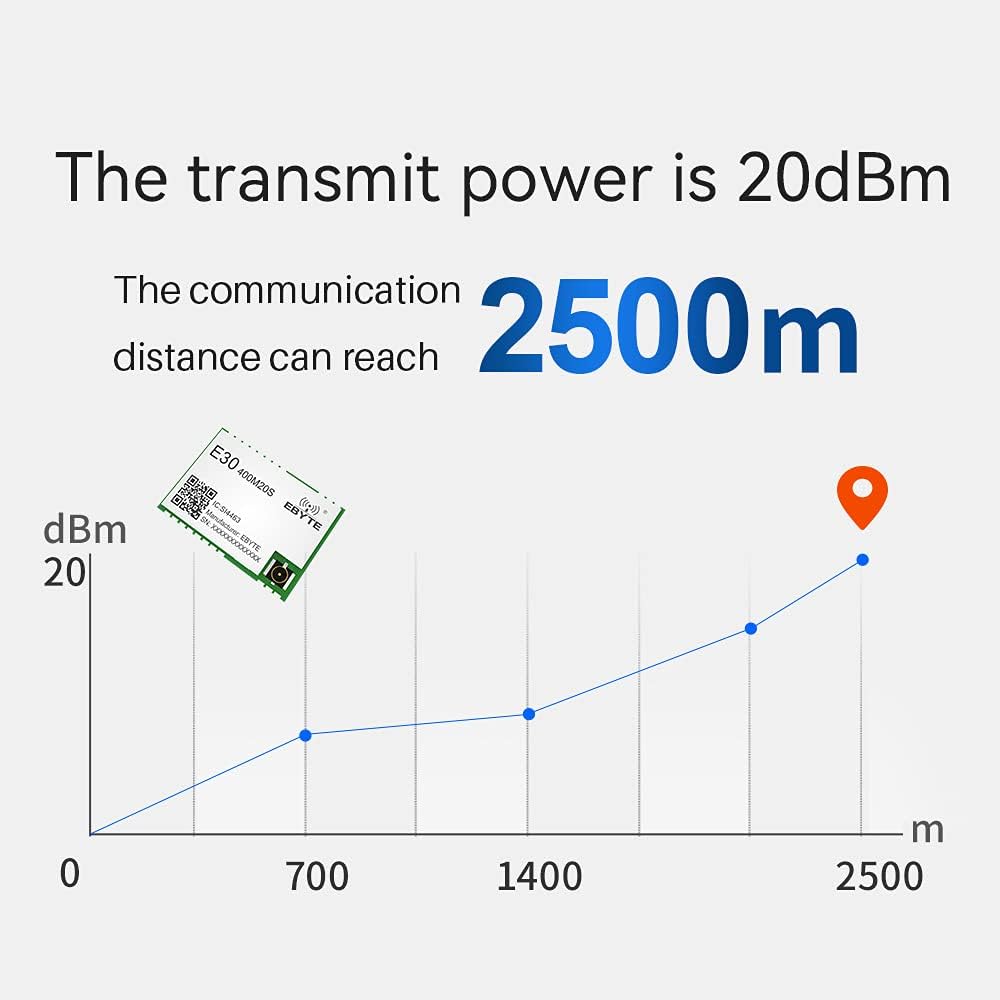
- Long Communication Distance: Capable of reaching up to 2500 meters in optimal conditions.
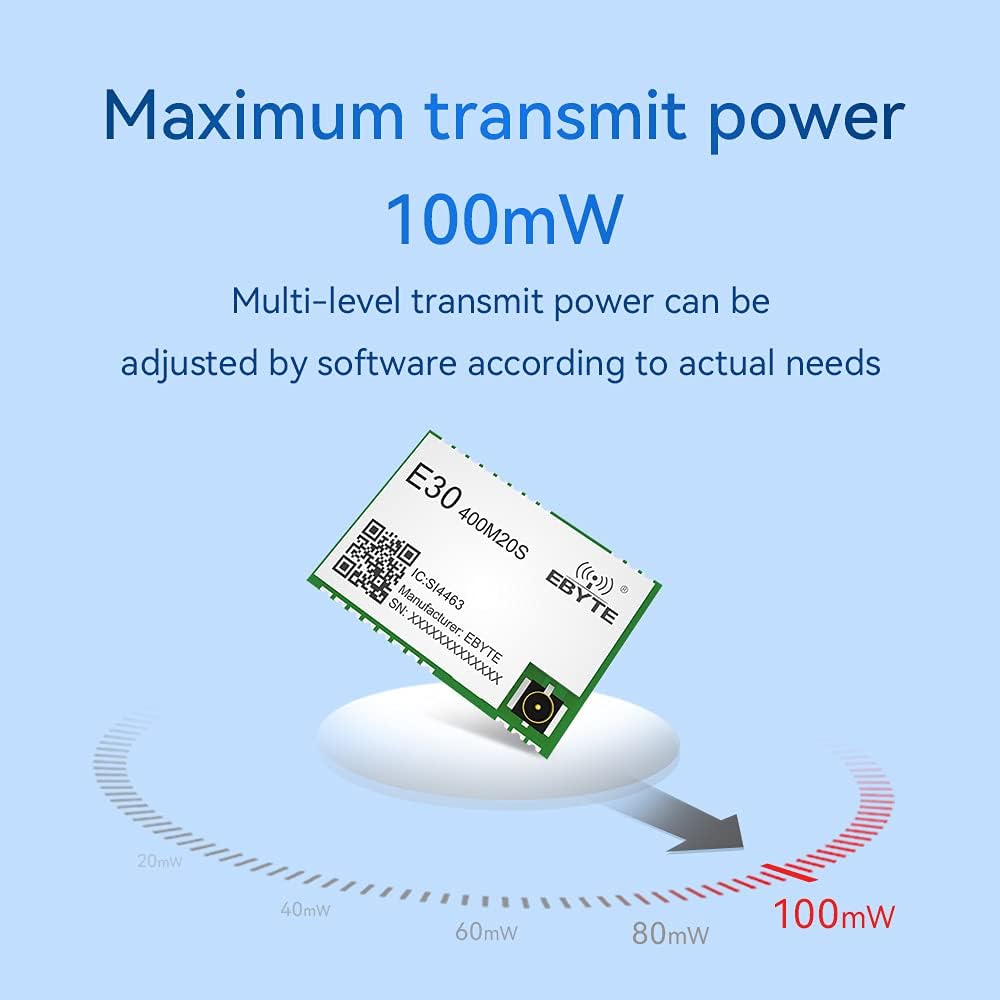
- High Transmit Power: Maximum output power of 100 mW (20 dBm).
- Wide Frequency Band: Supports 425-525MHz ultra-wide frequency operation.
- Flexible Air Data Rate: Supports air data rates from 1 kbps to 25 kbps.
- Wide Power Supply Range: Operates with a 1.8V to 3.6V power supply; 3.3V or higher is recommended for optimal performance.
- Industrial Grade Design: Robust design supporting -40°C to 85°C for long-term operation.
- High Sensitivity: Features high receiving sensitivity and strong anti-interference capabilities from the original SI4463 RF chip.
- Low Power Consumption: Supports development of low power consumption applications.
2. Product Overview
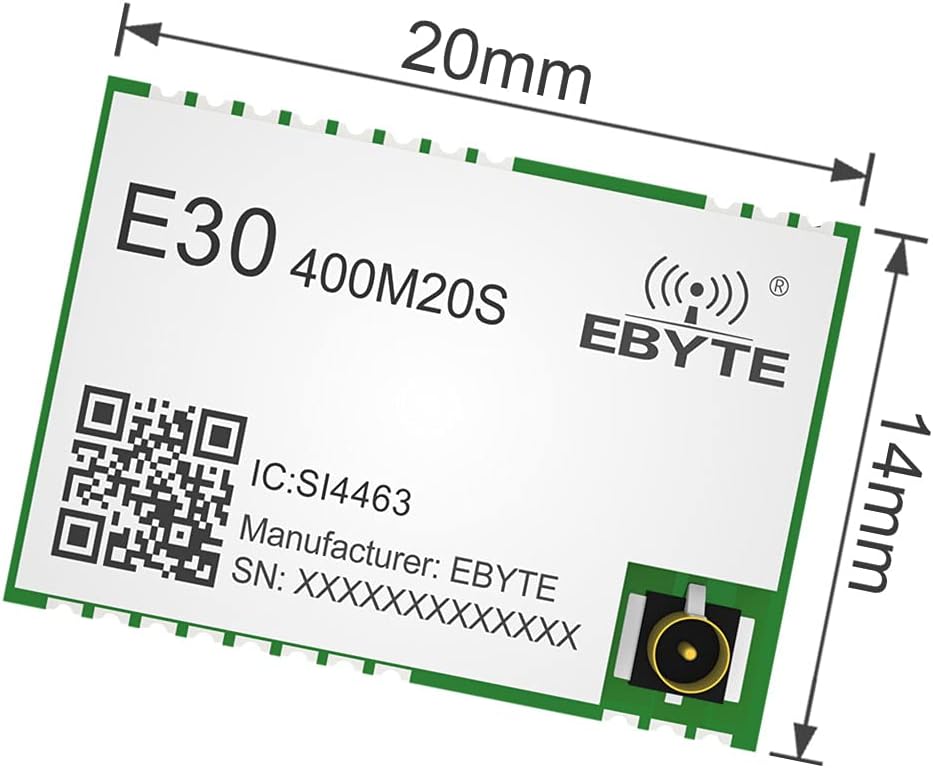
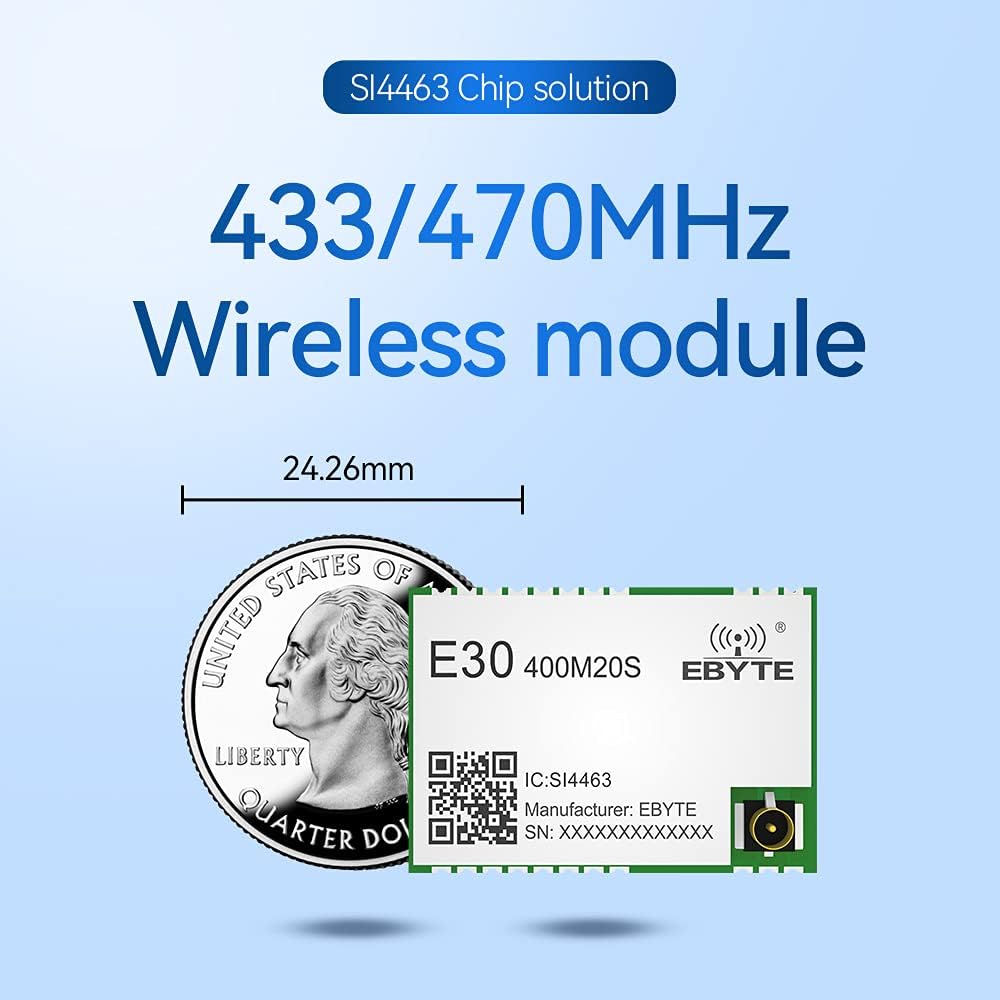
The E30-400M20S module is a compact and versatile solution for wireless data transmission. Its small form factor allows for easy integration into various electronic projects and products.

3. Specifications
Detailed technical specifications for the EBYTE E30-400M20S(4463) RF Wireless Module are provided below:
| Specification | Value |
|---|---|
| Model Number | E30-400M20S(4463) |
| Manufacturer | EBYTE |
| RF Chip | SI4463 (Silicon Labs) |
| Frequency Band | 425-525MHz |
| Maximum Transmit Power | 100 mW (20 dBm) |
| Communication Distance | Up to 2500m (2.5Km) |
| Air Data Rate | 1 kbps - 25 kbps |
| Interface | SPI |
| Power Supply | 1.8V - 3.6V (Recommended: >3.3V) |
| Operating Temperature | -40°C to 85°C |
| Material | Copper |
| Item Package Quantity | 1 |
| First Available Date | September 27, 2021 |
4. Setup
Setting up the E30-400M20S module involves proper electrical connections and software configuration for communication. As an SPI-based module, it requires connection to a microcontroller or host system via its Serial Peripheral Interface pins.
4.1 Electrical Connections:
- VCC: Connect to a stable power supply within the 1.8V to 3.6V range. A 3.3V supply is recommended for optimal performance.
- GND: Connect to the ground of your system.
- SPI Pins: Connect the module's MOSI, MISO, SCK, and CS (Chip Select) pins to the corresponding SPI pins on your microcontroller.
- Antenna: Connect a suitable 433MHz/470MHz antenna to the IPEX connector on the module. Ensure the antenna is correctly matched for impedance (typically 50 Ohm) for best performance.
4.2 Software Configuration:
The SI4463 chip requires software initialization and configuration via the SPI interface. This typically involves:
- Initializing the SI4463 registers according to the desired operating mode (e.g., transmit, receive).
- Setting parameters such as frequency, transmit power, air data rate, and modulation type.
- Implementing a communication protocol for data exchange between modules.
5. Operating
The E30-400M20S operates as a half-duplex transceiver, meaning it can either transmit or receive data at any given time, but not simultaneously. It supports transparent transmission, simplifying data handling for the user.
5.1 Transmit Mode:
- To transmit data, the module must be configured into transmit mode via SPI commands.
- Data is sent to the module's internal buffer via SPI, which is then modulated and transmitted wirelessly.
- The transmit power can be adjusted programmatically to optimize for range and power consumption.
5.2 Receive Mode:
- To receive data, the module must be configured into receive mode.
- The module continuously listens for incoming RF signals on the configured frequency.
- Received data is demodulated and stored in an internal buffer, from which it can be read by the microcontroller via SPI.
- The high receiving sensitivity of the SI4463 chip enhances reliable data reception even in challenging RF environments.
5.3 Air Data Rate:
The air data rate, ranging from 1 kbps to 25 kbps, can be selected based on application requirements. Lower data rates generally offer better sensitivity and longer range, while higher data rates allow for faster data transfer over shorter distances.
6. Maintenance
The E30-400M20S module is designed for industrial-grade reliability and requires minimal maintenance. However, adhering to the following guidelines can help ensure its longevity and optimal performance:
- Environmental Conditions: Operate the module within its specified temperature range of -40°C to 85°C. Avoid exposure to extreme humidity, corrosive substances, or direct water contact.
- Physical Handling: Handle the module with care to prevent physical damage to the components or solder joints. Avoid excessive mechanical stress.
- Power Supply: Ensure a stable and clean power supply within the recommended voltage range (1.8V to 3.6V). Voltage fluctuations or overvoltage can damage the module.
- Antenna Connection: Ensure the antenna is securely connected to the IPEX port. A loose or incorrect antenna can degrade performance or damage the RF front end.
- Cleaning: If necessary, clean the module gently with a dry, soft cloth. Do not use liquid cleaners or solvents.
7. Troubleshooting
If you encounter issues with your E30-400M20S module, consider the following troubleshooting steps:
7.1 No Communication:
- Power Supply: Verify that the module is receiving the correct voltage (1.8V-3.6V, ideally 3.3V) and that the power supply is stable.
- SPI Connections: Double-check all SPI connections (MOSI, MISO, SCK, CS) between the module and your microcontroller for correct wiring and secure contacts.
- Software Initialization: Ensure your microcontroller code correctly initializes the SI4463 chip, including setting up the operating mode, frequency, and data rate.
- Antenna: Confirm that a suitable antenna is connected and properly seated.
7.2 Short Communication Range:
- Antenna Quality: Ensure you are using a high-quality, correctly tuned 433MHz/470MHz antenna. Poor antenna quality or mismatch can significantly reduce range.
- Transmit Power: Verify that the module's transmit power is set to the desired level (e.g., 100mW) in your software configuration.
- Environmental Obstacles: RF signals are affected by obstacles. Large metal objects, concrete walls, and dense foliage can attenuate signals. Test in an open environment if possible.
- Interference: Check for potential sources of RF interference in the operating environment.
- Air Data Rate: A higher air data rate can reduce range. Consider lowering the data rate if range is critical.
7.3 Inconsistent Data Reception:
- Frequency Mismatch: Ensure both transmitting and receiving modules are configured to the exact same frequency.
- Air Data Rate Mismatch: Both modules must use the same air data rate.
- Noise: High electrical noise in the environment or from the power supply can affect reception. Implement proper grounding and power supply filtering.
- Packet Loss: Implement error checking (e.g., CRC) and retransmission mechanisms in your communication protocol to handle occasional packet loss.
8. Application Scenarios
The E30-400M20S module's stable performance, long transmission distance, and strong penetration capabilities make it suitable for a wide range of applications, including:
- Home Security Systems: Ideal for wireless alarm systems, remote keyless entry, and smart home sensors.
- Smart Home & Industrial Sensors: Physical layer technology solutions for Internet of Things (IoT) devices, offering good diffraction performance for villa-level coverage.
- VR Equipment: Provides reliable short-distance, high-speed communication for virtual reality devices, meeting certification indicators.
- Smart Wearables: Small size and maneuverability make it easy to integrate into smart wear devices, supporting low power consumption for battery-powered applications.
- Active RFID: Supports remote identification with security, stability, and scalability.
- Building Automation Solutions: For intelligent control and monitoring systems.
- Wireless Industrial-Grade Remote Control: Robust communication for industrial automation.
- Intelligent Agriculture & Oilfield Solutions: For remote monitoring and control in challenging environments.
- Health Care Products: Integration into various medical and health monitoring devices.
- Advanced Meter Reading Architecture (AMI): For wireless utility meter reading.
- Automotive Industry Applications: Various wireless communication needs within vehicles.

9. Warranty and Support
EBYTE provides a 1-year warranty for the E30-400M20S RF Wireless Module from the date of purchase.
For any issues, technical support, or to request a detailed user manual, please contact EBYTE customer support. Contact information can typically be found on the official EBYTE website or through your point of purchase.
When contacting support, please provide your product model (E30-400M20S(4463)) and a detailed description of the problem you are experiencing.


