
1. Introduction
The Rakstore XY-AP50H is a compact and versatile TPA3116D2 stereo digital amplifier board featuring Bluetooth 5.0 connectivity. It delivers 50W+50W output, making it suitable for various audio applications including home theater systems. This manual provides detailed instructions for setup, operation, and maintenance to ensure optimal performance and longevity of your device.
2. Safety Information
- Ensure the power supply voltage is within the specified range of DC 5-27V. Using an incorrect voltage can damage the device.
- Always connect speakers and power supply before powering on the amplifier.
- Avoid short-circuiting the speaker outputs or power input terminals.
- Do not expose the device to moisture, water, or extreme temperatures.
- Keep the device away from children.
- Disconnect power before performing any maintenance or making connections.
3. Product Features
- High Power Output: 50W + 50W stereo output.
- Bluetooth 5.0 Connectivity: Stable wireless audio transmission up to 15 meters (unobstructed).
- Wide Voltage Range: Operates on DC 5-27V / 2A or above.
- Multiple Audio Inputs: Supports Bluetooth, AUX, and USB Sound Card functions.
- Protection Mechanisms: Includes power supply reverse connection protection, short circuit protection, and self-recovery overheating protection.
- Speaker Compatibility: Adaptable for 10W-200W, 4Ω/8Ω speakers.
4. Product Overview and Components
Familiarize yourself with the various components and connection points of the XY-AP50H amplifier board.
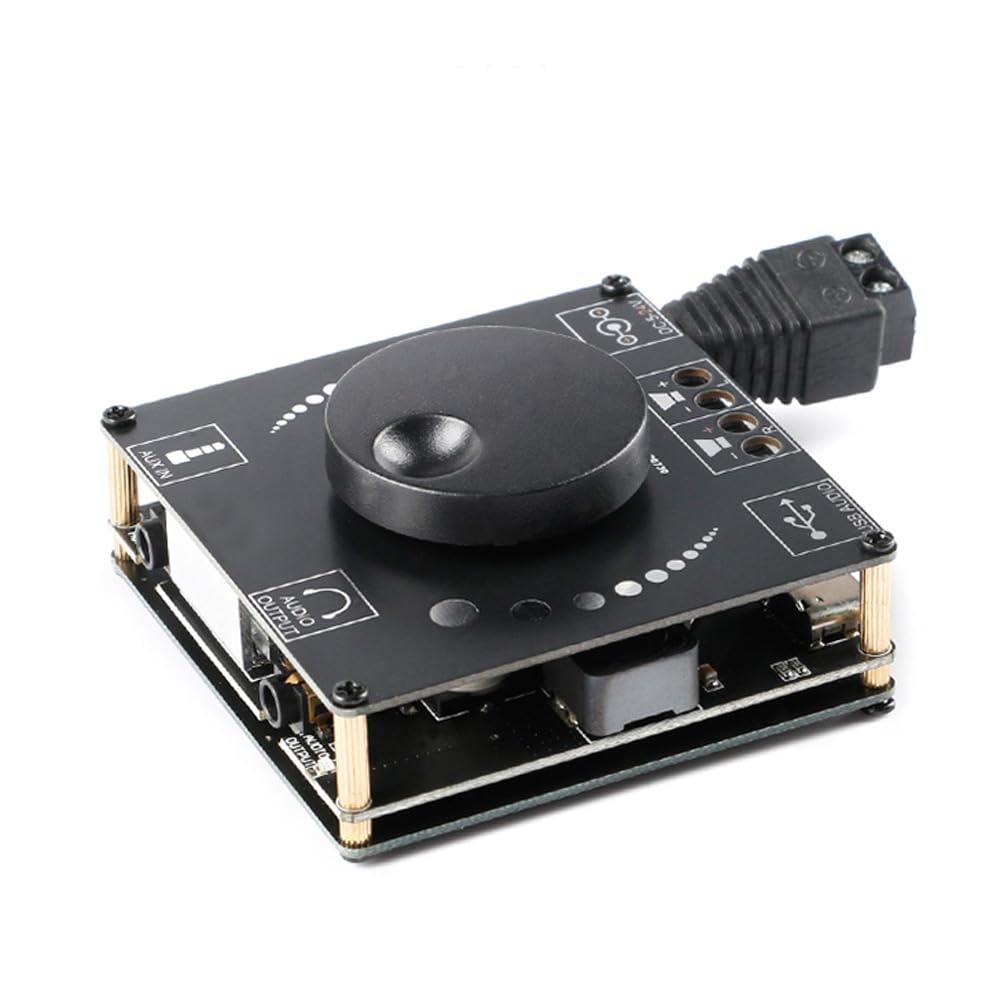
Image 4.1: Top view of the XY-AP50H amplifier board, showing the main components including the volume knob, power input, speaker terminals, AUX input, and USB port.

Image 4.2: Bottom view of the XY-AP50H amplifier board, indicating the USB Audio input, speaker outputs (SPKR, SPKL), and DC 5-24V power input.

Image 4.3: Dimensions of the XY-AP50H amplifier board, measuring approximately 60mm by 60mm.
5. Setup Instructions
5.1 Power Connection
- Ensure the amplifier is powered off and disconnected from any power source.
- Connect a DC 5-27V / 2A or above power adapter to the DC power input jack on the board. Observe polarity if using bare wires.
5.2 Speaker Connection
- Identify the left (SPKL) and right (SPKR) speaker output terminals on the board.
- Connect your passive speakers (10W-200W, 4Ω/8Ω) to the corresponding terminals. Ensure correct polarity (+ to + and - to -) for each speaker.
5.3 Audio Input Options
The XY-AP50H supports three audio input methods: Bluetooth, AUX, and USB Sound Card.
5.3.1 Bluetooth Connection
- Power on the amplifier board.
- On your audio source device (e.g., smartphone, tablet), enable Bluetooth and search for available devices.
- Select "XY-AP50H" from the list to pair. A confirmation sound will indicate successful pairing.
5.3.2 AUX Input Connection
- Connect a 3.5mm audio cable from your audio source device's headphone jack to the AUX input port on the amplifier board.
- The amplifier will automatically switch to AUX input mode when a cable is detected.
5.3.3 USB Sound Card Function

Image 5.1: Illustration of connecting the XY-AP50H to a computer via a data cable to utilize its USB sound card function, providing improved audio output quality.
- Connect the amplifier board to your computer using a USB data cable (Type-C to USB-A or Type-C to Type-C, depending on your computer's ports).
- Most computers will automatically recognize the amplifier as an external sound card.
- If prompted, select the XY-AP50H as the audio output device in your computer's sound settings.
- Open your computer's audio playback software to play music. The amplifier will output the audio.
6. Operating Instructions
6.1 Power On/Off
Connect or disconnect the DC power supply to power on or off the amplifier board.
6.2 Volume Control
Rotate the potentiometer knob on the board clockwise to increase volume and counter-clockwise to decrease volume.
6.3 Input Mode Switching
The amplifier automatically prioritizes inputs. Bluetooth is typically the default. Connecting an AUX cable will switch to AUX. Connecting via USB to a computer will activate the USB sound card mode.
7. Specifications
| Feature | Specification |
|---|---|
| Model | XY-AP50H |
| Amplifier Chip | TPA3116D2 |
| Bluetooth Version | BLE 5.0 |
| Output Power | 50W + 50W (Stereo) |
| Supply Voltage | DC 5-27V / 2A above |
| Transmission Distance | 15 meters (unobstructed) |
| Number of Channels | Left and Right Dual Channels (Stereo) |
| Adapted Speakers | 10W-200W, 4Ω/8Ω |
| Protection Mechanisms | Power supply reverse connection protection, short circuit protection, self-recovery overheating protection |
8. Troubleshooting
- No Sound:
- Check power supply connection and ensure it meets DC 5-27V / 2A or above.
- Verify speaker connections are secure and correctly polarized.
- Ensure the correct audio input mode is selected (Bluetooth paired, AUX cable connected, or USB sound card active).
- Adjust the volume knob on the amplifier and your audio source device.
- Distorted Sound:
- Reduce the volume from both the amplifier and the audio source.
- Check speaker impedance and power rating to ensure compatibility.
- Ensure power supply is stable and sufficient (at least 2A).
- Bluetooth Disconnection:
- Ensure the audio source device is within 15 meters of the amplifier and there are no major obstructions.
- Try unpairing and re-pairing the device.
- Ensure no other devices are interfering with the Bluetooth signal.
- Overheating:
- Ensure adequate ventilation around the amplifier board.
- Reduce output volume or check speaker impedance. The board has self-recovery overheating protection, which may temporarily shut down output.
9. Maintenance
- Keep the amplifier board clean and free from dust. Use a soft, dry cloth for cleaning.
- Avoid placing the board in environments with high humidity or extreme temperatures.
- Do not attempt to disassemble or modify the board, as this may void any potential warranty and cause damage.
10. Warranty and Support
For warranty information and technical support, please refer to the seller's policies or contact Rakstore customer service directly. Keep your purchase receipt as proof of purchase.