
1. Introduction
This manual provides essential information for the proper installation, configuration, and operation of your Teltonika RUT951 4G LTE Router. The RUT951 is a robust industrial cellular router designed for professional applications, offering reliable internet connectivity via 4G LTE, Wi-Fi, and Ethernet. It features dual-SIM support for network redundancy and is powered by RutOS, providing advanced customization and security features.
2. Product Overview
2.1 Key Features
- Dual-SIM 4G LTE cellular connectivity for reliable network access.
- Integrated Wi-Fi (802.11b/g/n) for local wireless networking.
- Four Ethernet interfaces (3x LAN, 1x WAN) for wired connections.
- Powered by RutOS for advanced customization, automation, and security.
- Robust design suitable for various IoT and industrial scenarios.
2.2 Package Contents
The standard package for the Teltonika RUT951 router typically includes:
- Teltonika RUT951 Router Unit
- Power Adapter
- 2 x Mobile Antennas (SMA)
- 2 x Wi-Fi Antennas (RP-SMA)
- Ethernet Cable
- Quick Start Guide
2.3 Router Layout
Familiarize yourself with the router's ports, indicators, and slots.
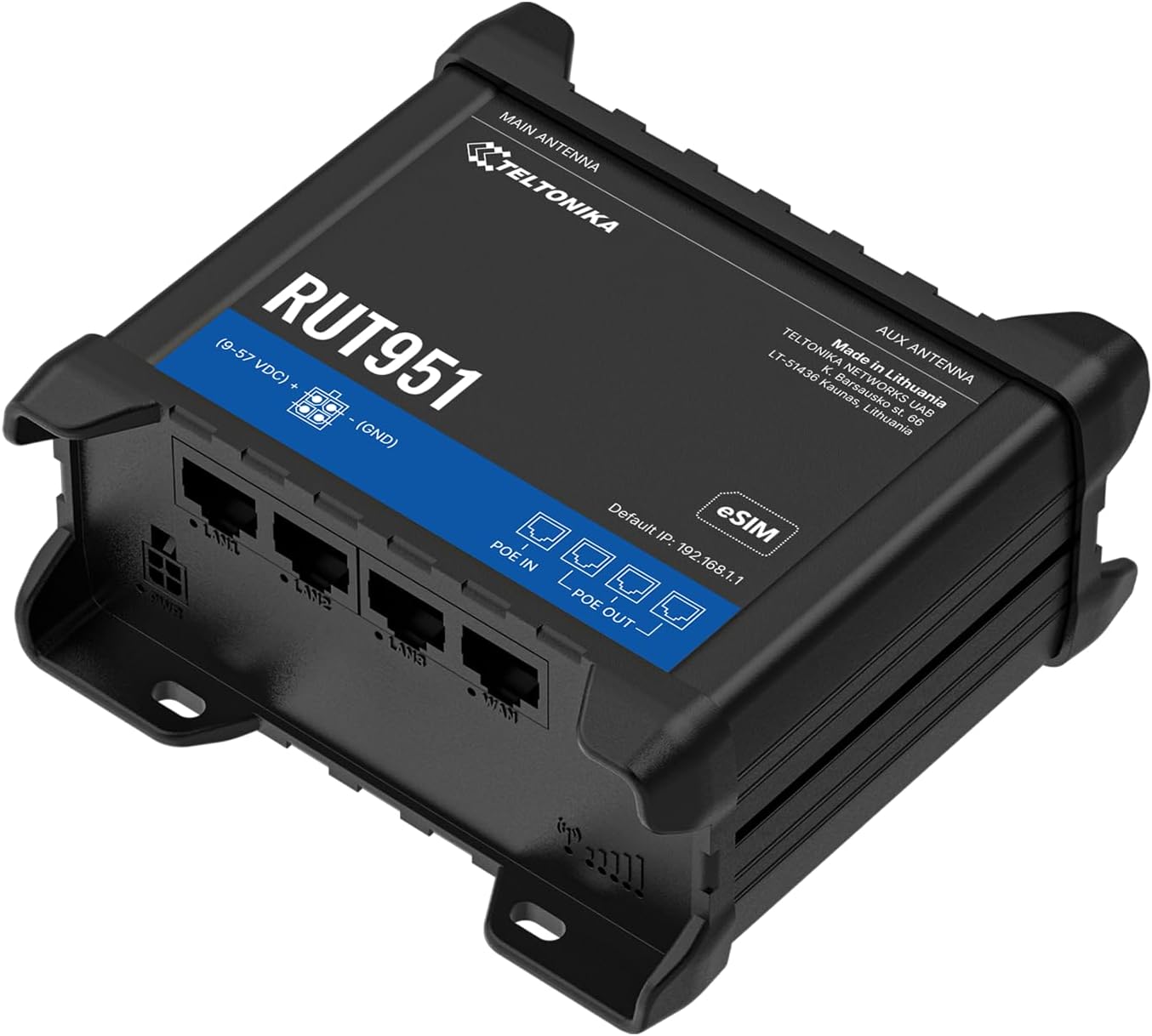
Figure 1: Front view of the Teltonika RUT951 router, showing the model name and general design.

Figure 2: Detailed diagram illustrating the various ports and indicators on the Teltonika RUT951 router, including mobile and Wi-Fi antenna connectors, SIM slots, Ethernet ports, power socket, and LED indicators.
- Mobile AUX Antenna Connector (SMA female): For secondary mobile antenna.
- Mobile MAIN Antenna Connector (SMA female): For primary mobile antenna.
- SIM1 / SIM2 Slots: For inserting cellular SIM cards.
- RESET Button: To restore factory settings or reboot.
- Wi-Fi Antenna Connectors (RP-SMA female): For Wi-Fi antennas.
- Power Socket: For connecting the power adapter.
- LAN Ethernet Ports: For connecting local network devices.
- WAN Ethernet Port: For connecting to an external network (e.g., fiber modem).
- Mobile Signal Strength LEDs: Indicate cellular signal strength.
- Mobile Connection Status LED: Indicates cellular connection status.
- LAN LEDs: Indicate activity on LAN ports.
- WAN LED: Indicates activity on the WAN port.
3. Setup Instructions
3.1 SIM Card Installation
- Locate the SIM card slots (SIM1 and SIM2) on the top panel of the router.
- Using a SIM ejector tool or a paperclip, gently press the small button next to the SIM slot to open it.
- Insert your activated Mini-SIM card(s) into the slot(s) with the gold contacts facing down and the notched corner oriented correctly.
- Push the SIM tray back into the router until it clicks into place.

Figure 3: Top view of the RUT951, highlighting the SIM card slots and antenna connectors.
3.2 Antenna Connection
- Screw the two mobile antennas onto the SMA connectors labeled 'MOBILE' (MAIN and AUX) on the top panel.
- Screw the two Wi-Fi antennas onto the RP-SMA connectors labeled 'WIFI' on the top panel.
- Ensure all antennas are securely tightened for optimal signal reception.
3.3 Power Connection
- Connect the provided power adapter to the power socket on the router.
- Plug the other end of the power adapter into a suitable power outlet.
- The router will power on automatically. Observe the power LED indicator.

Figure 4: Bottom view of the RUT951, showing the Ethernet ports and power input.
3.4 Ethernet Connection
To connect a device directly to the router:
- Connect one end of an Ethernet cable to any of the LAN ports (LAN1, LAN2, LAN3) on the router.
- Connect the other end of the Ethernet cable to your computer or network device.
- If you are using the router as a WAN gateway, connect your external modem (e.g., fiber modem) to the WAN port.
4. Operating Instructions
4.1 Initial Access to WebUI
- Ensure your computer is connected to the router via Ethernet or Wi-Fi. The default Wi-Fi SSID and password can be found on the router's label.
- Open a web browser and enter the default IP address: 192.168.1.1
- You will be prompted for login credentials. The default username is admin. The default password is also admin (or as specified on the router's label).
- Upon first login, you will be guided through a setup wizard to change the default password and configure basic settings.
4.2 Network Configuration
After initial login, you can configure various network settings through the WebUI:
- WAN Settings: Configure your cellular (4G LTE) connection, including APN settings, or set up the Ethernet WAN port.
- LAN Settings: Manage the local network IP address range and DHCP server.
- Wi-Fi Settings: Change Wi-Fi SSID, password, security protocols, and channel settings.
- Dual SIM: Configure failover or load balancing between the two SIM cards for continuous connectivity.
- VPN: Set up various VPN protocols for secure remote access.
5. Maintenance
5.1 Firmware Updates
Regularly updating the router's firmware is crucial for security, performance, and new features. Firmware updates can be performed via the WebUI under the 'System' or 'Firmware' section. Always download firmware from the official Teltonika Networks website.
5.2 Factory Reset
If you encounter persistent issues or forget your login credentials, you can perform a factory reset:
- With the router powered on, locate the RESET button (refer to Figure 2).
- Press and hold the RESET button for approximately 10 seconds until all LEDs flash.
- Release the button. The router will reboot with factory default settings.
6. Troubleshooting
- No Internet Connection:
- Check SIM card insertion and activation.
- Verify APN settings in the WebUI.
- Ensure mobile antennas are securely connected.
- Check cellular signal strength LEDs.
- Wi-Fi Not Working:
- Ensure Wi-Fi is enabled in the WebUI.
- Check Wi-Fi antenna connections.
- Verify Wi-Fi SSID and password.
- Cannot Access WebUI:
- Ensure your device is connected to the router (Ethernet or Wi-Fi).
- Verify your computer's IP settings (should be set to obtain IP automatically).
- Try clearing your browser's cache or using a different browser.
- Perform a factory reset if you suspect incorrect IP configuration or forgotten password.
7. Specifications
| Feature | Specification |
|---|---|
| Brand | Teltonika |
| Model Name | RUT951 |
| Connectivity Technology | Wi-Fi, 4G LTE, 3G, 2G |
| Wireless Communication Standard | 802.11b, 802.11g, 802.11n |
| Frequency Band Class | Dual-Band |
| Number of Ports | 4 (3x LAN, 1x WAN) |
| LAN Port Bandwidth | 100 Mbps |
| Data Transfer Rate | 150 Megabits Per Second (Max Upstream) |
| Operating System | RutOS |
| Item Weight | 287 Grams |
| Voltage | 30 Volts |
| Security Protocol | WPS (and others via RutOS) |
| Coverage | Dual SIM network redundancy |
8. Safety Information
- Use only the power adapter provided with the device.
- Do not expose the device to water, moisture, or extreme temperatures.
- Avoid placing the device near heat sources or in direct sunlight.
- Ensure proper ventilation to prevent overheating.
- Do not attempt to open or modify the device. This will void the warranty.
- Dispose of the device and its accessories responsibly according to local regulations.
9. Warranty and Support
The Teltonika RUT951 router comes with a standard manufacturer's warranty. For detailed warranty terms and conditions, please refer to the documentation included with your product or visit the official Teltonika Networks website. For technical support, firmware downloads, and additional resources, please visit the Teltonika Networks support portal or contact your vendor.


