
Introduction
This manual provides detailed instructions for the setup, operation, maintenance, and troubleshooting of your Donner DEK-510 54-Key Electronic Keyboard. Please read this manual thoroughly before using the instrument to ensure proper function and longevity.
Package Contents
Upon opening the package, verify that all the following items are included:
- Donner DEK-510 54-Key Electronic Keyboard
- Power Adapter
- Music Stand
- Microphone
- Keyboard Stand
- Keyboard Stool
- User Manual

Image: The Donner DEK-510 electronic keyboard shown with its included accessories: a keyboard stand, a stool, a microphone, and a power adapter.
Setup Instructions
1. Keyboard Stand Assembly
Assemble the keyboard stand according to the diagrams provided in the separate stand assembly guide (if applicable). Ensure all screws are tightened securely for stability. Adjust the stand to a comfortable playing height.
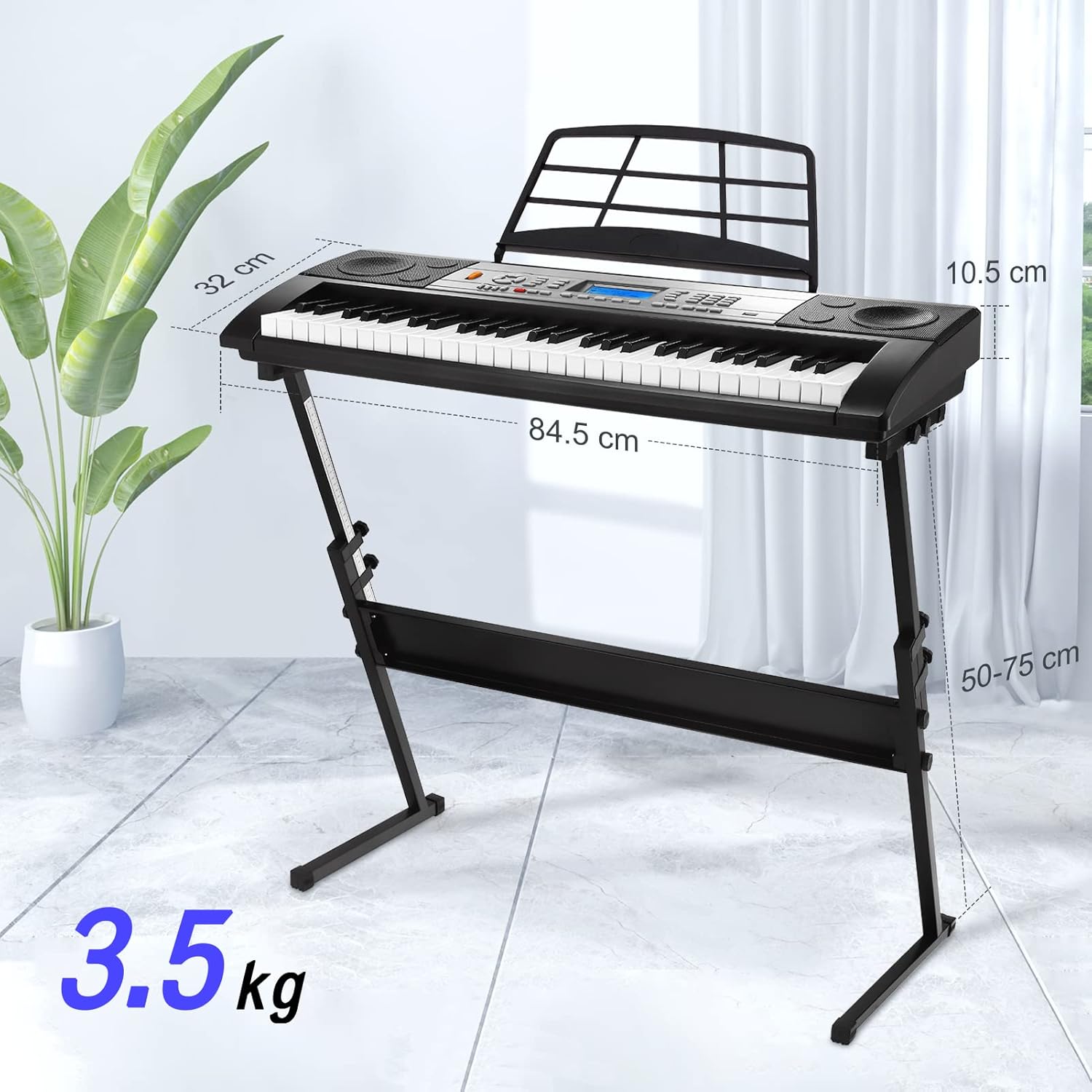
Image: The Donner DEK-510 keyboard resting on its adjustable stand, illustrating its compact dimensions and lightweight design (3.5 kg).
2. Power Supply
The DEK-510 can be powered using the included AC power adapter or by batteries (not included).
- AC Adapter: Connect the power adapter to the DC 9V input jack on the rear panel of the keyboard. Plug the other end into a standard wall outlet.
- Batteries: For portable use, insert 6 D-size batteries into the battery compartment located on the underside of the keyboard. Ensure correct polarity.

Image: Illustration showing the two power options for the keyboard: an AC power adapter or D-size batteries.
3. Connecting Peripherals
The DEK-510 offers various connection options on its rear panel:
- Microphone (MIC): Connect the included microphone to the MIC input jack for vocal accompaniment.
- Headphones (PHONES): Connect standard stereo headphones to the PHONES jack for private practice. This will mute the internal speakers.
- AUX IN: Connect an external audio device (e.g., MP3 player, smartphone) to the AUX IN jack to play along with your favorite music.
- AUX OUT: Connect the keyboard to an external amplifier or mixing console using the AUX OUT jack.
- USB MIDI: Use the USB MIDI port to connect the keyboard to a computer for MIDI data transfer, allowing use with music software.
- PEDAL: Connect a sustain pedal (not included) to the PEDAL jack for enhanced expression.

Image: A close-up view of the rear panel of the Donner DEK-510, highlighting the various input/output ports including USB MIDI, AUX OUT, MIC, DC IN, Pedal, AUX IN, and Phones.
Operating Instructions
1. Basic Operation
- Power On/Off: Press the POWER button to turn the keyboard on or off.
- Volume Control: Use the VOLUME knob or buttons to adjust the overall sound level.
- LCD Display: The integrated LCD screen displays the current function status, selected voice, rhythm, tempo, and learning mode feedback.

Image: The Donner DEK-510 keyboard's control panel and LCD display, illustrating its powerful features including 3 education modes, 500 tones, 300 rhythms, 40 demo songs, recording, sustain, delay, shift, auto chord, dual voice, and keyboard split.
2. Voices and Rhythms
- Selecting Voices: The keyboard features 500 built-in voices. Use the VOICE selection buttons and number pad to choose your desired instrument sound.
- Selecting Rhythms: There are 300 built-in rhythms. Use the RHYTHM selection buttons and number pad to select a rhythm. Press START/STOP to begin or end the rhythm.
- Tempo Adjustment: Adjust the speed of rhythms and demo songs using the TEMPO +/- buttons.
- Auto Accompaniment: Engage auto-accompaniment to play chords that match the selected rhythm.

Image: The Donner DEK-510 keyboard's control panel, emphasizing its extensive sound library with 300 rhythms, 500 tones, and 40 demo songs.
3. Learning Modes
The DEK-510 includes three intelligent teaching modes to assist beginners:
- One-Key Learning Mode: Practice songs by pressing any key, and the keyboard will play the correct notes.
- Follow Mode: The keyboard waits for you to play the correct note before proceeding to the next.
- Ensemble Mode: Play along with the melody, and the keyboard will provide the accompaniment.

Image: A child playing the Donner DEK-510 keyboard, with the LCD screen displaying visual feedback for one of the three intelligent learning modes.

Image: A tablet displaying sheet music positioned on the keyboard's music stand, illustrating how external learning resources can be integrated with the instrument.
4. Advanced Functions
- Recording and Playback: Use the RECORD button to capture your performance and the PLAY button for playback.
- Sustain: Press the SUSTAIN button to lengthen the decay of notes.
- Vibrato: Press the VIBRATO button to add a slight pitch modulation effect to notes.
- Keyboard Split (DUAL): This function allows you to divide the keyboard into two sections, each with a different voice, enabling two players or different sounds in each hand.
- Dual Voice: Layer two different voices to play simultaneously when a key is pressed.
- Programming Function: Create custom rhythm patterns.

Image: A close-up of the control panel showing the dedicated buttons for Vibrato and Sustain effects.

Image: The keyboard keys are visually divided into two sections, demonstrating the keyboard split function where different sounds can be assigned to each half.
5. Microphone Use
Connect the included microphone to the MIC input. Adjust the microphone volume using the dedicated control (if available) or the main volume. This allows you to sing along while playing the keyboard.

Image: A person playing the Donner DEK-510 keyboard and singing into a microphone, demonstrating the instrument's vocal accompaniment capability.
Maintenance
- Cleaning: Wipe the keyboard surface with a soft, dry cloth. For stubborn dirt, use a slightly damp cloth and then dry thoroughly. Avoid abrasive cleaners or solvents.
- Storage: Store the keyboard in a cool, dry place away from direct sunlight, extreme temperatures, and high humidity.
- Handling: Avoid dropping the instrument or subjecting it to strong impacts.
- Power: Disconnect the power adapter when the keyboard is not in use for extended periods. Remove batteries if storing for a long time to prevent leakage.
Troubleshooting
| Problem | Possible Cause | Solution |
|---|---|---|
| No sound from speakers. | Volume is too low; headphones are connected; power issue. | Increase volume; disconnect headphones; check power connection/batteries. |
| Keyboard does not power on. | Power adapter not connected; batteries are dead or incorrectly inserted. | Ensure power adapter is securely connected; replace batteries or check polarity. |
| Distorted sound. | Volume too high; external device volume too high. | Lower keyboard volume; adjust volume on connected external devices. |
| Microphone not working. | Microphone not connected properly; microphone volume too low. | Ensure microphone is fully inserted into the MIC jack; increase microphone volume. |
Specifications
| Feature | Detail |
|---|---|
| Model | DEK-510 |
| Keys | 54 Standard Keys |
| Voices | 500 Built-in Tones |
| Rhythms | 300 Built-in Rhythms |
| Demo Songs | 40 Built-in Demo Songs |
| Learning Modes | 3 Intelligent Teaching Modes (One-Key, Follow, Ensemble) |
| Display | LCD Screen |
| Functions | Recording, Playback, Sustain, Vibrato, Keyboard Split, Dual Voice, Auto Accompaniment, Programming, Volume Control, Tempo Control, Auto Chord |
| Speakers | 2 High-Quality Stereo Speakers |
| Connectivity | USB MIDI, AUX OUT, MIC IN, DC IN, PEDAL, AUX IN, PHONES |
| Power Supply | AC Power Adapter (DC 9V) or 6 x D-size Batteries |
| Dimensions (Keyboard) | Approximately 84.5 cm (L) x 32 cm (W) x 10.5 cm (H) |
| Weight (Keyboard) | 3.5 kg |
Warranty and Support
For warranty information, product support, or technical assistance, please refer to the warranty card included with your product or visit the official Donner website. You may also contact Donner customer service directly for further assistance.
Official Website: www.donnerdeal.com


