
EVGA 08G-P4-3172-KR
EVGA GeForce RTX 2070 Super XC Gaming Graphics Card User Manual
Model: 08G-P4-3172-KR
Introduction
The EVGA GeForce RTX 2070 Super XC Gaming graphics card is engineered to deliver exceptional performance for gaming and demanding applications. Powered by the NVIDIA Turing architecture, it features 8GB of GDDR6 memory, dual HDB fans for efficient cooling, adjustable RGB lighting, and a durable metal backplate. This manual provides essential information for the proper installation, operation, and maintenance of your graphics card.
What's in the Box
Upon opening your EVGA GeForce RTX 2070 Super XC Gaming package, you should find the following items:
- EVGA GeForce RTX 2070 Super XC Gaming Graphics Card
- User Manual (this document)
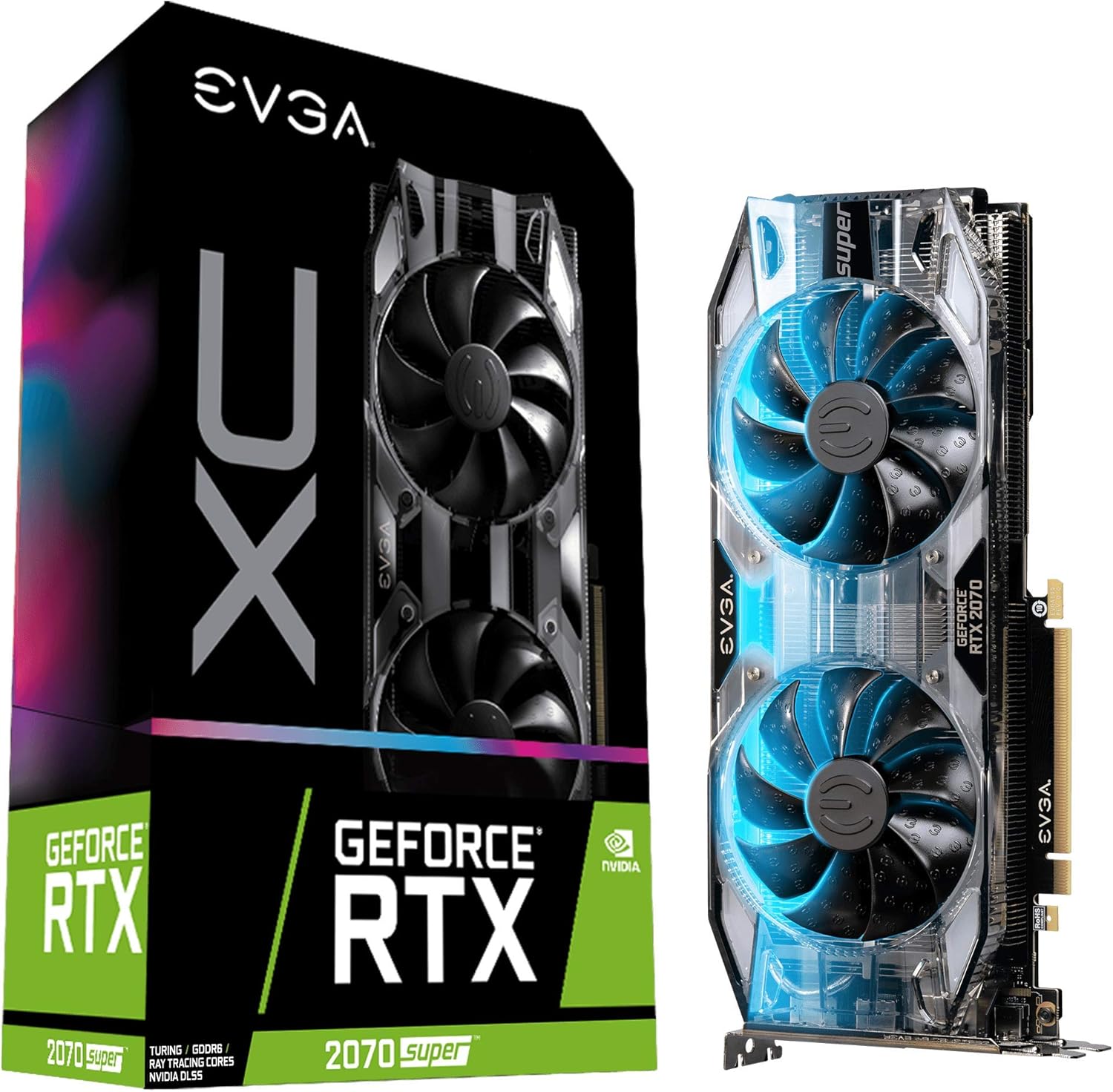
Image: The EVGA GeForce RTX 2070 Super XC Gaming graphics card shown alongside its retail packaging.
Specifications
| Feature | Detail |
|---|---|
| Graphics Coprocessor | NVIDIA GeForce RTX 2070 |
| GPU Clock Speed | 1800 MHz (Boost) |
| Graphics RAM Size | 8 GB GDDR6 |
| Memory Speed | 14000 MHz |
| Max Screen Resolution | 7680x4320 |
| Video Output Interface | HDMI, DisplayPort, USB-C |
| Cooling | Dual HDB Fans |
| Backplate | All-metal |
| Dimensions (LxWxH) | 10.62 x 4.37 x 1.77 inches |
| Item Weight | 1.76 pounds |

Image: Top view of the graphics card, showcasing the dual HDB fans.
Installation
Proper installation is crucial for optimal performance and system stability. Ensure your system meets the minimum power supply and physical clearance requirements before proceeding.
1. Physical Installation
- Power Off and Unplug: Completely shut down your computer and disconnect all power cables from the wall outlet.
- Open Case: Open your computer case to access the motherboard and PCIe slots.
- Locate PCIe Slot: Identify an available PCIe x16 slot on your motherboard. This graphics card typically occupies two expansion slots.
- Remove Slot Covers: Remove the necessary metal slot covers from the back of your computer case corresponding to the chosen PCIe slot.
- Insert Graphics Card: Carefully align the graphics card with the PCIe slot and press down firmly until it is securely seated. Ensure the retention clip on the motherboard clicks into place.
- Secure Card: Use screws to secure the graphics card to the computer case at the expansion slot bracket.
- Connect Power: Connect the required PCIe power cables from your power supply to the graphics card. This model typically requires 8-pin and 6-pin PCIe power connectors.
- Close Case: Once secured and powered, close your computer case.

Image: Side view of the graphics card, highlighting the HDMI, DisplayPort, and USB-C outputs.
2. Driver Installation
- Power On: Reconnect all power cables and turn on your computer.
- Initial Boot: Your operating system may boot with a basic display driver.
- Download Drivers: Visit the official NVIDIA website (www.nvidia.com/drivers) to download the latest graphics drivers for your GeForce RTX 2070 Super.
- Install Drivers: Run the downloaded driver installer and follow the on-screen prompts. A restart may be required after installation.
- Install EVGA Precision X1: For advanced monitoring, overclocking, and RGB control, download and install the EVGA Precision X1 software from the official EVGA website (www.evga.com/precisionx1/).

Image: An EVGA banner indicating installation guidance for GeForce GTX and RTX series.
Operation
Your EVGA GeForce RTX 2070 Super is designed for high-performance computing, particularly for gaming and content creation.
Key Features and Usage:
- Real-time Ray Tracing: Experience cutting-edge, hyper-realistic graphics in supported games and applications.
- High Performance: With a Real Boost Clock of 1800 MHz and 8192 MB GDDR6 memory, the card delivers smooth frame rates and efficient processing.
- Cooling System: The dual HDB fans provide high-performance cooling while maintaining quiet acoustic noise during normal operation. Fans will spin up under heavy load to dissipate heat effectively.
- Adjustable RGB LED: Customize the integrated RGB lighting to match your system's aesthetic using the EVGA Precision X1 software.
- Video Editing and Content Creation: Beyond gaming, this card is a powerful tool for video editing, 3D rendering, and other graphically intensive tasks, leveraging its robust processing capabilities.

Image: An angled view of the graphics card, showcasing its design and potential RGB illumination.
Maintenance
Regular maintenance helps ensure the longevity and optimal performance of your graphics card.
- Dust Removal: Periodically clean dust from the fans and heatsink using compressed air. Ensure the computer is powered off and unplugged before cleaning. Hold the fan blades gently to prevent them from spinning rapidly during cleaning, which can damage the bearings.
- Driver Updates: Keep your graphics drivers updated to the latest version from the NVIDIA website. Driver updates often include performance improvements, bug fixes, and compatibility enhancements.
- Software Monitoring: Use EVGA Precision X1 or other monitoring software to keep an eye on GPU temperatures and fan speeds. Ensure temperatures remain within safe operating limits, especially during heavy loads.

Image: The metal backplate of the graphics card, designed for structural integrity and heat dissipation.
Troubleshooting
If you encounter issues with your graphics card, consider the following common troubleshooting steps:
- No Display/Black Screen:
- Ensure the graphics card is fully seated in the PCIe slot.
- Verify all PCIe power cables are securely connected to the card.
- Check that your monitor cable is connected to the graphics card's output, not the motherboard's integrated graphics port.
- Test with a different display cable or monitor if possible.
- Driver Issues/Crashes:
- Perform a clean installation of the latest graphics drivers from NVIDIA's website. Use DDU (Display Driver Uninstaller) in Safe Mode to remove old drivers completely before installing new ones.
- Ensure your operating system is up to date.
- Overheating/Fan Noise:
- Clean dust from the fans and heatsink.
- Ensure adequate airflow within your computer case.
- Monitor temperatures using EVGA Precision X1. If temperatures are consistently high, consider adjusting fan curves or improving case ventilation.
- Performance Issues (Low FPS, Stuttering):
- Verify that your system meets the recommended specifications for the games or applications you are running.
- Ensure graphics drivers are up to date.
- Check for background applications consuming system resources.
- Confirm that the card is receiving sufficient power from the power supply.
Warranty and Support
EVGA stands behind the quality of its products. The EVGA GeForce RTX 2070 Super XC Gaming graphics card comes with a 3-year warranty.
For technical support, warranty claims, or additional product information, please visit the official EVGA website or contact their customer service:
- EVGA Official Website: www.evga.com
- Product Registration: Register your product on the EVGA website to ensure full warranty coverage and access to support resources.
Ask a question about this manual
Ask about setup, troubleshooting, compatibility, parts, safety, or missing instructions. Manuals+ will review the question and use this page’s manual context to help answer it.