
1. Introduction
The Extech EX330 is a compact, autoranging digital multimeter designed for a wide range of electrical and electronic measurements. Its robust design and comprehensive features make it an essential tool for professionals and hobbyists alike. This manual provides detailed instructions for the safe and effective use of your EX330 multimeter.
Key features of the EX330 include:
- Built-in non-contact AC voltage detector (NCV) for enhanced safety.
- Large 4000-count LCD display for clear readings.
- Automatic ranging for simplified operation.
- Measures AC/DC Voltage, AC/DC Current, Resistance, Capacitance, Frequency, Duty Cycle, and Temperature.
- Diode test and Continuity check functions.
- Data Hold and Max Hold features.
- Durable rubber holster for protection.
- UL listed Cat III 600V safety rating.

2. Getting Started
2.1. Battery Installation
The EX330 multimeter requires two AAA batteries for operation. To install or replace batteries:
- Ensure the multimeter is turned off.
- Locate the battery compartment on the rear of the unit.
- Use a screwdriver to open the battery compartment cover.
- Insert two AAA batteries, observing the correct polarity (+ and -) as indicated inside the compartment.
- Replace the battery compartment cover and secure it with the screw.
2.2. Connecting Test Leads
The multimeter comes with a set of red and black test leads. Proper connection is crucial for accurate and safe measurements.
- Always connect the black test lead to the COM (Common) input jack.
- For most voltage, resistance, and continuity measurements, connect the red test lead to the V/Ω/µA/CAP/Hz/Temp input jack.
- For current measurements up to 400mA, connect the red test lead to the mA input jack.
- For high current measurements up to 10A, connect the red test lead to the 10A input jack.

3. Operating Instructions
3.1. Power On/Off
To turn the multimeter on, rotate the function switch from the OFF position to any desired measurement function. To turn the multimeter off, rotate the function switch back to the OFF position.
3.2. Function Selection (Rotary Dial)
The large rotary dial on the front of the multimeter allows you to select the desired measurement function. The EX330 features automatic ranging, which simplifies operation by automatically selecting the correct measurement range.
- VAC / VDC: Measures AC or DC Voltage.
- mA / 10A: Measures AC or DC Current (milliampere or ampere).
- Ω: Measures Resistance.
- CAP: Measures Capacitance.
- Hz/%: Measures Frequency and Duty Cycle.
- °F / °C: Measures Temperature in Fahrenheit or Celsius.
- Diode / Continuity: Tests diodes and checks for circuit continuity.
3.3. Non-Contact Voltage (NCV) Detection
The NCV feature allows for quick detection of AC voltage without direct contact, enhancing safety when working with electrical systems. To use the NCV function, press and hold the NCV button. The top of the meter will illuminate and an audible tone will sound if AC voltage is detected.

3.4. Voltage Measurement (AC/DC)
To measure voltage:
- Set the rotary dial to VAC or VDC as appropriate.
- Connect the black test lead to the COM jack and the red test lead to the V/Ω/µA/CAP/Hz/Temp jack.
- Connect the test probes in parallel across the circuit or component to be measured.
- Read the voltage value on the LCD display.

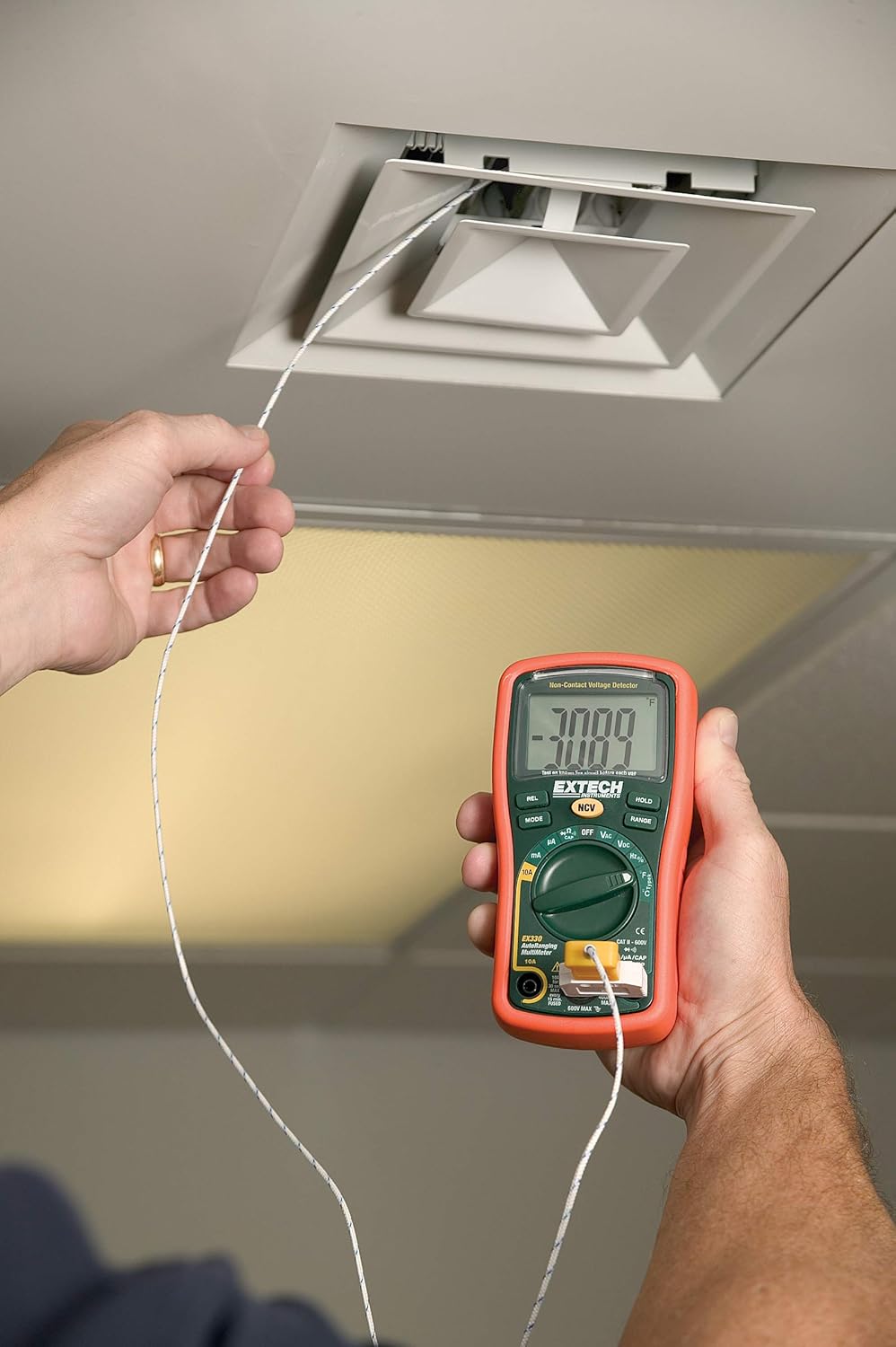
3.5. Temperature Measurement (Type K)
The EX330 includes a Type K temperature probe for accurate temperature readings.
- Set the rotary dial to °F or °C.
- Plug the Type K temperature probe into the V/Ω/µA/CAP/Hz/Temp and COM input jacks, observing polarity.
- Place the tip of the temperature probe on or near the object whose temperature is to be measured.
- Allow time for the reading to stabilize on the display.
3.6. Data Hold and Max Hold
- Press the HOLD button to freeze the current reading on the display. Press again to release.
- Press the MODE button repeatedly while in certain functions to cycle through sub-functions or to activate MAX HOLD, which captures and displays the maximum measured value.
3.7. Product Features Overview
Watch this video for a quick overview of the Extech EX330's key features and applications.
Video 3.1: Overview of Extech EX330 Multimeter features, including AC/DC voltage measurement, 4000-count display, built-in non-contact voltage detector, and Type K temperature measurement.
3.8. Accuracy Demonstration
This video demonstrates the accuracy and reliability of Extech multimeters, showcasing two units providing consistent readings when measuring voltage from a power supply.
Video 3.2: Demonstration of two Extech multimeters measuring voltage from a power supply, highlighting their consistent and accurate readings over time.
4. Maintenance and Care
4.1. Cleaning
To clean the multimeter, use a soft, damp cloth. Do not use abrasives or solvents. Ensure the unit is off and disconnected from any circuits before cleaning.
4.2. Battery Replacement
When the battery indicator appears on the display, replace the batteries as described in Section 2.1. Prompt battery replacement ensures continued accuracy and proper operation.
4.3. Fuse Replacement
If the multimeter fails to measure current, the fuse may need replacement. Refer to the specifications for the correct fuse type and rating. Fuse replacement should only be performed by qualified personnel.
5. Troubleshooting
This section addresses common issues you might encounter with your EX330 multimeter.
| Problem | Possible Cause | Solution |
|---|---|---|
| No display or dim display | Dead or low batteries | Replace batteries (Section 2.1) |
| Incorrect readings | Incorrect function selected, poor test lead connection, damaged test leads | Verify function, check connections, replace test leads if damaged |
| No current measurement | Blown fuse | Replace fuse (Section 4.3) |
| NCV not detecting voltage | Voltage too low, interference, or incorrect usage | Ensure voltage is within detectable range, minimize interference, follow NCV instructions (Section 3.3) |
6. Technical Specifications
| Specification | Value |
|---|---|
| Display | 4000 Count LCD |
| AC/DC Voltage | Up to 600V |
| AC/DC Current | Up to 10A |
| Resistance | Up to 40MΩ |
| Capacitance | Up to 100µF |
| Frequency | Up to 10MHz |
| Temperature (Type K) | -4 to 1382°F (-20 to 750°C) |
| Non-Contact Voltage (NCV) | 100 to 600VAC |
| Power Source | 2 x AAA batteries (included) |
| Dimensions (L x W x H) | 5.7 x 2.9 x 1.6 inches |
| Weight | 9.9 ounces (0.28 kg) |
| Safety Rating | UL listed Cat III - 600V |
| Country of Origin | China |

7. Warranty and Support
7.1. Warranty Information
The Extech EX330 Autoranging Mini Multimeter is covered by a 1-year parts and labor warranty from the date of purchase. This warranty covers defects in materials and workmanship under normal use. It does not cover damage resulting from misuse, unauthorized modifications, accidents, or neglect.
7.2. Customer Support
For technical assistance, troubleshooting, or warranty claims, please contact Extech customer support. Refer to the official Extech website or your product packaging for the most current contact information.


