
QSC RMX 5050, 120V
QSC RMX5050 Power Amplifier User Manual
Model: RMX 5050, 120V
1. Introduction
The QSC RMX5050 Power Amplifier is designed for professional audio applications, delivering high levels of sustained power and audio performance. It features a three-tier, Class H design for efficiency and reliability, making it suitable for touring, live sound, and mobile entertainment setups.

Figure 1.1: Front view of the QSC RMX5050 Power Amplifier. This image shows the amplifier's front panel with the QSC logo, power switch, gain controls for Channel 1 and Channel 2, and various LED indicators.
2. Safety Information
Please read and understand all safety instructions before operating the QSC RMX5050 Power Amplifier. Retain this manual for future reference.
- Power Source: Connect the amplifier only to the specified voltage and frequency as indicated on the rear panel.
- Ventilation: Ensure adequate airflow around the amplifier. Do not block ventilation openings.
- Moisture: Do not expose the amplifier to rain or moisture. Do not place objects filled with liquids on the amplifier.
- Servicing: Refer all servicing to qualified service personnel. Do not attempt to service this unit yourself.
- Grounding: Always ensure the amplifier is properly grounded to prevent electric shock.
3. Setup
3.1 Unpacking
Carefully remove the amplifier from its packaging. Inspect the unit for any signs of damage that may have occurred during transit. Retain the original packaging for future shipping or storage.
3.2 Placement and Mounting
The RMX5050 is designed for standard 19-inch rack mounting and occupies 3U of rack space. Ensure the rack provides sufficient ventilation and structural support for the amplifier's weight (approximately 75 pounds).
3.3 Connections
Before making any connections, ensure the amplifier is powered off and disconnected from the AC mains.
3.3.1 Input Connections
The RMX5050 features balanced 1/4" TRS, XLR, and barrier strip inputs for flexible connectivity. Connect your audio source (mixer, preamplifier, etc.) to the appropriate input connectors for Channel 1 and Channel 2.
3.3.2 Output Connections
Connect your loudspeakers to the amplifier's outputs using either binding posts or Neutrik Speakon connectors. Ensure correct polarity and impedance matching for optimal performance and to prevent damage to speakers or the amplifier.

Figure 3.1: Rear panel of the QSC RMX5050 Power Amplifier. This image highlights the various input options (XLR, TRS, barrier strip), output connectors (Speakon, binding posts), DIP switches for configuration, and the AC power inlet.
3.3.3 Power Connection
Connect the supplied AC power cord to the amplifier's power inlet and then to a grounded AC outlet. Verify that the power source matches the amplifier's voltage requirements.
3.4 Initial Power-Up
- Ensure all audio connections are secure.
- Set the front panel gain controls to their minimum (fully counter-clockwise) position.
- Power on your audio source equipment first.
- Flip the power switch on the RMX5050 to the "ON" position. The power indicator LED should illuminate.
- Slowly increase the gain controls to the desired level.
4. Operating the Amplifier
4.1 Front Panel Controls and Indicators
- Power Switch: Toggles the amplifier on/off.
- Power LED: Illuminates green when the amplifier is powered on.
- Gain Controls (Channel 1 & 2): Rotary knobs to adjust the input sensitivity for each channel.
- Signal LED: Illuminates green when an audio signal is present at the input.
- Clip LED: Illuminates red when the output signal is clipping (distorting). Reduce input level or gain if this LED frequently illuminates.
- Protect LED: Illuminates red if the amplifier enters protection mode due to overheating, short circuit, or other fault conditions.

Figure 4.1: Front panel of the QSC RMX5050 Power Amplifier with the power indicator illuminated. This view clearly shows the power switch, gain knobs, and the Signal, Clip, and Protect LEDs for both channels.
4.2 Rear Panel DIP Switches
The rear panel features DIP switches that allow configuration of various operating parameters. Always power off the amplifier before changing DIP switch settings.
- Clip Limiter: Engages a circuit that prevents severe clipping and protects speakers.
- Low-Frequency Filters: High-pass filters (e.g., 30 Hz, 50 Hz) to remove unwanted low-frequency content, protecting speakers and improving clarity.
- Operating Mode: Selects between Stereo, Parallel, or Bridged Mono operation.
4.3 Operating Modes
4.3.1 Stereo Mode
In stereo mode, each channel operates independently, amplifying its respective input signal and sending it to its dedicated output. This is the standard mode for two-channel sound reinforcement.
4.3.2 Parallel Mode
In parallel mode, a single input signal is fed to both amplifier channels, which then drive separate speaker loads. This is useful for driving multiple speakers with the same mono signal.
4.3.3 Bridged Mono Mode
Bridged mono mode combines the power of both amplifier channels into a single, higher-power output. This mode is typically used to drive a single, high-power loudspeaker or subwoofer. Consult the manual for specific wiring instructions for bridged mono operation.
5. Maintenance
5.1 Cleaning
Periodically clean the exterior of the amplifier with a soft, dry cloth. Do not use abrasive cleaners or solvents. Ensure ventilation grilles are free from dust and debris.
5.2 Ventilation
The RMX5050 relies on internal fans for cooling. Regularly check that the air intake and exhaust vents are not obstructed. Operating the amplifier in poorly ventilated spaces can lead to overheating and activation of protection circuits.
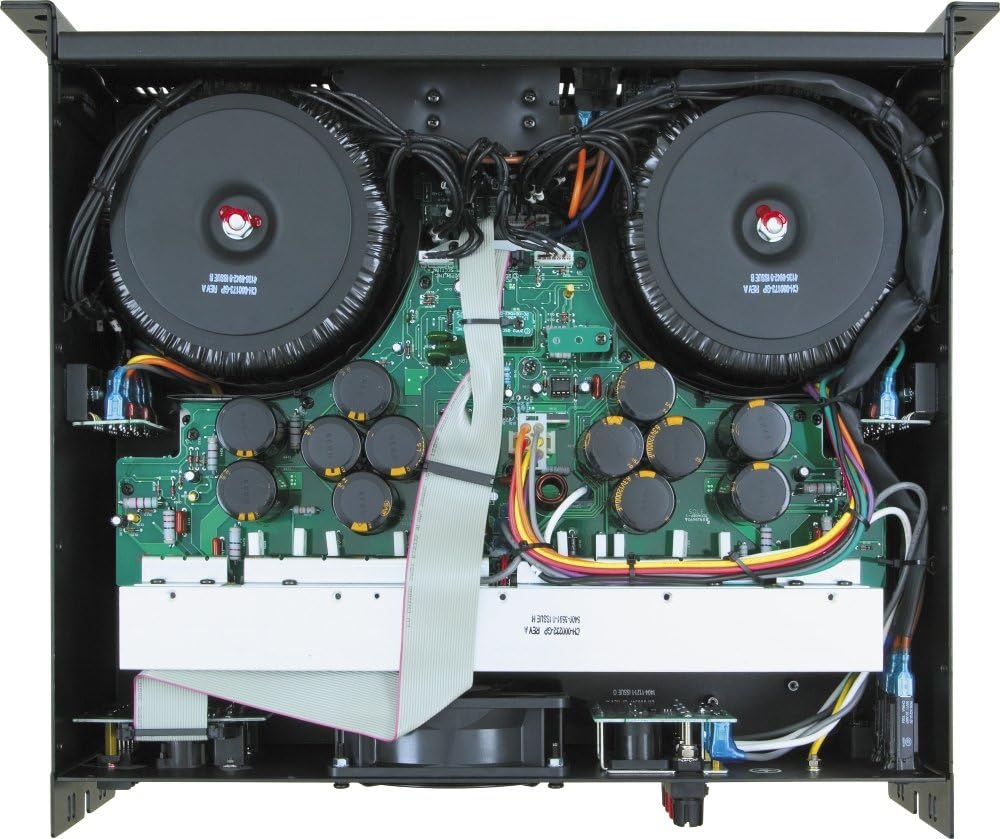
Figure 5.1: Internal view of the QSC RMX5050 Power Amplifier. This image shows the large toroidal transformers, circuit boards, capacitors, and the central cooling fan, emphasizing the robust internal design and the importance of clear airflow.
5.3 Storage
If storing the amplifier for an extended period, ensure it is kept in a dry, temperature-controlled environment, away from direct sunlight and extreme temperatures. It is recommended to use the original packaging for protection.
6. Troubleshooting
This section provides solutions to common issues you might encounter. If the problem persists, contact QSC customer support or a qualified service technician.
| Problem | Possible Cause | Solution |
|---|---|---|
| No Power | Power cord disconnected, AC outlet faulty, internal fuse blown. | Check power cord connection. Test AC outlet. If fuse is suspected, contact service. |
| No Sound Output | Input cables disconnected, speaker cables disconnected, gain controls at minimum, amplifier in protect mode. | Verify all cable connections. Increase gain. Check Protect LED; if illuminated, refer to manual for fault conditions. |
| Distorted Sound (Clip LED on) | Input signal too high, gain set too high, speaker impedance too low. | Reduce input signal level from source. Decrease amplifier gain. Verify speaker impedance matches amplifier's capabilities. |
| Amplifier Overheating (Protect LED on) | Insufficient ventilation, blocked vents, excessive load. | Ensure proper airflow. Clear any obstructions from vents. Reduce load or operating time. Allow amplifier to cool. |
7. Specifications
Key technical specifications for the QSC RMX5050 Power Amplifier:
- Item Weight: 75 pounds
- Model Number: RMX 5050, 120V
- Compatible Devices: Monitor (general audio monitoring)
- Connector Type: Speakon, binding post (outputs); 1/4" TRS, XLR, barrier strip (inputs)
- Output Wattage: 2000 Watts (specific configurations may vary, refer to full power ratings)
- Wattage (RMS): 1600 watts (typical rating, specific configurations may vary)
- Brand: QSC
- Form Factor: ATX (This seems like a miscategorization from the source data, typically refers to computer motherboards. For amplifiers, it's usually rack-mount or chassis type. The RMX5050 is a 3U rack-mount amplifier.)
- Cooling Method: Air (Fan-cooled)
- Number of Connectors: 5 (This is likely a count of specific types, not total)
- Fan Count: 1 (Main cooling fan)
8. Warranty and Support
For detailed warranty information and technical support, please refer to the official QSC website or contact QSC customer service directly. Keep your purchase receipt as proof of purchase for warranty claims.
You can visit the official QSC Store for more information: QSC Official Store
Related documentsRMX 5050, 120V

Ask a question about this manual
Ask about setup, troubleshooting, compatibility, parts, safety, or missing instructions. Manuals+ will review the question and use this page’s manual context to help answer it.