
1. Introduction
The Yahboom Raspbot V2 is an open-source AI vision robot car designed for beginners, powered by the Raspberry Pi 5. It features a Mecanum wheel chassis, a high-resolution wide-angle camera, and integrates with the OpenCV image processing library and Media-Pipe machine learning framework. This robot car is capable of advanced functions such as color recognition, target tracking, license plate recognition, autonomous driving, face recognition, and gesture recognition.
The Raspberry Pi 5 brings significant breakthroughs in processor speed, multimedia performance, memory, and connectivity. This enhancement, combined with the robot drive expansion board, greatly boosts the AI capabilities of the Raspbot V2, providing smoother camera operation and more powerful AI functions.
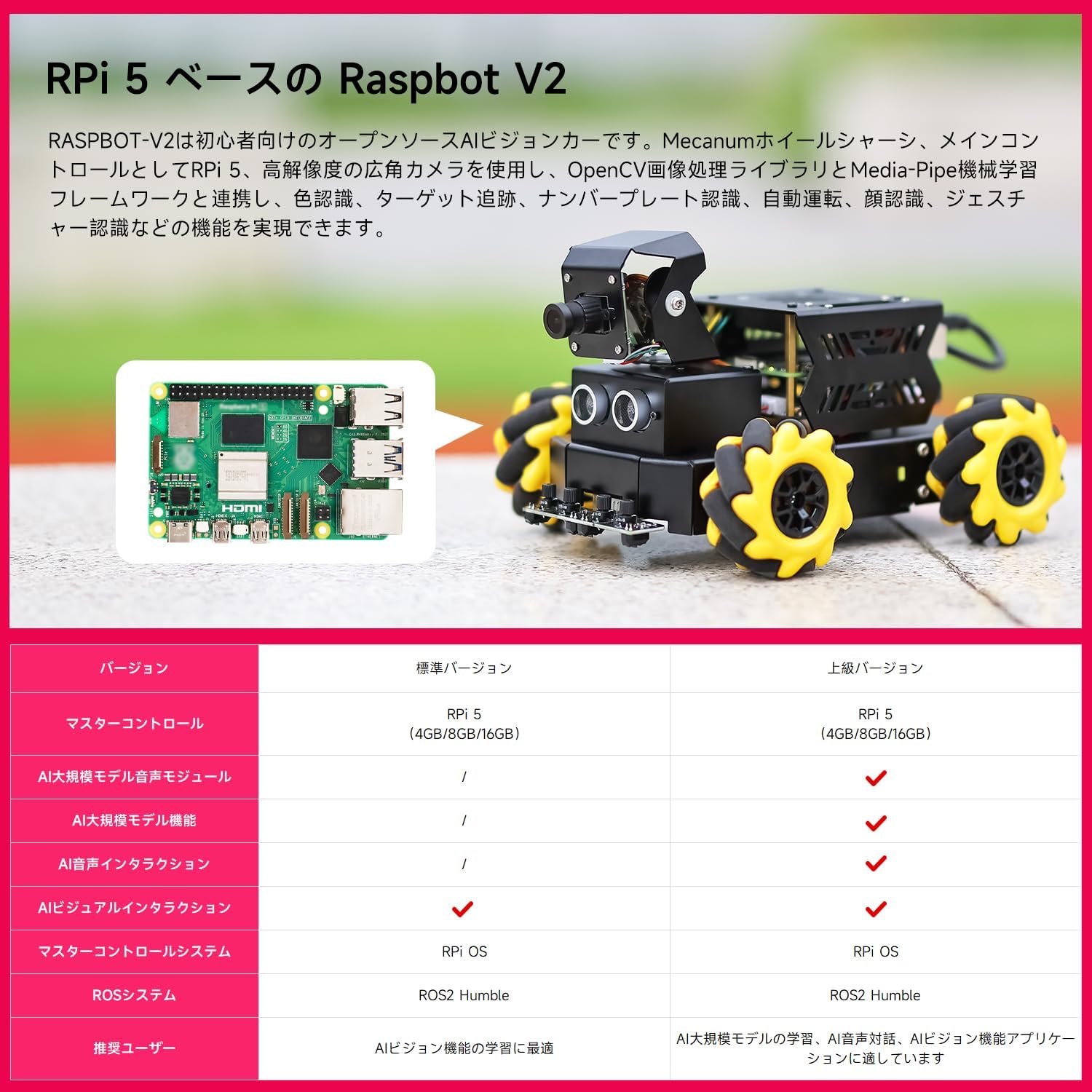
Figure 1: Overview of the RPi 5 based Raspbot V2, highlighting its core components and capabilities.
Version Comparison
| Feature | Standard Version | Advanced Version |
|---|---|---|
| Master Control | RPi 5 (4GB/8GB/16GB) | RPi 5 (4GB/8GB/16GB) |
| AI Large Model Voice Module | / | ✓ |
| AI Large Model Features | / | ✓ |
| AI Voice Interaction | / | ✓ |
| AI Visual Interaction | / | ✓ |
| Master Control System | RPi OS | RPi OS |
| ROS System | ROS2 Humble | ROS2 Humble |
| Recommended User | Best for learning AI features | Best for learning AI large models, AI voice interaction, AI vision applications |
Table 1: Comparison of features between the Standard and Advanced versions of Raspbot V2.
2. Product Components
The Raspbot V2 comes with various components designed for its advanced functionalities. The chassis is pre-assembled for convenience. Key components include:
- Raspberry Pi 5 (main control)
- Robot Driver Board
- 2DOF Camera PTZ (Pan-Tilt-Zoom) with HD 110° Wide-Angle Camera
- Mecanum Wheels (x4)
- TT Geared Motors
- Ultrasonic Sensor
- 4-Channel Tracking Sensor
- 7.4V Battery Pack
- Adapter Board
- Cooling Fan
- OLED Display
- RGB Colorful Light Bar
- Optional: AI Large Model Voice Module, Speaker
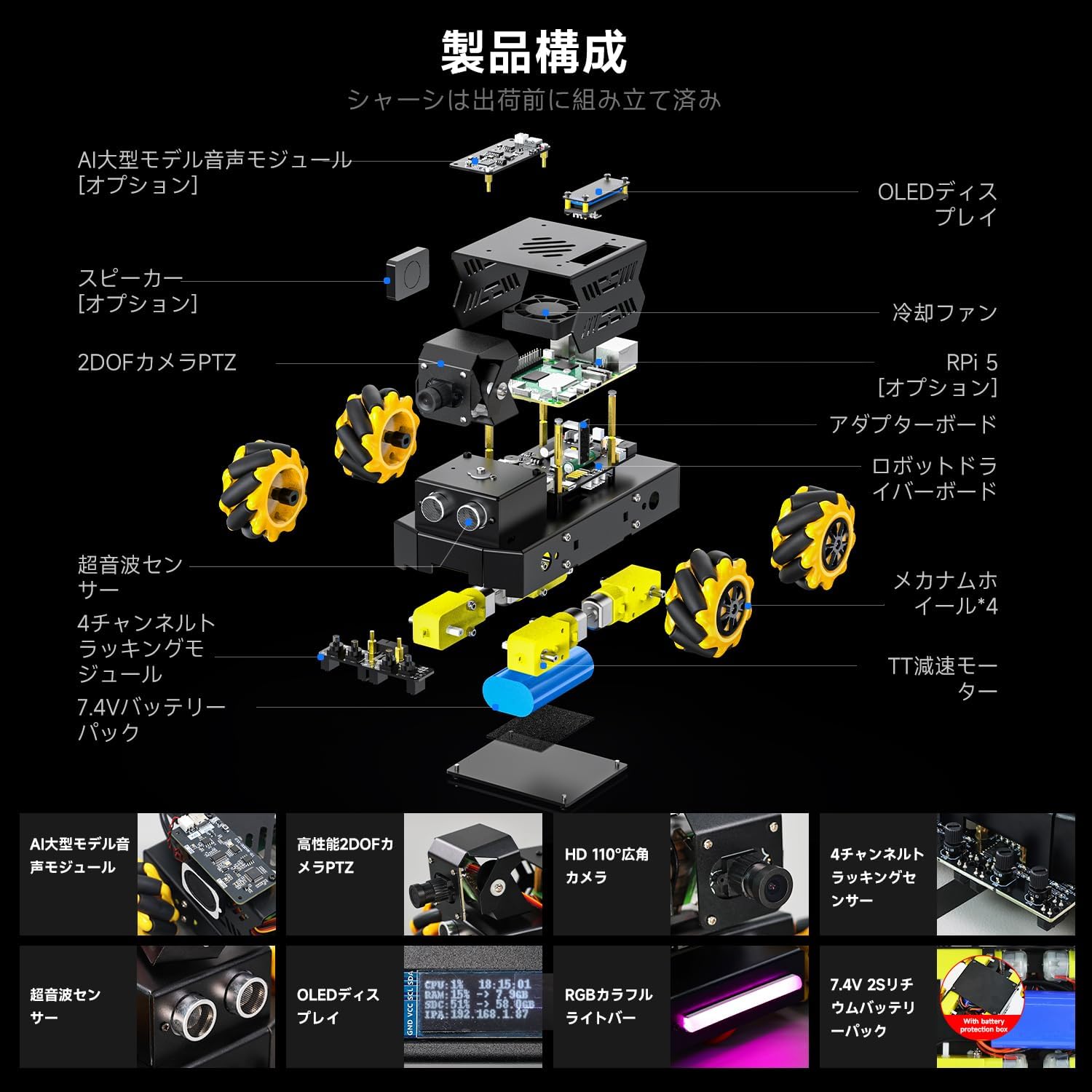
Figure 2: Exploded view illustrating the various components of the Raspbot V2, including the Raspberry Pi 5, camera, sensors, and drive system.
3. Setup Guide
3.1. Assembly
The main chassis of the Raspbot V2 is pre-assembled before shipment. You will need to attach the Raspberry Pi 5, camera module, and connect the various sensors and motors to the robot driver board. Refer to the detailed assembly instructions provided in the separate assembly guide or online resources for step-by-step visual guidance.
3.2. Power Connection
The Raspbot V2 requires a stable and sufficient power supply, especially with the enhanced performance of the Raspberry Pi 5. It is recommended to use a dedicated 5.1V/5A PD power supply that supports the Pi5 power protocol. This ensures optimal performance and provides enough power for USB peripherals.

Figure 3: Comparison of power supply options for Raspberry Pi 5, emphasizing the benefits of using a dedicated 5.1V/5A PD power supply for optimal performance.
3.3. Software Installation and Configuration
The Raspbot V2 operates on Raspberry Pi OS and utilizes ROS2 Humble for robotics control. Key libraries like OpenCV are used for image processing. Ensure your Raspberry Pi 5 is set up with the latest Raspberry Pi OS. Follow the official Yahboom documentation for installing ROS2 Humble, OpenCV, and any specific drivers or software packages required for the robot's functionalities. This typically involves flashing an SD card with the appropriate image and then performing software updates and installations via the command line.
4. Operating Instructions
4.1. Control Methods
The Raspbot V2 can be controlled through multiple interfaces:
- Mobile APP: Use the dedicated mobile application for remote control and monitoring.
- PC Software: Control the robot via a PC interface, often used for programming and advanced debugging.
- Remote Control/Handle: Utilize a physical remote control or game handle for intuitive manual operation.
All control methods support FPV (First Person View) image transmission from the HD camera, allowing real-time visual feedback.
4.2. Omnidirectional Movement
Equipped with Mecanum wheels, the Raspbot V2 can achieve 360° omnidirectional movement. This allows for complex maneuvers including forward, lateral (strafing), diagonal movement, and rotation, making it highly versatile in various environments.

Figure 4: Examples of omnidirectional movement patterns achievable with Mecanum wheels, including polyline movement, circular drift, and lateral movement.
4.3. AI Vision Applications
The Raspbot V2 leverages its HD camera and AI capabilities to perform a range of intelligent applications:
- Visual Tracking/Following: Identify and track specific objects or colors.
- Autonomous Navigation: Navigate autonomously, avoiding obstacles and following predefined paths or waypoints.
- Object Recognition: Detect and identify various objects, including 3D objects and specific items like trash.
- Face Detection and Tracking: Identify human faces and track their movement.
- Human Posture Estimation: Analyze and estimate human body postures.
- Gesture Recognition: Interpret human gestures for interactive control.
- Scene Understanding: Analyze visual input to understand the environment and context.
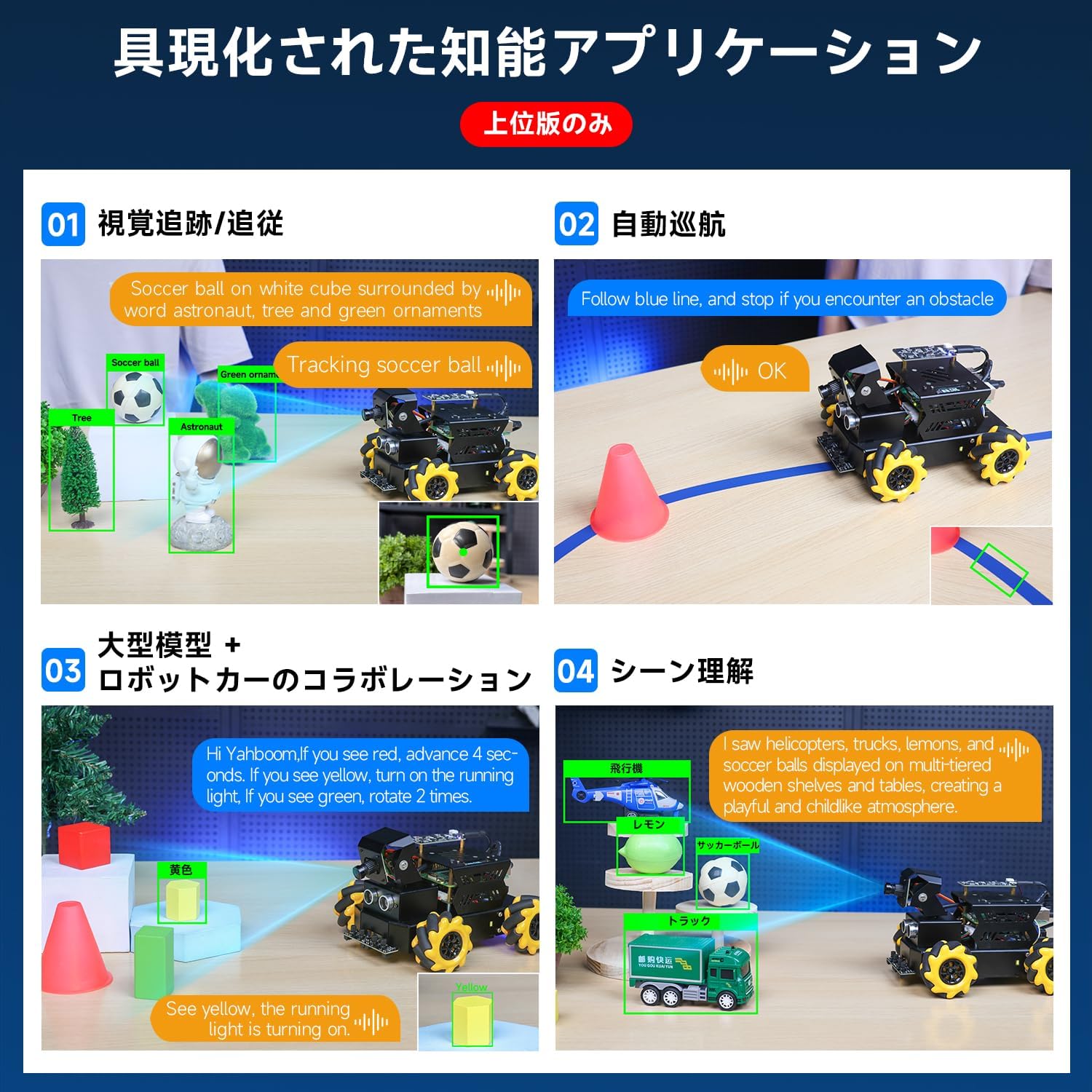
Figure 5: Visual examples of the Raspbot V2's intelligent applications, including visual tracking, autonomous navigation, large model collaboration, and scene understanding.
5. Performance Enhancements (Raspberry Pi 5)
The Raspberry Pi 5 significantly upgrades the robot's processing power and capabilities:
- CPU: Features a new Broadcom BCM2712 processor with 4 Cortex-A76 cores, upgraded from Pi 4B's Cortex-A72. The manufacturing process is reduced from 28nm to 16nm, and the frequency is increased from 1.5GHz to 2.4GHz.
- GPU: Boosted from Pi 4B's 600 MHz VideoCore VI(6) to 800 MHz VideoCore VII(7), supporting OpenGL ES 3.1 and Vulkan 1.2.
- Memory: Upgraded to LPDDR4X-4267 for faster data access.
- Power & TF Card Slot: Type-C power supply upgraded to 5V5A with PD support. The protocol supports high-speed SDR104 mode Micro SD cards.
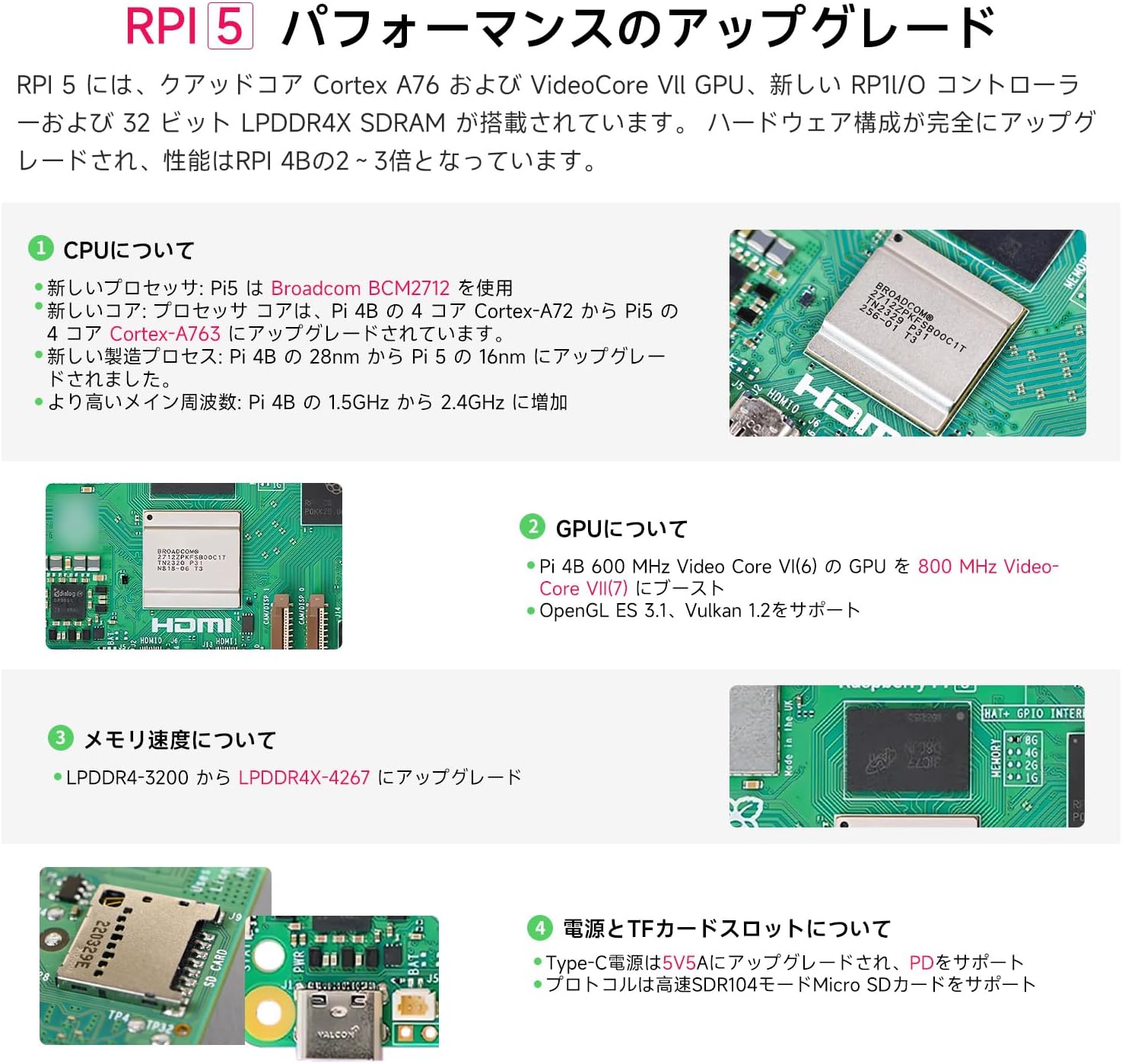
Figure 6: Detailed breakdown of the Raspberry Pi 5's performance upgrades, including CPU, GPU, memory, and power/TF card slot specifications.
6. Cooling Solutions
Due to the increased performance of the Raspberry Pi 5, effective cooling is crucial for stable operation, especially under heavy loads. It is not recommended to use the RPi 5 without a cooling device or with only a heatsink, as this can negatively impact performance. Various cooling solutions are available:
- Pure Copper Heatsink Set: Can be used in conjunction with a cooling fan.
- Acrylic Case: Features a removable top cover, includes a PWM cooling fan, and supports camera bracket installation.
- Metal Case: Made of matte-painted metal and includes a PWM cooling fan.
- Silver ABS Case: Offers a quickly removable design, matte texture, and includes a PWM cooling fan.
- Active Radiator (e.g., Coolbra Pi50): Provides higher heat dissipation efficiency for prolonged full-load operation.
For most users engaged in daily development and learning, a fan-equipped case is recommended. For scenarios requiring the RPi 5 to operate under full load for extended periods, a kit with an active cooler is advisable.

Figure 7: Visual representation of various cooling solutions for the Raspberry Pi 5, including heatsinks and different case types with fans, along with a chart comparing their heat dissipation performance under idle and CPU load conditions.
7. Maintenance
To ensure the longevity and optimal performance of your Raspbot V2, follow these maintenance guidelines:
- Cleaning: Regularly clean the robot's chassis, wheels, and sensors to prevent dust and debris buildup. Use a soft, dry cloth. For hard-to-reach areas, use compressed air.
- Software Updates: Keep the Raspberry Pi OS, ROS2, OpenCV, and any other installed software up to date. Regular updates can improve performance, add new features, and fix bugs.
- Battery Care: Follow proper battery charging and storage procedures. Avoid overcharging or completely draining the battery. Store the robot in a cool, dry place when not in use.
- Component Inspection: Periodically check all connections (wires, cables) to ensure they are secure. Inspect the Mecanum wheels for any wear or damage.
8. Troubleshooting
If you encounter issues with your Raspbot V2, consider the following common troubleshooting steps:
- Robot Not Powering On: Ensure the power supply is correctly connected and providing sufficient voltage (5.1V/5A). Check the battery level if using battery power.
- Connectivity Issues (APP/PC Control): Verify that the Raspberry Pi 5 is connected to the network (Wi-Fi) and that your control device is on the same network. Check IP addresses and firewall settings.
- Camera Not Working: Ensure the camera module is securely connected to the Raspberry Pi 5. Check camera software settings and permissions.
- Motors Not Responding: Check motor connections to the robot driver board. Verify that the motor drivers are correctly configured in the software. Ensure the battery has enough charge.
- AI Features Not Functioning: Confirm that all necessary AI libraries (e.g., OpenCV, Media-Pipe) are installed and up to date. Check for any error messages in the console output. Ensure sufficient processing power and memory are available.
- Overheating: If the Raspberry Pi 5 feels excessively hot, ensure the cooling fan is operating correctly and that there is adequate airflow. Consider upgrading to a more robust cooling solution if operating under continuous heavy load.
For more detailed troubleshooting, refer to the official Yahboom support resources and community forums.
9. Specifications
- Model: Raspbot V2
- Main Control: Raspberry Pi 5 (4GB/8GB/16GB options)
- Processor: Broadcom BCM2712 (Quad-core Cortex-A76 @ 2.4GHz)
- GPU: VideoCore VII (800MHz)
- Memory: LPDDR4X-4267 SDRAM
- Chassis: Mecanum Wheel Chassis
- Camera: 2DOF HD 110° Wide-Angle Camera
- Sensors: Ultrasonic Sensor, 4-Channel Tracking Sensor
- Motor: TT Geared Motor
- Power Supply: Recommended 5.1V/5A PD (Type-C)
- Battery: 7.4V Battery Pack
- Operating System: Raspberry Pi OS
- Robotics Framework: ROS2 Humble
- Image Processing: OpenCV, Media-Pipe
10. Warranty and Support
Yahboom products typically come with a standard manufacturer's warranty. Please refer to the warranty card included with your product or visit the official Yahboom website for specific warranty terms and conditions.
For technical support, troubleshooting assistance, or to access additional resources such as detailed assembly guides, software tutorials, and community forums, please visit the official Yahboom support page or contact their customer service directly. Keep your purchase receipt and product model number (Raspbot V2) handy when seeking support.


