
1. Introduction
Thank you for choosing the JOMAA MS-622 Dual Mode Wireless Vertical Trackball Mouse. This manual provides detailed instructions for setting up, operating, and maintaining your device. Please read this manual carefully before use to ensure optimal performance and longevity of your trackball mouse.
The MS-622 combines dual connectivity options (2.4GHz wireless and Bluetooth), an ergonomic design for comfort, and adjustable precision to enhance your computing experience.
2. Product Overview
The JOMAA MS-622 trackball mouse is designed for comfort and efficiency. Familiarize yourself with its components:
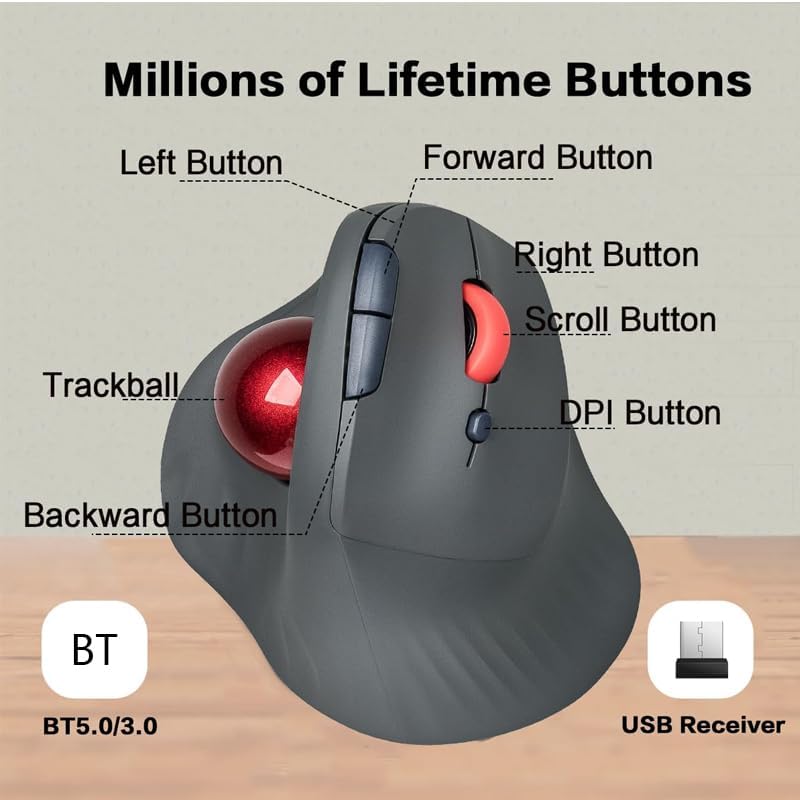
Image 2.1: Component Layout. This image illustrates the various buttons and features of the MS-622 mouse, including the Left Button, Forward Button, Right Button, Scroll Button, DPI Button, Trackball, and Backward Button. It also indicates Bluetooth 5.0/3.0 and the USB Receiver.
- Left Button: Standard left-click function.
- Right Button: Standard right-click function.
- Scroll Wheel/Button: For scrolling content vertically and as a middle-click button.
- Forward Button: Navigates forward in web browsers or file explorers.
- Backward Button: Navigates backward in web browsers or file explorers.
- DPI Button: Adjusts cursor sensitivity (CPI).
- Trackball: Controls cursor movement.
- Mode Switch: Located on the bottom, for switching between 2.4GHz and Bluetooth modes.
- USB-C Charging Port: For recharging the internal battery.
The ergonomic design of the MS-622 promotes a natural hand and wrist posture, reducing strain during extended use.

Image 2.2: Ergonomic Design. This image highlights the 60-degree tilt of the mouse, designed to support natural hand placement and provide comfort for all-day use.

Image 2.3: Wrist Posture Comparison. This image visually compares the wrist position when using a traditional mouse (twisted wrist) versus the JOMAA MS-622 trackball mouse (normal wrist), illustrating the ergonomic benefits.
3. Setup Instructions
The MS-622 offers two connectivity options: 2.4GHz wireless via a USB receiver and Bluetooth. You can switch between these modes using the switch on the bottom of the mouse.
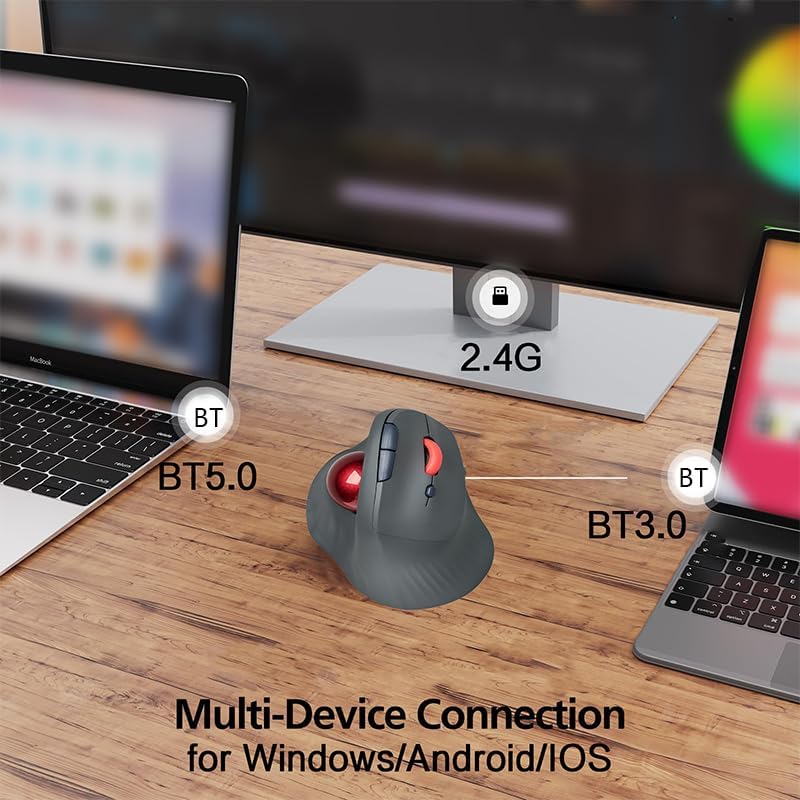
Image 3.1: Multi-Device Connection. This image demonstrates the mouse connecting to different devices (laptops, monitor) using both 2.4GHz wireless (via a USB dongle) and Bluetooth 5.0/3.0.
3.1. 2.4GHz Wireless Connection
- Locate the USB wireless receiver, typically stored in a compartment on the bottom of the mouse.
- Plug the USB receiver into an available USB port on your computer.
- Switch the mode selector on the bottom of the mouse to the '2.4G' position.
- The mouse should automatically connect. If not, try turning the mouse off and on again.
3.2. Bluetooth Connection
- Switch the mode selector on the bottom of the mouse to the 'BT' position.
- On your computer or device, open Bluetooth settings.
- The mouse should appear as 'MS-622' or similar in the list of discoverable devices. Select it to pair.
- Follow any on-screen prompts to complete the pairing process.
- The mouse supports Bluetooth 5.0 and 3.0, allowing connection to a wide range of devices.
4. Operating Instructions
4.1. CPI Adjustment
The MS-622 features adjustable CPI (Counts Per Inch) settings, allowing you to change the cursor sensitivity to suit your task. Press the DPI button (refer to Image 2.1) to cycle through the available CPI levels:
- 800 CPI: For precise, detailed work.
- 1200 CPI: Standard setting for general use.
- 1600 CPI: For faster cursor movement across larger screens.

Image 4.1: CPI Adjustment. This image illustrates the three adjustable CPI levels (800, 1200, 1600) and points to the dedicated CPI button on the mouse.
4.2. Button Functions
The 5 buttons and scroll wheel are pre-programmed for common functions:
- Left Click: Primary selection.
- Right Click: Context menu.
- Scroll Wheel: Scroll up/down. Press for middle-click.
- Forward/Backward Buttons: Navigate web pages or folders.
- DPI Button: Cycle CPI settings.
5. Maintenance
5.1. Charging the Battery
The MS-622 features a built-in 500mAh rechargeable lithium battery. When the battery is low, the indicator light may flash, or performance may degrade.
- Connect the included USB charging cable to the USB-C port on the front of the mouse.
- Plug the other end of the cable into a USB power source (e.g., computer USB port, USB wall adapter).
- The indicator light will show charging status (e.g., solid red while charging, off when fully charged).
- A full charge typically takes a few hours and provides extended use.
5.2. Cleaning the Trackball
Over time, dust and debris can accumulate around the trackball, affecting its smooth operation. Regular cleaning is recommended.
- Turn off the mouse.
- Gently push the trackball out from the bottom of the mouse (there might be a small opening or button to release it).
- Use a clean, lint-free cloth or cotton swab to wipe the trackball clean.
- Clean the inside cavity of the trackball housing, paying attention to the small sensors.
- Reinsert the trackball, ensuring it clicks securely into place.
5.3. General Cleaning
Wipe the exterior of the mouse with a soft, damp cloth. Avoid using harsh chemicals or abrasive cleaners.
6. Troubleshooting
- Mouse not responding:
- Ensure the mouse is turned on and the battery is charged.
- Check the connection mode (2.4GHz or Bluetooth) and ensure it matches your device's connection.
- For 2.4GHz, ensure the USB receiver is securely plugged in. Try a different USB port.
- For Bluetooth, ensure Bluetooth is enabled on your device and the mouse is properly paired. Try re-pairing.
- Cursor movement is erratic or sticky:
- Clean the trackball and its housing as described in Section 5.2.
- Ensure the surface beneath the mouse is clean and free of obstructions (though less critical for a trackball mouse).
- Mouse not charging:
- Ensure the USB charging cable is securely connected to both the mouse and the power source.
- Try a different USB port or charging adapter.
- Verify the charging cable is not damaged.
- Connection drops frequently:
- Ensure the mouse is within the 10-meter wireless range of your device.
- Minimize interference from other wireless devices (e.g., Wi-Fi routers, other Bluetooth devices).
- Ensure the battery is sufficiently charged.
7. Specifications
| Feature | Detail |
|---|---|
| Model Number | MS-622 |
| Connectivity | 2.4GHz Wireless, Bluetooth 5.0, Bluetooth 3.0 |
| Wireless Range | Up to 10 meters (33 feet) |
| Buttons | 5 buttons + Scroll Wheel |
| CPI Settings | 800 / 1200 / 1600 (Adjustable) |
| Battery | Built-in 500mAh Rechargeable Lithium Battery |
| Charging Port | USB-C |
| Product Dimensions | 11.5 x 9.2 x 7.1 cm (4.53" x 3.62" x 2.80") |
| Item Weight | 7.4 ounces |
| Compatibility | Windows, macOS, Linux, Android, iOS (Bluetooth dependent) |
| Movement Detection Technology | Trackball |
8. Warranty Information
The JOMAA MS-622 Dual Mode Wireless Vertical Trackball Mouse is covered by a standard manufacturer's warranty. Please refer to the warranty card included in your product packaging or contact JOMAA customer support for specific terms and conditions regarding warranty coverage and duration.
9. Customer Support
For any questions, technical assistance, or support inquiries regarding your JOMAA MS-622 trackball mouse, please contact JOMAA customer support through the retailer where you purchased the product or visit the official JOMAA website for contact information.


