
1. Introduction
This manual provides essential information for the safe and effective installation, operation, and maintenance of the CHINT NCH8 Din Rail Household Mini AC Contactor. The NCH8 series is designed for various applications, including controlling lighting, heating, ventilation, and other household or similar electrical loads.
Key features of the CHINT NCH8 AC Contactor include:
- Protection against damage caused by short circuits and overloads.
- Constructed with insulating materials suitable for various environmental conditions.
- Flame-retardant and UV-resistant housing for enhanced durability.
- Screw-type terminals to ensure stable and secure electrical connections.
- Suitable for integration with solar inverters, charge controllers, and battery banks in appropriate configurations.
2. Safety Information
WARNING: Electrical shock hazard. Installation and maintenance should only be performed by qualified personnel.
- Always disconnect power before installing, wiring, or servicing the contactor.
- Ensure all wiring complies with local and national electrical codes.
- Do not operate the contactor if it appears damaged or has been exposed to moisture.
- Verify correct voltage and current ratings for your application before installation.
- Use appropriate personal protective equipment (PPE) when working with electrical systems.
3. Product Overview
The CHINT NCH8 series AC Contactor is a modular device designed for mounting on a standard 35mm DIN rail. It features a compact design and clear terminal markings for ease of installation.
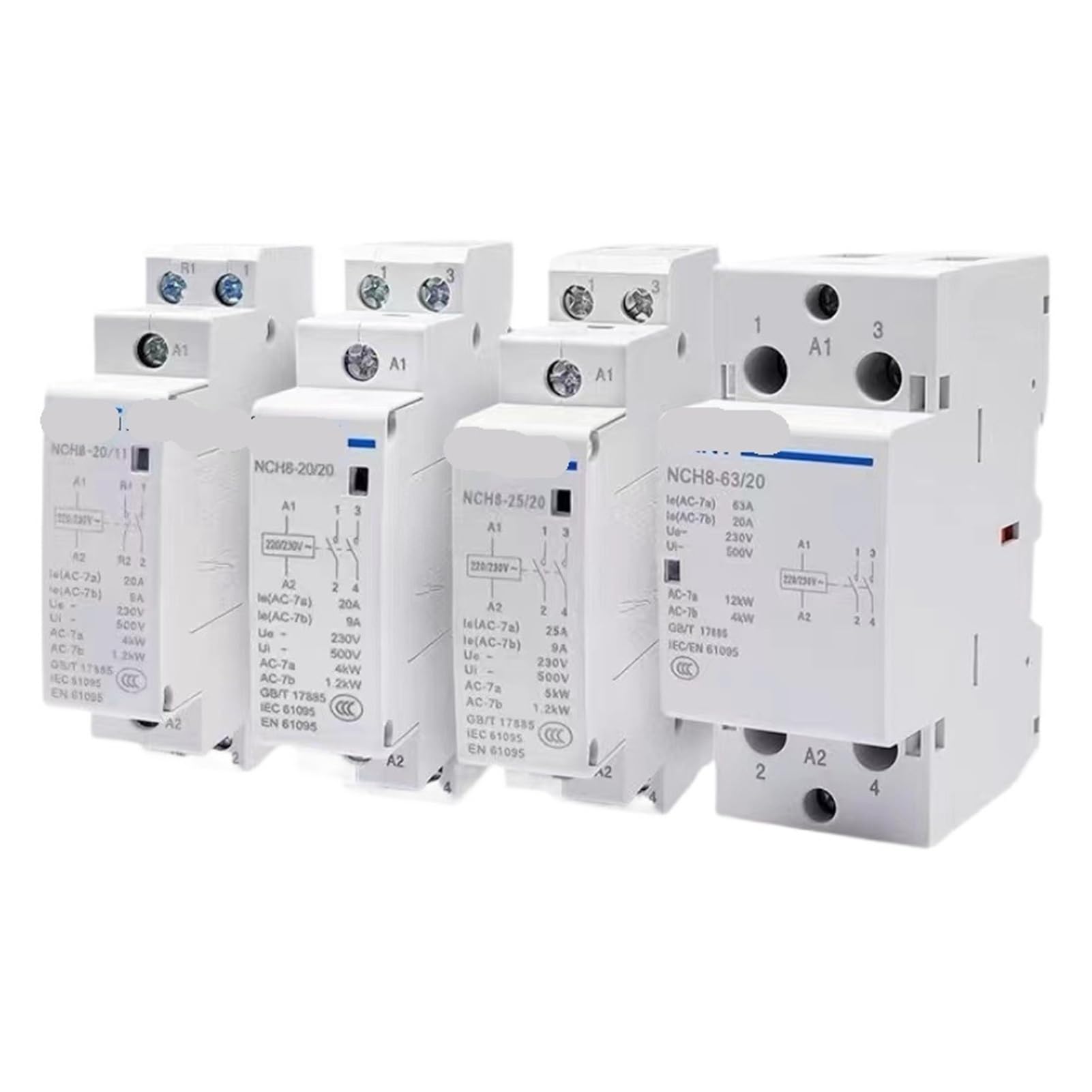
Figure 1: Front-side view of a CHINT NCH8-20/02 AC Contactor, showing the model number, electrical ratings, and terminal designations (A1, A2 for coil, R1, R3 for main contacts).

Figure 2: Front view of a CHINT NCH8-63/20 AC Contactor, illustrating the main power terminals (1, 3, 2, 4) and coil terminals (A1, A2). This model is rated for 63A.

Figure 3: Side view of a CHINT NCH8-20/40 AC Contactor, showing a 4-pole configuration with multiple main contact terminals (1, 3, 5, 7 and 2, 4, 6, 8) and coil terminals (A1, A2).

Figure 4: Rear view of the CHINT NCH8 AC Contactor, highlighting the integrated clip mechanism for secure attachment to a standard 35mm DIN rail.
4. Installation
4.1 DIN Rail Mounting
- Ensure all power to the circuit is disconnected at the main breaker.
- Locate a suitable 35mm DIN rail within your electrical enclosure.
- Hook the top edge of the contactor onto the DIN rail.
- Press the bottom of the contactor firmly until the locking clip engages with the DIN rail, securing the device in place.
- To remove, pull down the locking clip and tilt the contactor off the rail.
4.2 Wiring
The NCH8 contactor has two main sets of terminals: coil terminals (A1, A2) and main power contacts (e.g., 1/L1, 3/L2, 5/L3, 7/L4 for inputs and 2/T1, 4/T2, 6/T3, 8/T4 for outputs, or R1, R3 for inputs and R2, R4 for outputs depending on the model and pole configuration). Refer to the specific markings on your contactor model.
- Coil Wiring: Connect the control voltage (e.g., 220V, 230V, or 400V AC as specified on the device) to terminals A1 and A2. This voltage energizes the coil, causing the main contacts to close or open.
- Main Power Wiring: Connect the incoming power supply to the input terminals (e.g., 1, 3, 5, 7 or R1, R3). Connect the load (e.g., motor, lighting circuit) to the corresponding output terminals (e.g., 2, 4, 6, 8 or R2, R4).
- Ensure all wire connections are tight and secure to prevent loose connections, which can cause overheating or arcing.
- Double-check all wiring against the circuit diagram and the markings on the contactor before restoring power.
5. Operation
The CHINT NCH8 AC Contactor operates by energizing its electromagnetic coil. When the appropriate control voltage is applied to terminals A1 and A2, the coil creates a magnetic field that pulls the armature, causing the main power contacts to change state (typically from normally open to closed, or normally closed to open).
- When the coil is energized, the main contacts will close, allowing power to flow to the connected load.
- When the coil is de-energized, the main contacts will return to their original state (open), disconnecting power from the load.
- Some models may include an indicator window or LED to show the contactor's operational status (energized/de-energized).
6. Maintenance
The CHINT NCH8 AC Contactor is designed for reliable, long-term operation with minimal maintenance. However, periodic inspection is recommended to ensure optimal performance and safety.
- Visual Inspection: Periodically inspect the contactor for any signs of physical damage, discoloration, or overheating. Check for loose connections or frayed wires.
- Cleaning: If necessary, gently clean the exterior of the contactor with a dry, soft cloth. Do not use solvents or abrasive cleaners. Ensure no dust or debris accumulates around the terminals or ventilation openings.
- Terminal Tightness: Over time, vibrations can loosen terminal screws. Periodically check and re-tighten all terminal screws to the recommended torque (if specified).
- Environmental Conditions: Ensure the operating environment remains within the specified temperature and humidity ranges to prevent premature failure.
Always disconnect power before performing any maintenance or inspection.
7. Troubleshooting
If the CHINT NCH8 AC Contactor is not functioning as expected, consider the following common issues and solutions:
- Contactor Does Not Engage (Contacts Do Not Close):
- Check if the control voltage is present at terminals A1 and A2.
- Verify that the control voltage matches the coil voltage rating of the contactor.
- Inspect for loose or incorrect wiring to the coil terminals.
- Check for any external control circuit issues (e.g., faulty switch, sensor, or relay).
- Contactor Engages But Load Does Not Receive Power:
- Verify that the main power supply is present at the input terminals (e.g., 1, 3).
- Check for loose or incorrect wiring to the main power terminals.
- Ensure the load itself is functional and correctly wired.
- Inspect the main contacts for signs of damage or excessive wear (only by qualified personnel with power disconnected).
- Contactor Overheats:
- Ensure the load current does not exceed the contactor's rated current.
- Check for loose terminal connections, which can cause resistance and heat.
- Verify adequate ventilation around the contactor.
- Ensure the coil voltage is within the specified range; incorrect voltage can cause overheating.
If troubleshooting steps do not resolve the issue, consult a qualified electrician or contact CHINT customer support.
8. Specifications
The following specifications are typical for the CHINT NCH8 series AC Contactors. Specific ratings (current, voltage, contact configuration) will vary by model. Always refer to the markings on your specific device.
| Feature | Value |
|---|---|
| Item Type | SWITCHES |
| Rated Current (Ie) | 20A, 25A, 40A, 63A (model dependent) |
| Rated Operating Voltage (Ue) | 220V, 230V, 400V AC (model dependent) |
| Rated Insulation Voltage (Ui) | 500V |
| Contact Configuration | 1NO, 1NC, 2NO, 2NC, 4NO (model dependent) |
| Number of Poles | 2P, 4P (model dependent) |
| Mounting Type | 35mm DIN Rail |
| Package Dimensions | 0.39 x 0.39 x 0.39 inches (approximate) |
| Item Weight | 3.53 ounces (approximate) |
| Manufacturer | Generic (Product is CHINT NCH8) |
| ASIN | B0G6JDSCCJ |
| Date First Available | December 12, 2025 |


