
Introduction to SUNLU PVA Filament
SUNLU PVA (Polyvinyl Alcohol) filament is a specialized water-soluble support material designed for FDM 3D printing. It is engineered to provide reliable support for complex 3D models, particularly those with intricate geometries, overhangs, and internal cavities. After printing, the PVA support material can be easily dissolved in water, leaving behind a clean, smooth, and damage-free surface on the main printed object.

Image: A 3D printed object demonstrating the use of SUNLU PVA water-soluble support material. The main object is grey, and the support structure, printed with PVA, is a translucent yellow, positioned beneath an overhang.
Key Features:
- Water-Soluble Support: Dissolves completely in water, eliminating the need for manual removal and preventing damage to intricate prints.
- Precision Surface Quality: Ensures a smooth and intact surface finish on the main model by bonding seamlessly and dissolving without leaving residue.
- Excellent Compatibility: Works effectively with common printing materials such as PLA, PETG, TPU, ABS, ASA, and Nylon, offering versatility for various projects.

Image: A detailed 3D printed black panther model being rinsed in water, illustrating how PVA supports dissolve cleanly, allowing for complex designs with intricate details to be realized without residue.
Setup and Preparation
Proper preparation of PVA filament is crucial for successful 3D printing. PVA is highly hygroscopic, meaning it readily absorbs moisture from the air. Moisture absorption can lead to printing issues such as bubbling, poor layer adhesion, and stringing.
Filament Drying:
Before printing, it is highly recommended to dry the SUNLU PVA filament. This ensures optimal print quality and prevents common moisture-related problems.
- Dry the filament at 50°C for 4-6 hours. For best results, especially if the filament has been exposed to humidity, consider drying at 55°C for 12 hours.
- Use a dedicated filament dryer or a convection oven set to the appropriate temperature.

Image: A 3D printer setup with a filament dryer, emphasizing the importance of drying PVA filament. An inset shows a close-up of a print with visible defects, likely due to moisture.
Loading Filament:
Follow your 3D printer's instructions for loading filament. Ensure the filament path is clear and the nozzle is at the recommended printing temperature before feeding the PVA filament.
Operating Instructions: Printing with PVA
To achieve optimal results when printing with SUNLU PVA filament, adhere to the following recommended settings. These parameters are general guidelines and may require slight adjustments based on your specific 3D printer model and environmental conditions.
Recommended Print Settings for PVA 3D Filament 1.75mm:
- Nozzle Temperature: 200-210°C (For faster printing, 210-230°C may be used).
- Print Speed: 50-100mm/s (For faster printing, 100-200mm/s may be used).
- Bed Temperature (with Glue): 35-45°C. Using a glue stick on the print bed can improve adhesion.

Image: A visual guide illustrating the recommended print settings for SUNLU PVA 3D Filament 1.75mm, including nozzle temperature, print speed, and bed temperature ranges.
Support Structure Considerations:
- Standard Supports: It is recommended to use standard support structures for greater stability during printing.
- Tree Supports: Tree supports are generally prone to collapse when used with PVA and are not recommended for critical support applications.
Post-Processing: Dissolving PVA Supports
The primary advantage of PVA filament is its ability to dissolve in water, leaving your printed model clean and free of support marks. Follow these steps for effective dissolution:
- Prepare Water: Place the 3D printed object with PVA supports into a container of water.
- Water Temperature: Using warm water will significantly speed up the dissolving process. The dissolution rate increases with water temperature.
- Agitation (Optional): Gentle agitation of the water can also accelerate dissolution.
- Partial Removal: For large or dense PVA supports, partially dissolved scaffolds may be manually removed to reduce the overall waiting time.
- Rinse and Dry: Once all PVA is dissolved, rinse the model thoroughly with clean water and allow it to dry completely.

Image: A sequence of three images demonstrating the PVA dissolution process: 1) A 3D print with visible PVA supports, 2) The print submerged in water during dissolution, and 3) The final print after supports have completely dissolved, showing a clean surface.

Image: A comparison showing the smooth and clean surface achieved with SUNLU PVA after dissolution, contrasted with a blemish and rough surface from a generic PVA, highlighting the precision surface quality.
Maintenance and Storage
Proper maintenance and storage of SUNLU PVA filament are essential to preserve its quality and ensure consistent printing performance over time.
Storage:
- PVA is highly susceptible to moisture. Always store unused filament in a sealed, airtight container or bag with desiccant packets (e.g., silica gel).
- Keep the filament in a cool, dry place away from direct sunlight and humidity.
Pre-Print Drying:
Even if stored correctly, it is good practice to dry PVA filament for 4-6 hours at 50°C before each use, especially if it has been stored for an extended period or in a humid environment.
Troubleshooting Common Issues
This section addresses common problems encountered when printing with PVA filament and offers solutions to help you achieve successful prints.
| Issue | Possible Cause | Solution |
|---|---|---|
| Bubbling or Popping Sounds During Printing | Moisture absorption in the filament. | Dry the filament thoroughly at 50°C for 4-6 hours (or 55°C for 12 hours for severe cases) before printing. Store in an airtight container with desiccant. |
| Poor Layer Adhesion or Brittle Prints | Moisture in filament, incorrect nozzle temperature, or insufficient bed adhesion. | Ensure filament is dry. Verify nozzle temperature is within 200-210°C. Use a bed temperature of 35-45°C with glue for better adhesion. |
| Stringing or Oozing | Moisture in filament, incorrect retraction settings, or nozzle temperature too high. | Dry filament. Adjust retraction distance and speed in your slicer. Lower nozzle temperature slightly within the recommended range. |
| Supports Collapsing (especially Tree Supports) | Insufficient structural integrity of the support type. | Use standard support structures instead of tree supports for better stability with PVA. Ensure adequate support density. |
| Slow Dissolution of Supports | Cold water or lack of agitation. | Use warm water to speed up dissolution. Gently agitate the water or the printed object. Manually remove partially dissolved sections if possible. |
Product Specifications
| Attribute | Detail |
|---|---|
| Brand | SUNLU |
| Material | PVA (Polyvinyl Alcohol) |
| Filament Diameter | 1.75mm |
| Net Weight | 1KG |
| Spool Diameter | 200mm |
| Spool Hub Diameter | 55mm |
| Spool Width | 67mm |
| ASIN | B0FYCG8289 |
| Date First Available | June 10, 2025 |
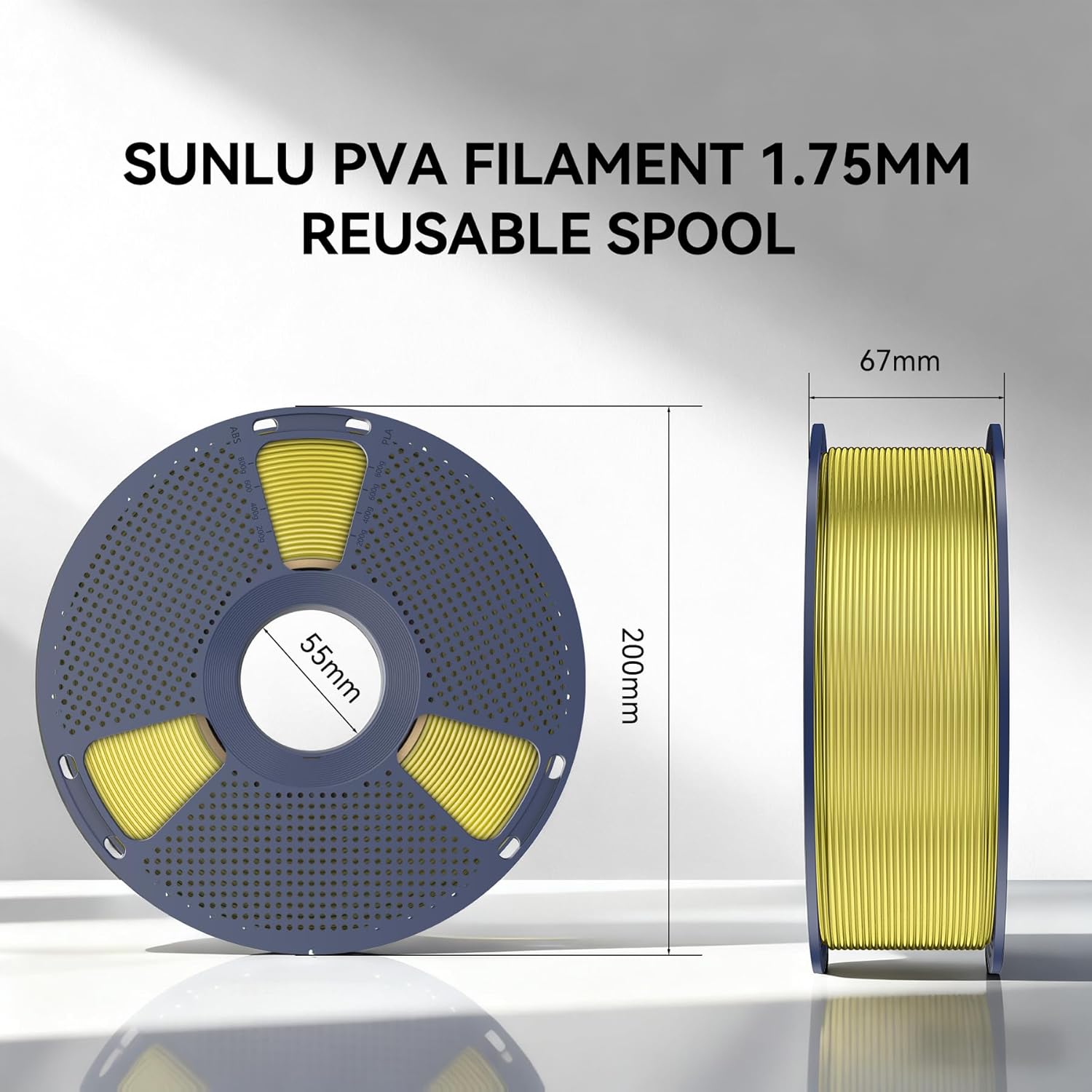
Image: A diagram illustrating the dimensions of the SUNLU PVA filament spool, including its diameter, hub diameter, and width.


