
1. Introduction
Welcome to the Dyness 12V 100Ah LiFePO4 Deep Cycle Battery user manual. This document provides essential information for the safe and efficient use of your battery. It is designed for various applications including RVs, marine systems, off-grid solar installations, and backup power. Please read this manual thoroughly before installation and operation.
2. Safety Information
WARNING: Failure to follow these safety instructions may result in serious injury, property damage, or death.
- Always wear appropriate personal protective equipment (PPE), including eye protection and insulated gloves, when handling batteries.
- Do not short-circuit the battery terminals. This can cause severe arcing, fire, or explosion.
- Keep the battery away from heat sources, open flames, and flammable materials.
- Do not disassemble, puncture, drop, or damage the battery. Internal components are hazardous.
- Ensure proper ventilation during charging and operation to prevent heat buildup.
- Use only compatible chargers specifically designed for LiFePO4 batteries (e.g., a 14.6V 20A lithium-ion charger). Using an incompatible charger can damage the battery or cause a fire.
- Avoid charging or discharging the battery outside the specified temperature ranges. The integrated BMS will provide protection, but external conditions should be monitored.
- In case of fire, use a Class D fire extinguisher. Water can exacerbate lithium fires.
- Keep out of reach of children and pets.
- Do not connect the battery to a load or charger if it shows signs of damage, swelling, or leakage.
3. Product Overview
The Dyness 12V 100Ah LiFePO4 Deep Cycle Battery is a high-performance energy storage solution. It features Grade A+ lithium iron phosphate cells, offering a long cycle life and stable voltage output for reliable power.
Key Features:
- Advanced 100A BMS: An integrated Battery Management System provides comprehensive protection against overcharge, over-discharge, over-current, short-circuit, and extreme temperatures.
- Low Temperature Protection: Charging automatically stops below 0°C (32°F), and discharging stops below -20°C (-4°F) to ensure safety and prolong battery life.
- Extended Cycle Life: Designed for over 4,000 deep charge-discharge cycles, with minimal capacity loss, and up to 15,000 cycles under specific conditions.
- Low Self-Discharge Rate: Approximately 1-2% per month, significantly lower than lead-acid batteries, allowing for easier storage.
- Scalable Design: Up to 16 battery modules can be connected (4 in series x 4 in parallel) to achieve a maximum system capacity of 51.2V and 400Ah (20,480 Wh).
- Lightweight: Weighs only 9.9 kg, approximately one-third the weight of comparable lead-acid batteries.

Image: Internal structure highlighting Grade A+ cells and the impressive 4000+ cycle life.
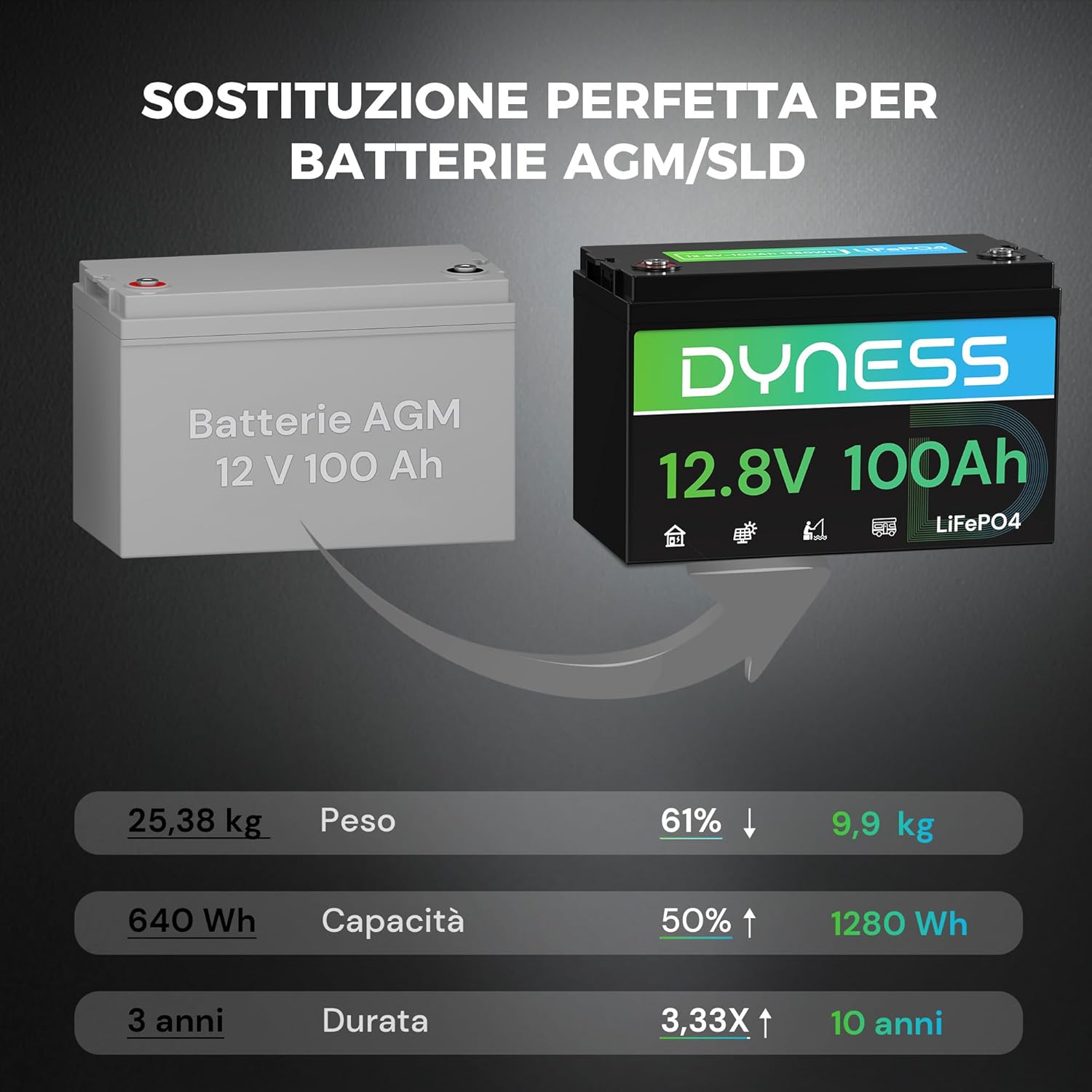
Image: Comparison of Dyness LiFePO4 battery with traditional AGM/SLA batteries, showing benefits in weight, capacity, and lifespan.
4. Setup
4.1 Unpacking and Inspection
Carefully remove the battery from its packaging. Inspect the battery for any signs of physical damage, such as cracks, dents, or swelling. If any damage is observed, do not proceed with installation and contact customer support immediately.
4.2 Initial Charge
It is recommended to fully charge the battery before its first use to ensure optimal performance and calibration of the Battery Management System (BMS).
4.3 Connection
Ensure all connections are secure and properly tightened to prevent resistance and potential hazards.
- Connect the positive (+) terminal of the battery to the positive (+) terminal of your load/charger.
- Connect the negative (-) terminal of the battery to the negative (-) terminal of your load/charger.
For Multiple Batteries:
- Parallel Connection: To increase total capacity (Ampere-hours) while maintaining the nominal voltage (12.8V), connect positive terminals together and negative terminals together.
- Series Connection: To increase total voltage, connect the positive terminal of one battery to the negative terminal of the next battery.
The Dyness 12V 100Ah battery supports connecting up to 16 modules (4 in series x 4 in parallel) for a maximum system of 51.2V 400Ah (20,480 Wh).
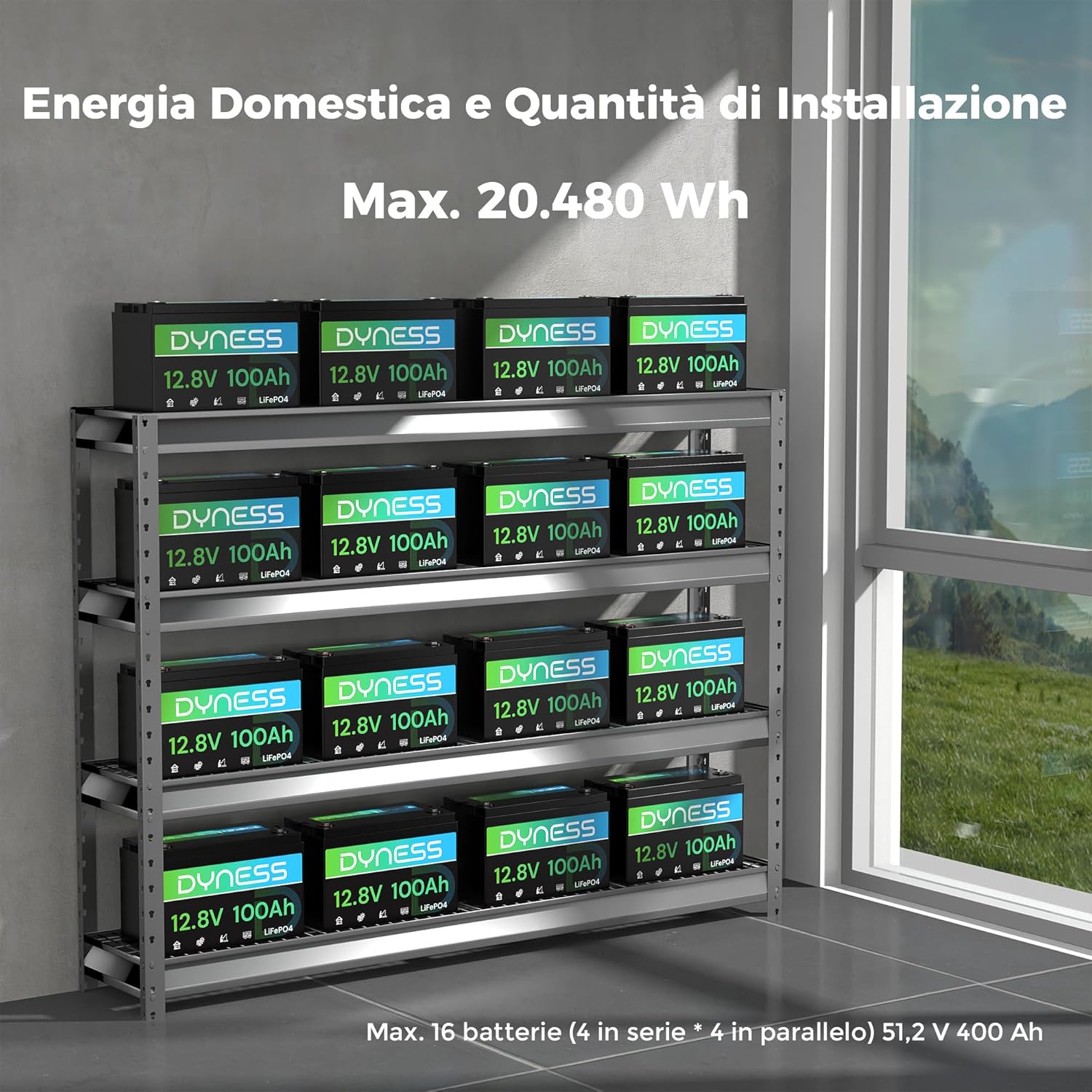
Image: Illustration of connecting multiple batteries for scalable energy storage, up to 16 modules.
4.4 Recommended Charger
Use a 14.6V 20A lithium-ion charger or connect to solar panels/generators with a rated power of ≥400W for optimal charging performance.
5. Operating Instructions
5.1 Normal Operation
The battery is designed for deep cycle applications, providing stable power output for extended periods. Monitor your system's voltage and current to ensure it operates within the battery's specifications.
5.2 Temperature Considerations
The integrated BMS actively protects the battery from extreme temperatures:
- Charging Cut-off: Charging will automatically cease if the battery temperature drops below 0°C (32°F).
- Discharging Cut-off: Discharging will automatically cease if the battery temperature drops below -20°C (-4°F).
- Charging Resumption: Charging resumes when the temperature rises above 5°C (41°F).
These features ensure the battery's longevity and safe operation in various climates.

Image: Explanation of the low temperature shutdown feature, detailing charging and discharging cut-off temperatures.
5.3 Applications
This battery is ideal for a wide range of applications:
- RVs and Campers
- Marine and Boat Systems
- Off-grid Solar Systems
- Photovoltaic Energy Storage
- Backup Power Systems
Note: This battery is not suitable for automotive starting applications or vehicles requiring start-stop functionality.

Image: Dyness battery being used as an emergency power source for an RV.
6. Maintenance
6.1 Regular Inspection
Periodically inspect the battery terminals for any signs of corrosion or loose connections. Ensure all connections are tight and clean.
6.2 Cleaning
Keep the battery clean and dry. Use a damp cloth to wipe the exterior. Do not use solvents or abrasive cleaners, as these can damage the battery casing.
6.3 Storage
If storing the battery for an extended period (more than one month), ensure it is charged to approximately 50-70% of its capacity. Store the battery in a cool, dry place, away from direct sunlight, moisture, and extreme temperatures. The low self-discharge rate of LiFePO4 batteries minimizes capacity loss during storage, but periodic checks are recommended.
7. Troubleshooting
This section provides solutions to common issues you might encounter. If the problem persists, please contact customer support.
7.1 Battery Not Charging
- Check Connections: Ensure all charging cables are securely connected to both the battery and the charger.
- Verify Charger Compatibility: Confirm that your charger is specifically designed for LiFePO4 batteries and is functioning correctly.
- Temperature Check: Ensure the ambient temperature is above 0°C (32°F). The BMS will prevent charging below this temperature.
7.2 Battery Not Discharging / No Power Output
- Check Connections: Verify all load connections are secure and correct.
- Load Compatibility: Ensure the connected load is within the battery's specified current and power limits.
- Temperature Check: Ensure the ambient temperature is above -20°C (-4°F). The BMS will prevent discharging below this temperature.
- BMS Protection: The BMS may have activated a protection mode (e.g., over-discharge, short-circuit, over-current). Disconnect the load, wait a few minutes, and try reconnecting. If the issue persists, contact support.
7.3 Unusual Odor or Swelling
Immediately disconnect the battery from all loads and chargers. Do not attempt to use or charge the battery. Contact Dyness customer support without delay.
8. Specifications

Image: Detailed dimensions of the Dyness 12.8V 100Ah LiFePO4 battery.
| Specification | Value |
|---|---|
| Brand | Dyness |
| Model | 12V 100Ah LiFePO4 |
| Nominal Voltage | 12.8 Volts |
| Capacity | 100 Ampere-hours (Ah) |
| Battery Chemistry | Lithium Iron Phosphate (LiFePO4) |
| Integrated BMS | 100A |
| Cycle Life | Up to 15,000 cycles (4,000 cycles at 100% DoD) |
| Low Temperature Charge Cut-off | 0°C (32°F) |
| Low Temperature Discharge Cut-off | -20°C (-4°F) |
| Dimensions (L x W x H) | 33 x 17.2 x 21.4 cm (13 x 6.77 x 8.43 inches) |
| Weight | 9.9 kg |
| Max. Series Connection | 4 batteries |
| Max. Parallel Connection | 4 batteries (up to 16 total modules in 4S4P) |
| Certifications | CE/UN38.3 |
9. Warranty and Support
9.1 Warranty
The Dyness 12V 100Ah LiFePO4 Deep Cycle Battery comes with a 5-year warranty from the date of purchase. This warranty covers defects in materials and workmanship under normal use and service conditions. Please retain your proof of purchase for warranty claims.
9.2 Customer Support
For technical assistance, warranty claims, or any questions regarding your Dyness battery, please contact Dyness customer support. Dyness offers 24/7 customer assistance for immediate support. Refer to the official Dyness website or your purchase documentation for the most current contact details.


