
1. Introduction
The SMSL AS400 is a versatile audio device combining a Digital-to-Analog Converter (DAC), a headphone amplifier (HPA), and a power amplifier (AMP) into a single unit. Designed for high-fidelity audio reproduction, it supports various input sources and offers powerful output for both speakers and headphones. This manual provides detailed instructions for the proper setup, operation, and maintenance of your AS400 unit.

Figure 1.1: The SMSL AS400 functions as a DAC, Headphone Amplifier, and Power Amplifier.
2. Safety Information
- Power Supply: Use only the provided power adapter. Ensure the voltage matches your local power supply specifications.
- Ventilation: Do not block ventilation openings. Ensure adequate airflow around the unit to prevent overheating.
- Moisture: Keep the unit away from water, moisture, and high humidity environments.
- Cleaning: Disconnect power before cleaning. Use a dry, soft cloth. Do not use liquid or aerosol cleaners.
- Servicing: Do not attempt to service this product yourself. Refer all servicing to qualified service personnel.
- Placement: Place the unit on a stable, level surface. Avoid placing it near heat sources or in direct sunlight.
3. Package Contents
Please check that all items are present in the package:
- SMSL AS400 Unit
- Remote Control (RC-8A)
- Power Cable
- USB Cable
- Bluetooth Antenna
- User Manual (this document)
4. Product Overview
4.1 Front Panel

Figure 4.1: Front Panel of the SMSL AS400 and included remote control.

Figure 4.2: Front Panel Component Identification.
- Display Screen: Shows current input, sample rate, volume, and menu options.
- Remote Window: Infrared receiver for the remote control.
- Function Knob:
- Press: Enter menu / OK
- Hold: Exit menu
- Rotate: Change value / Volume control
- 4.4mm Headphone Jack: Balanced headphone output.
- 6.35mm Headphone Output: Unbalanced headphone output.
4.2 Rear Panel

Figure 4.3: Rear Panel Component Identification.
- Grounding Terminal: For connecting a turntable ground wire.
- PHONO Input: RCA inputs for turntables with MM cartridges.
- LINE Input (AUX): RCA analog input for external audio sources.
- Coaxial Input: Digital audio input.
- SW Out (Preamp): Subwoofer pre-out.
- USB Input (PRE): USB-B input for connecting to a computer or other digital source.
- Optical Input: Digital audio input.
- HDMI (ARC) Input: Audio Return Channel for connecting to a TV.
- Bluetooth Antenna: For wireless Bluetooth connectivity.
- Left/Right Channel Output: Speaker terminals for passive speakers.
- AC Power Input: Connect the power cable here.
4.3 Remote Control (RC-8A)
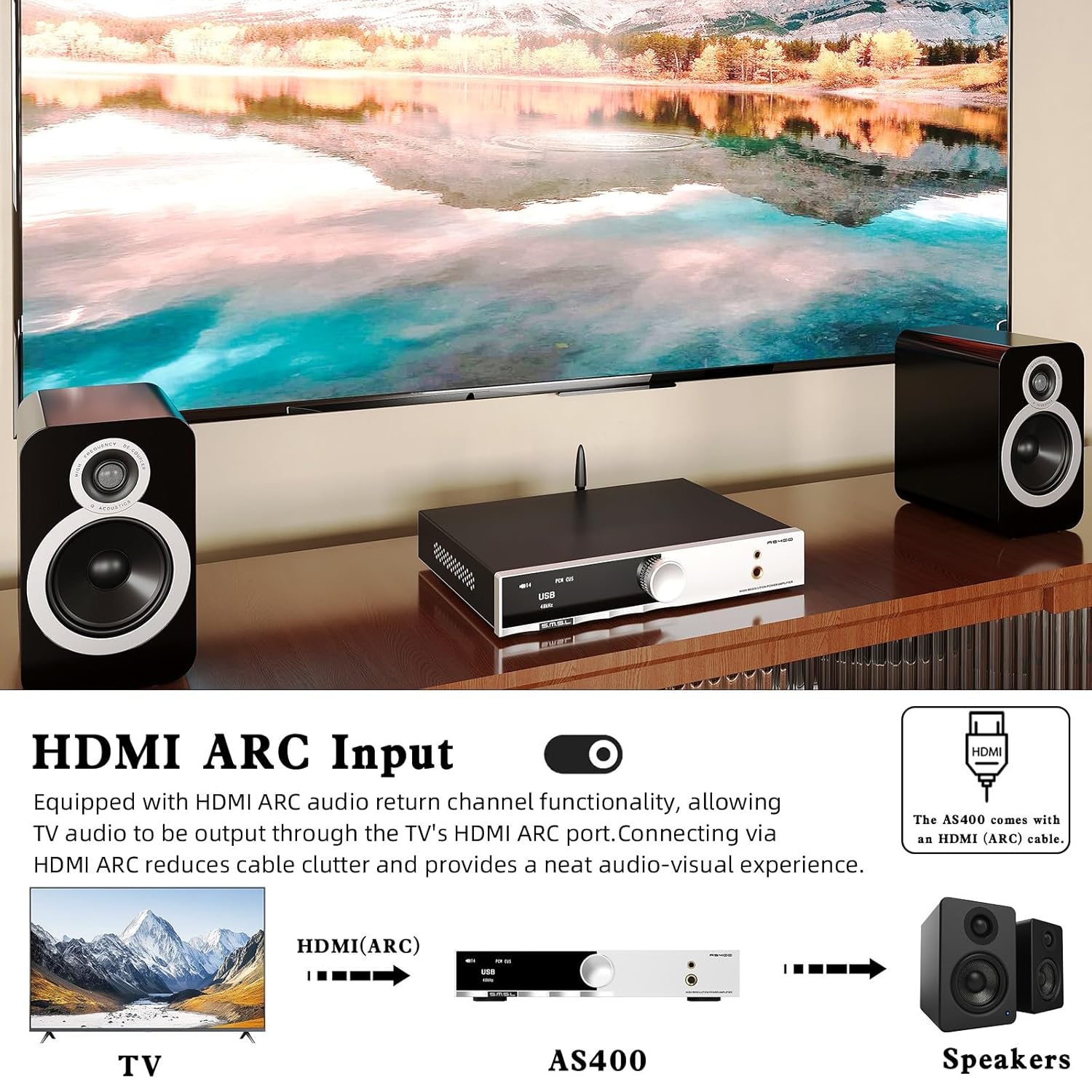
Figure 4.4: Remote Control Functions.
- Power ON/OFF: Turns the unit on or off.
- Up/Down: Navigate menu options or adjust settings.
- MENU/OK: Enters the main menu or confirms a selection.
- FN (Function): Enters the secondary interface for additional settings.
- Input Select: Cycles through available input sources.
- Mute: Mutes or unmutes the audio output.
- Output Switching: Switches between speaker and headphone outputs.
- Volume +/-: Adjusts the output volume.
5. Setup
5.1 Connecting Speakers
- Ensure the AS400 is powered off.
- Connect your passive speakers to the Left and Right Channel Output terminals on the rear panel. Ensure correct polarity (+ to + and - to -).
- If using a powered subwoofer, connect it to the SW Out (Preamp) port using an RCA cable.
5.2 Connecting Audio Sources
The AS400 supports multiple input types:
- USB: Connect a computer or other USB audio source to the USB Input (PRE) port using the provided USB cable.
- Optical/Coaxial: Connect digital audio sources (e.g., CD player, game console) to the Optical or Coaxial Input ports.
- RCA (LINE): Connect analog audio sources (e.g., media player) to the LINE Input (AUX) ports.
- PHONO: Connect a turntable with an MM cartridge to the PHONO Input ports. Ensure the turntable's ground wire is connected to the Grounding Terminal on the AS400.
- HDMI (ARC): Connect your TV's HDMI ARC port to the AS400's HDMI (ARC) Input for TV audio output.
- Bluetooth: Screw the Bluetooth antenna onto its designated port for wireless connectivity.

Figure 5.1: HDMI ARC and Bluetooth Connectivity.
5.3 Power Connection
- Connect the power cable to the AC Power Input on the rear panel of the AS400.
- Plug the other end of the power cable into a suitable wall outlet.
6. Operating Instructions
6.1 Power On/Off
Press the Power ON/OFF button on the remote control or the function knob to turn the unit on or off.
6.2 Input Selection
Use the 'Input Select' button on the remote or rotate the function knob to cycle through available inputs (USB, Optical, Coaxial, RCA, PHONO, HDMI ARC, Bluetooth).
6.3 Volume Control
Adjust the volume using the 'Volume +/-' buttons on the remote or by rotating the function knob.
6.4 Menu Navigation and Settings
Press the function knob or the 'MENU/OK' button on the remote to enter the main menu. Use the 'Up/Down' buttons or rotate the knob to navigate. Press 'MENU/OK' to select an option. Hold the function knob or press the 'FN' button to exit the menu.
Key menu options include:
- Input: Selects the active audio input.
- Output: Switches between speaker and headphone outputs.
- EQ: Select from 8 preset EQ modes (Direct, Bass, Rock, etc.) to tailor sound.
- Bass/Treble: Adjust bass and treble levels for personalized sound.
- Filter: Select from 5 PCM digital filters.
- Color: Change the display screen color.
- BT Clear: Clears paired Bluetooth devices.

Figure 6.1: Setup Menu and Sound Customization Options.
6.5 Bluetooth Pairing
- Ensure the Bluetooth antenna is connected.
- Select 'Bluetooth' as the input source on the AS400.
- On your mobile device, search for Bluetooth devices and select 'SMSL AS400'.
- Once paired, audio from your device will stream to the AS400.
- To clear paired devices, navigate to 'BT Clear' in the menu.
6.6 MQA/MQA-CD Playback
The AS400 supports MQA and MQA-CD decoding. When playing MQA content via USB, Optical, or Coaxial inputs, the display will indicate MQA status, ensuring studio-quality audio reproduction.
7. Maintenance
- Cleaning: Use a soft, dry cloth to wipe the exterior of the unit. Avoid abrasive cleaners or solvents.
- Dust: Regularly dust the unit, especially around ventilation areas, to prevent dust buildup.
- Connections: Periodically check all cable connections to ensure they are secure.
- Storage: If storing the unit for an extended period, disconnect it from power and store it in a cool, dry place.
8. Troubleshooting
If you encounter issues with your AS400, please refer to the following common problems and solutions:
| Problem | Possible Cause | Solution |
|---|---|---|
| No power | Power cable disconnected; power outlet faulty. | Check power cable connection; try a different outlet. |
| No sound output | Incorrect input selected; volume too low; speakers/headphones not connected; output mode incorrect. | Verify input source; increase volume; check speaker/headphone connections; ensure correct output mode (speaker/headphone) is selected in the menu. |
| Bluetooth connection unstable | Antenna not connected; interference; device too far. | Ensure Bluetooth antenna is securely attached; move device closer to AS400; clear paired devices via 'BT Clear' in menu and re-pair. |
| Subwoofer output is weak or not triggering. | Subwoofer sensitivity setting; AS400 subwoofer output level. | Adjust the gain/volume setting on your powered subwoofer. Ensure the subwoofer is powered on. Note that the AS400's subwoofer output is a pre-out and its level is tied to the main volume. |
| Distorted sound | Input signal too high; faulty cable; speaker impedance mismatch. | Reduce input source volume; check/replace cables; ensure speaker impedance is within AS400's supported range. |
If the problem persists after attempting these solutions, please contact customer support.
9. Specifications

Figure 9.1: Detailed Product Specifications.
| Feature | Specification |
|---|---|
| Inputs | RCA / BT / USB / Optical / Coaxial / Phono / I²S / HDMI (ARC) |
| THD+N | 0.003% |
| Output Power (RMS) | 165W x2 (4Ω), 85W x2 (8Ω) |
| Input Sensitivity/Impedance | 280mV/22kΩ |
| Dimensions (WxHxD) | 210.4 x 46 x 254 mm |
| Weight | 1.57 kg (3.46 lbs) |
| USB Compatibility | Windows 7 / 8 / 8.1 / 10 / 11, Mac OSX, Linux |
| Bit Depth | USB: 1bit, 16-32bit; Optical/Coaxial: 1bit, 16-32bit |
| SNR | 107dB |
| Channel Separation | 98dB |
| USB Transmission | Asynchronous Transfer |
| Power Consumption | 40W (Normal Volume) |
| MQA Decoder | USB / Optical / Coaxial |
| MQA-CD Decoder | Optical / Coaxial |
| Sampling Rate (USB) | PCM: 44.1-768kHz; DSD: 2.8224-11.2896MHz |
| Sampling Rate (Optical/Coaxial) | PCM: 44.1-192kHz; DSD: DSD64 (DoP) |
10. Warranty and Support
The SMSL AS400 comes with a standard manufacturer's warranty. Please refer to the warranty card included in your package for specific terms and conditions, including warranty period and coverage.
For technical support, troubleshooting assistance beyond this manual, or warranty claims, please contact your authorized SMSL dealer or visit the official SMSL website for contact information.
Please retain your proof of purchase for warranty purposes.


