
1. Introduction
This manual provides detailed instructions for the setup, operation, and maintenance of your KCEVE KVM Switch. This device allows you to control up to three computers (two laptops and one desktop) using a single set of keyboard, mouse, and two HDMI monitors. It supports high-resolution video output up to 4K@60Hz and features USB 3.0 ports for high-speed data transfer.
2. Package Contents
Please verify that all items listed below are included in your package:
- 1 x KCEVE KVM Switch (Model KC-302HX-CA)
- 2 x USB-C Cables
- 2 x HDMI Cables
- 1 x USB 3.0 Cable
- 1 x Wired Remote Control (1.5m)
- 1 x DC 12V Power Adapter
- 1 x User Manual

Image: All components included in the KCEVE KVM Switch package, neatly arranged.
3. Product Overview
The KVM switch is designed for efficient multi-computer management, allowing seamless switching between devices while sharing peripherals and dual monitors.
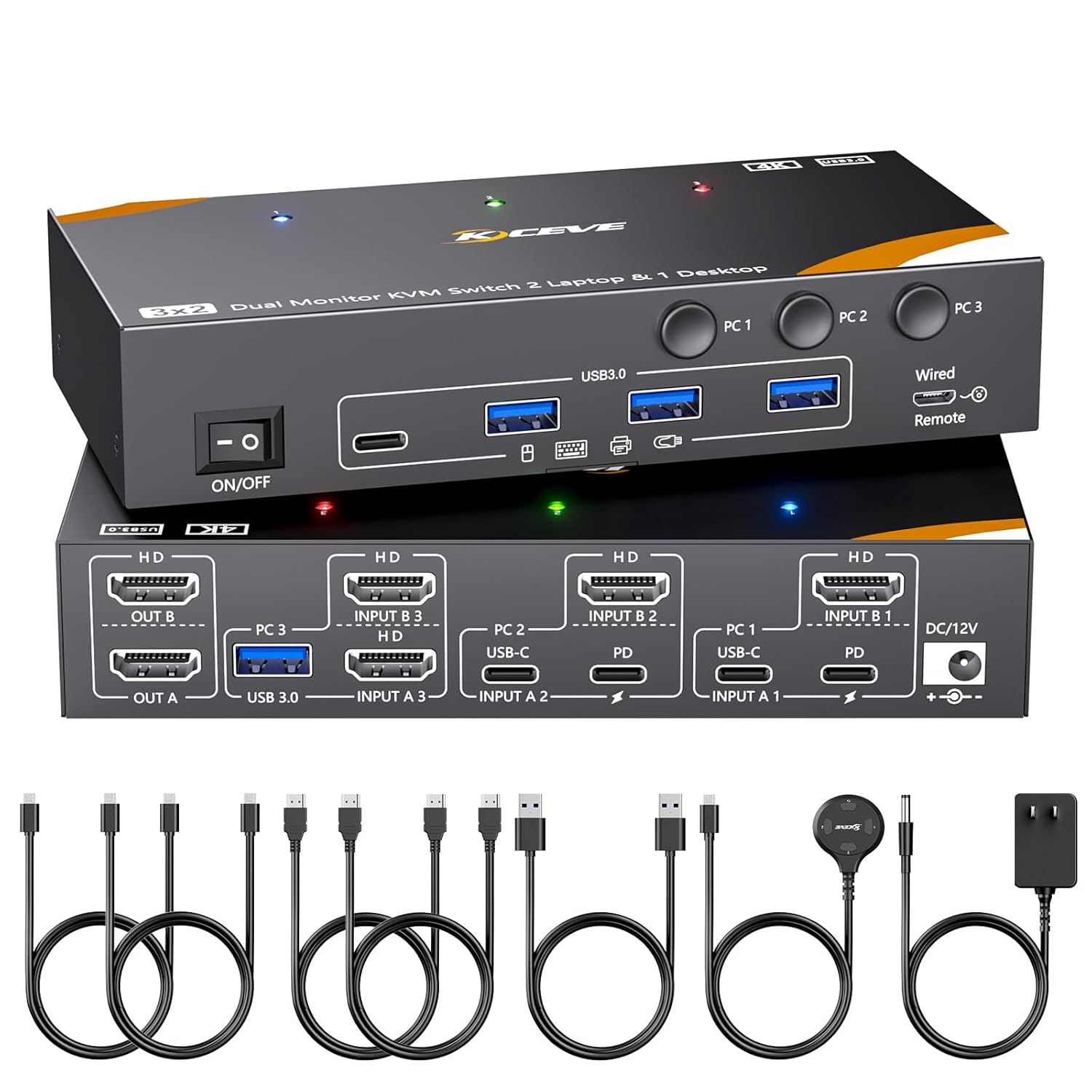
Image: Front and rear view of the KCEVE KVM Switch unit, showing all connection ports and buttons.
Front Panel Ports:
- ON/OFF Switch: Power control for the KVM switch.
- USB 3.0 Ports (x4): For connecting USB peripherals like keyboard, mouse, printer, USB drives, etc.
- PC1, PC2, PC3 Buttons: Manual selection buttons for switching between connected computers.
- Wired Remote Port: For connecting the external wired remote control.
Rear Panel Ports:
- DC 12V: Power input port.
- PC1 (USB-C + HDMI): Input for Laptop 1 (USB-C for data/video/PD, HDMI for video).
- PC2 (USB-C + HDMI): Input for Laptop 2 (USB-C for data/video/PD, HDMI for video).
- PC3 (USB 3.0 + HDMI x2): Input for Desktop (USB 3.0 for data, two HDMI for dual video output).
- OUT A / OUT B (HDMI): Output ports for connecting two HDMI monitors.
4. Setup Instructions
Follow these steps to correctly set up your KCEVE KVM Switch:
4.1 Connecting Computers
Ensure all devices are powered off before making connections.
- For Desktop (PC3): Connect two HDMI cables from your desktop's graphics card to the 'INPUT A 3' and 'INPUT B 3' HDMI ports on the KVM switch. Connect one USB 3.0 cable from your desktop's USB port to the 'USB 3.0 INPUT A 3' port on the KVM switch.
- For Laptops (PC1 & PC2): For each laptop, connect one HDMI cable from the laptop's HDMI output to the corresponding 'INPUT A' and 'INPUT B' HDMI ports (e.g., 'INPUT A 1' and 'INPUT B 1' for PC1). Connect one USB-C cable from the laptop's USB-C port to the corresponding 'USB-C IN' port (e.g., 'USB-C IN 1' for PC1). Ensure your laptop's USB-C port and HDMI can output video simultaneously.

Image: A visual guide illustrating how to connect desktop and laptop computers to the KVM switch using HDMI, USB 3.0, and USB-C cables.
4.2 Connecting Monitors
- Connect an HDMI cable from your first monitor to the 'OUT A' HDMI port on the KVM switch.
- Connect an HDMI cable from your second monitor to the 'OUT B' HDMI port on the KVM switch.
4.3 Connecting Peripherals
- Plug your USB keyboard, mouse, and other USB 3.0 devices (e.g., printer, scanner, webcam) into the USB 3.0 ports on the front panel of the KVM switch.
- If desired, connect the wired remote control to the 'Wired Remote' port on the front panel.

Image: Close-up of the KVM switch's front panel, showing USB 3.0 ports connected to a mouse, keyboard, and USB drive, highlighting 5Gbps data transfer.
4.4 Power Connection
- Connect the DC 12V power adapter to the 'DC 12V' port on the rear panel of the KVM switch.
- Plug the power adapter into a wall outlet.
The KVM switch also provides 85W Power Delivery (PD) for laptops connected via USB-C. For optimal charging, use a 100W PD charger with the KVM switch.

Image: A laptop connected to the KVM switch, illustrating 85W Power Delivery for charging.
5. Operating Instructions
5.1 Switching Between Computers
You can switch between the connected computers using two methods:
- Panel Buttons: Press the 'PC1', 'PC2', or 'PC3' button on the front panel of the KVM switch to select the desired computer. The LED indicator above the button will light up to show the active computer.
- Wired Remote: Use the included 1.5m wired remote control to switch between computers by pressing its button.

Image: Demonstrates switching between computers using both the KVM switch's front panel buttons and the wired remote control.
5.2 Display Modes
The KVM switch supports various display modes for your dual monitors:
- Extended Mode: Displays different content on each monitor, extending your desktop workspace.
- Mirror Mode: Duplicates the content of one monitor onto the other.
You can typically switch between these modes by pressing 'Windows + P' on your keyboard (for Windows OS). Please note that Apple M1/M2 chips only support single-screen output, and MacBook Pro (M3) cannot output images through both USB-C and HDMI ports simultaneously.

Image: Two monitors connected to the KVM switch, illustrating both extended desktop and mirrored display configurations.
6. Specifications
| Feature | Description |
|---|---|
| Model Number | KC-302HX-CA |
| Input Ports | 2 x USB-C (for Laptops), 1 x USB 3.0 (for Desktop), 4 x HDMI (2 for Laptops, 2 for Desktop) |
| Output Ports | 2 x HDMI (OUT A, OUT B), 4 x USB 3.0 |
| Video Resolution | Up to 4K@60Hz, 4K@30Hz, 2K@144Hz, 1080P@144Hz (backward compatible) |
| USB Data Transfer | Up to 5Gbps (USB 3.0) |
| Power Delivery (PD) | 85W for USB-C connected laptops (requires 100W PD charger for KVM) |
| Switching Methods | Panel Button, Wired Remote |
| Material | Metal Shell |
| Dimensions | 15.24 x 5.08 x 2.54 cm |
| Operating Voltage | 12 Volts |

Image: Visual representation of 4K@60Hz and 2K@144Hz resolution support.
7. Troubleshooting
If you encounter issues, please refer to the following common problems and solutions:
- No Display on Monitors:
- Ensure all HDMI and USB-C/USB 3.0 cables are securely connected to both the KVM switch and your computers/monitors.
- Verify the KVM switch is powered on and the correct computer input is selected.
- Check if your laptop's USB-C port and HDMI output can function simultaneously for video.
- Try restarting the KVM switch and connected computers.
- Keyboard/Mouse Not Responding:
- Ensure the USB cables from the computers to the KVM switch are properly connected.
- Try plugging the keyboard/mouse into different USB 3.0 ports on the KVM switch.
- Some specialized keyboards/mice may require direct connection to the computer or specific drivers.
- Intermittent Connection/Flickering Screen:
- Use high-quality HDMI and USB cables. Longer cables may require active extenders.
- Ensure the KVM switch is receiving adequate power from the DC 12V adapter.
- Check for updated graphics drivers on your computers.
- Laptop Not Charging via USB-C PD:
- Verify that your USB-C cable supports Power Delivery.
- Ensure the KVM switch is powered by the DC 12V adapter and that you are using a 100W PD charger for the KVM switch itself.
8. Maintenance
To ensure the longevity and optimal performance of your KCEVE KVM Switch, please follow these maintenance guidelines:
- Cleaning: Use a soft, dry cloth to clean the exterior of the device. Avoid using liquid cleaners or aerosols, as they may damage the unit.
- Ventilation: Ensure the KVM switch is placed in a well-ventilated area to prevent overheating. Do not block any ventilation openings.
- Cable Management: Keep cables organized and untangled to prevent damage and ensure stable connections.
- Storage: When not in use for extended periods, store the device in a cool, dry place away from direct sunlight and extreme temperatures.
9. Warranty and Support
KCEVE provides 12 months of after-sales service and lifetime technical support for your KVM switch. If you have any questions or require assistance, please do not hesitate to contact our customer support team.
Contact Information: Please refer to the contact details provided on the product packaging or the official KCEVE website for the most up-to-date support information.


