
1. Safety Information
Important Safety Instructions: Read and understand all instructions before operating this equipment. Failure to follow these instructions may result in serious injury or death.
- Always operate the lift on a flat, level, and solid surface. Any slope greater than 4° is unsafe and can lead to instability.
- Ensure the vehicle is properly centered and balanced on the lift pads before raising.
- Do not exceed the maximum load capacity of 5000 lbs (2300 kg).
- Always engage all available locking levers once the desired height is reached to prevent accidental lowering.
- Keep hands and feet clear of moving parts during operation.
- Wear appropriate personal protective equipment (PPE) such as safety glasses and gloves.
- Never work under a vehicle supported only by the hydraulic system. Always use the mechanical safety locks.
- Ensure adequate lighting in the work area.
- Keep children and unauthorized personnel away from the lift during operation.
- Use only hydraulic oil No. 46 for optimal performance and to prevent damage.
2. Product Overview
The Jocisland Portable Car Lift is designed for safe and efficient vehicle maintenance in home garages and professional shops. It features a robust scissor lift structure, adjustable height settings, and a 5000 lb lifting capacity.
Key Features:
- 5000 lb (2300 kg) Load Capacity: Supports most standard sedans and compact cars.
- 26-inch Maximum Lifting Height: Provides ample clearance for under-vehicle access.
- Adjustable Height Settings: 4 height increments (75, 75, 100 mm) and 4 adjustable height settings (170-260 mm) with 2 extension panels for versatility.
- Durable Construction: Made from high-strength Q235B steel for stability and longevity.
- Portability: Equipped with 4 wheels for easy movement and a foldable design for compact storage.
- Mechanical Safety Fixing: Multiple locking levers ensure secure operation at desired heights.
- Upgraded Spring Design: Allows for faster height recovery.
3. Package Contents
Verify that all components are present and undamaged upon receipt. If any parts are missing or damaged, contact customer support immediately.
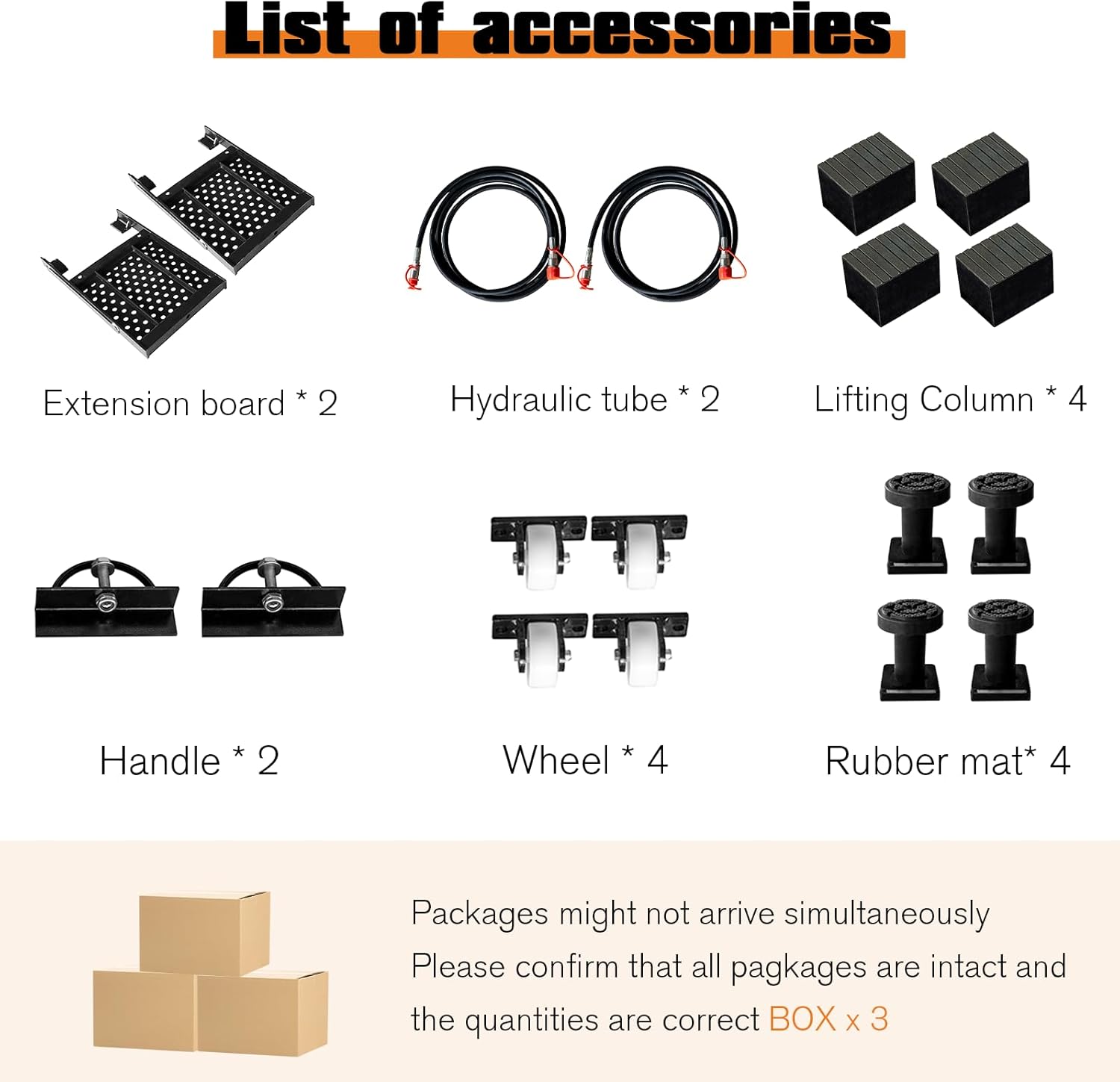
Image 3.1: Components included with the Jocisland Portable Car Lift. This image displays two extension boards, two hydraulic tubes, four lifting columns, two handles, four wheels, and four rubber mats. It also notes that packages might arrive separately and to confirm quantities.
- Main Lift Unit (2 sections)
- Hydraulic Power Unit (with control box)
- Hydraulic Tubes (2)
- Extension Boards (2)
- Lifting Columns (4)
- Handles (2)
- Wheels (4)
- Rubber Mats (4)
- Instruction Manual (this document)
4. Setup Instructions
Proper setup is crucial for safe operation. Follow these steps carefully.
- Unpacking and Inspection: Carefully remove all components from the packaging. Inspect for any shipping damage. Report any damage to the carrier and supplier immediately.
- Positioning the Lift: Place the two main lift sections on a flat, level, and solid concrete surface. Ensure there is sufficient clear space around the lift for vehicle access and operation.
- Attaching Wheels (Optional for mobility): If you intend to move the lift frequently, attach the provided wheels to the designated points on the lift frame.
- Connecting Hydraulic Hoses: Connect the hydraulic hoses from the power unit to the lift cylinders. Ensure all connections are tight and secure to prevent leaks. Refer to the diagram below for proper connection points.

Image 4.1: Close-up view of the hydraulic cylinder and connections on the lift, showing the upgraded spring design and mechanical safety fixing points.
- Filling with Hydraulic Oil: The lift does not come pre-filled with hydraulic fluid. Fill the power unit reservoir with hydraulic oil No. 46. Consult the power unit manual for specific filling instructions and capacity.
- Power Connection: Connect the power unit to a suitable 120V / 60Hz power source. Ensure the power supply meets the lift's requirements.
- Initial Test Run: Before placing a vehicle on the lift, perform a test run. Raise and lower the lift a few times to ensure smooth operation and to bleed any air from the hydraulic system. Observe for any leaks or unusual noises.
5. Operating Instructions
Follow these steps for safe and effective operation of your portable car lift.
- Vehicle Positioning: Drive the vehicle onto the lift platforms, ensuring it is centered and the lift pads are positioned under the vehicle's designated lifting points. Use the rubber mats and lifting columns as needed to achieve proper contact and height.

Image 5.1: A white sedan positioned on the Jocisland Portable Car Lift, demonstrating proper vehicle placement for lifting.
- Raising the Vehicle: Using the control box, press the "UP" button to slowly raise the vehicle. Monitor the vehicle's stability as it rises. Stop lifting once the desired working height is achieved. The lift offers a maximum lifting height of 26 inches.
Video 5.1: This video demonstrates the process of positioning a vehicle on the lift and raising it to a working height. It provides a visual guide to the initial lifting operation.

Image 5.2: Diagram illustrating the maximum 26-inch lifting height and adjustable range of the lift pads (170-260mm) and rubber pads (75x75x100mm).
- Engaging Safety Locks: Once the vehicle is at the desired height, engage the mechanical safety locks. This is a critical step to ensure safety. The lift has multiple locking positions. Ensure all locking levers are fully engaged before working under the vehicle.
- Lowering the Vehicle: To lower the vehicle, first slightly raise the lift to disengage the mechanical safety locks. Then, using the control box, press the "DOWN" button to slowly lower the vehicle. A minimum load of approximately 220 lbs (100 kg) is required for the lift to descend smoothly. Ensure the area around and under the vehicle is clear before lowering.
Video 5.2: This video illustrates the method for lowering the car lift, including how to disengage the mechanical safety lock using a tool and the controlled descent of the lift. It also mentions the need for a minimum weight for descent.
- Storing the Lift: When not in use, the lift can be folded for compact storage. Use the integrated wheels and handles for easy mobility.

Image 5.3: The Jocisland Portable Car Lift in its folded position, being moved with its integrated wheels. Insets show a close-up of the wheels and the fixed handle for easy access and hanging.
6. Maintenance
Regular maintenance ensures the longevity and safe operation of your car lift.
- Hydraulic Oil: Check the hydraulic oil level regularly. Refill with hydraulic oil No. 46 as needed. Replace the hydraulic oil annually or as recommended by the power unit manufacturer.
- Inspections: Periodically inspect all moving parts, pins, bolts, and hydraulic hoses for wear, damage, or leaks. Tighten any loose fasteners.
- Cleaning: Keep the lift clean and free of dirt, grease, and debris. This prevents premature wear and ensures smooth operation.
- Lubrication: Lubricate pivot points and other moving parts with appropriate grease as recommended in the power unit manual.
- Storage: Store the lift in a dry, protected area when not in use to prevent corrosion.
Video 6.1: This video addresses common problems and maintenance tips for portable car lifts, including how to replace fittings and valves, emphasizing the importance of proper sealing with raw material belt.
7. Troubleshooting
Refer to this section for solutions to common issues. If problems persist, contact customer support.
| Problem | Possible Cause | Solution |
|---|---|---|
| Lift does not raise. | No power to the hydraulic unit; Low hydraulic oil level; Air in the hydraulic system; Faulty motor/pump. | Check power connection and circuit breaker; Fill hydraulic oil to correct level; Bleed air from the system (operate lift up/down several times); Contact customer support. |
| Lift lowers slowly or unevenly. | Air in the hydraulic system; Obstruction; Leaking hydraulic fluid; Insufficient load for descent (minimum 220 lbs required). | Bleed air from the system; Check for obstructions; Inspect for leaks and tighten connections; Ensure minimum load is met. |
| Lift makes unusual noises. | Low hydraulic oil; Air in the system; Worn pump/motor components. | Check and fill hydraulic oil; Bleed air from the system; Contact customer support for inspection. |
| Mechanical safety locks do not engage/disengage. | Obstruction; Misalignment; Damaged locking mechanism. | Check for debris; Ensure lift is level; Inspect locking components for damage; Contact customer support. |
8. Specifications
Detailed technical specifications for the Jocisland Portable Car Lift.

Image 8.1: Detailed product dimensions and key specifications including voltage, material, color, net weight, and overall product size.
| Specification | Value |
|---|---|
| Model Number | JSJ111 |
| Load Capacity | 5000 lbs (2300 kg) |
| Maximum Lifting Height | 26 inches (660 mm) |
| Minimum Height | 5.7 inches (145 mm) |
| Adjustable Height Settings | 170-260 mm (for lifting columns) |
| Material | Q235B Carbon Steel |
| Power Supply | AC 120V / 60Hz |
| Item Weight | 377 lbs (171 kg) |
| Item Dimensions (L x W x H) | 86 x 15 x 26 inches (2184 x 381 x 660 mm) |
| Color | Black |
| Hydraulic Oil Type | No. 46 |
9. Warranty and Support
For warranty information, technical support, or to order replacement parts, please contact Jocisland customer service.
- Customer Service: Refer to your purchase documentation or the official Jocisland website for current contact information.
- Proof of Purchase: Keep your original purchase receipt for warranty claims.
- Model Number: When contacting support, please provide the model number (JSJ111) and a detailed description of the issue.