
1. Product Overview
The eletechsup R4IOI16 is a versatile 16-channel multi-function RS485 IO core board designed for various industrial and home automation applications. It supports Modbus RTU protocol and offers flexible configuration options for digital inputs (DI) and digital outputs (DO). This board can be easily integrated into existing IO expansion board systems via its 2.54mm pin header terminal.
Key features include:
- Configurable IO modes: 16DI, 16DO, 8DI-8DO, 4DI-12DO, 12DI-4DO.
- NPN/PNP input and output level switching.
- Wide power supply range: DC 6-25V (main) or DC 4-5V (secondary).
- Compact size and lightweight design.
2. What's in the Box
Your package should contain the following items:
- 2PCS R4IOI16 RS485 I/O Core Board (Available as 'Only Board' or 'With Pin' versions).

Image: eletechsup R4IOI16 board with pre-soldered pins.
3. Specifications
| Feature | Description |
|---|---|
| Model Number | R4IOI16 |
| Power Supply 1 | DC 6-25V (Anti-reverse protection) |
| Power Supply 2 | DC 4-5V (Reverse connection prohibited) |
| Working Current | 5.6mA |
| MODBUS RTU Function Codes | Write: 05, 06, 15, 16; Read: 01, 02, 03 |
| Configurable IO Modes | 16DI, 16DO, 8DI-8DO, 4DI-12DO, 12DI-4DO |
| Input/Output Levels | NPN/PNP Switchable via registers 0X00F5/0X00F6 |
| Input Mode | Supports 3.3V/5V TTL level input (Low level default, High level option) |
| Output Mode | 5V TTL level (Low level default, High level option) |
| Communication Anomaly Settings | Restart (0X00F3), Close all outputs (0X00F4) |
| Max Devices (MODBUS) | 247 devices in parallel |
| Input Port Status | Query (default) and Automatic Reporting |
| Baud Rates | 1200, 2400, 4800, 9600 (default), 19200, 38400, 57600, 115200 |
| Parity | None, Odd, Even |
| Interface | 2.54MM pin header |
| Dimensions | 51mm x 26mm x 3.8mm |
| Weight | 6 grams |
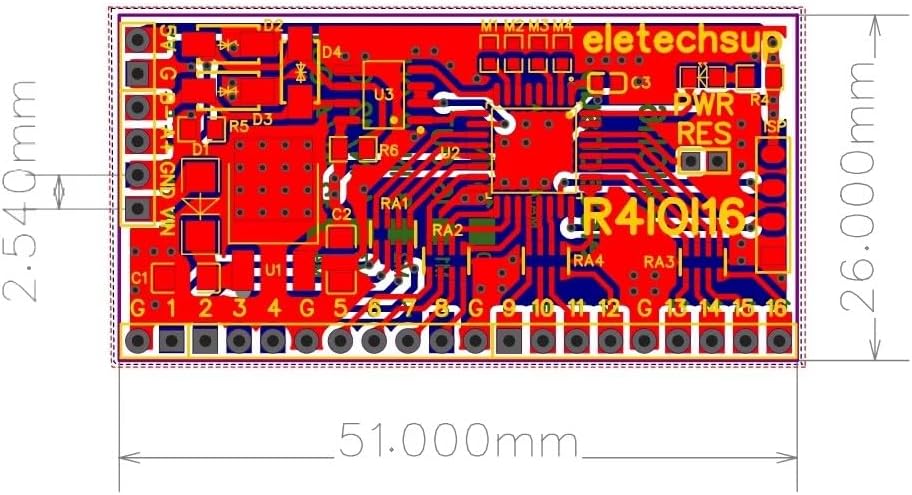
Image: Physical dimensions of the R4IOI16 board.
4. Setup
4.1 Power Supply Connection
The R4IOI16 board supports two power supply options:
- DC 6-25V: Connect to the designated power input terminals. This input includes anti-reverse protection.
- DC 4-5V: An alternative power input. Ensure correct polarity as reverse connection is prohibited.
4.2 Physical Connection
The board features a 2.54mm pin header interface, allowing for easy connection using Dupont wires or integration into a breadboard setup. Ensure all connections are secure before applying power.
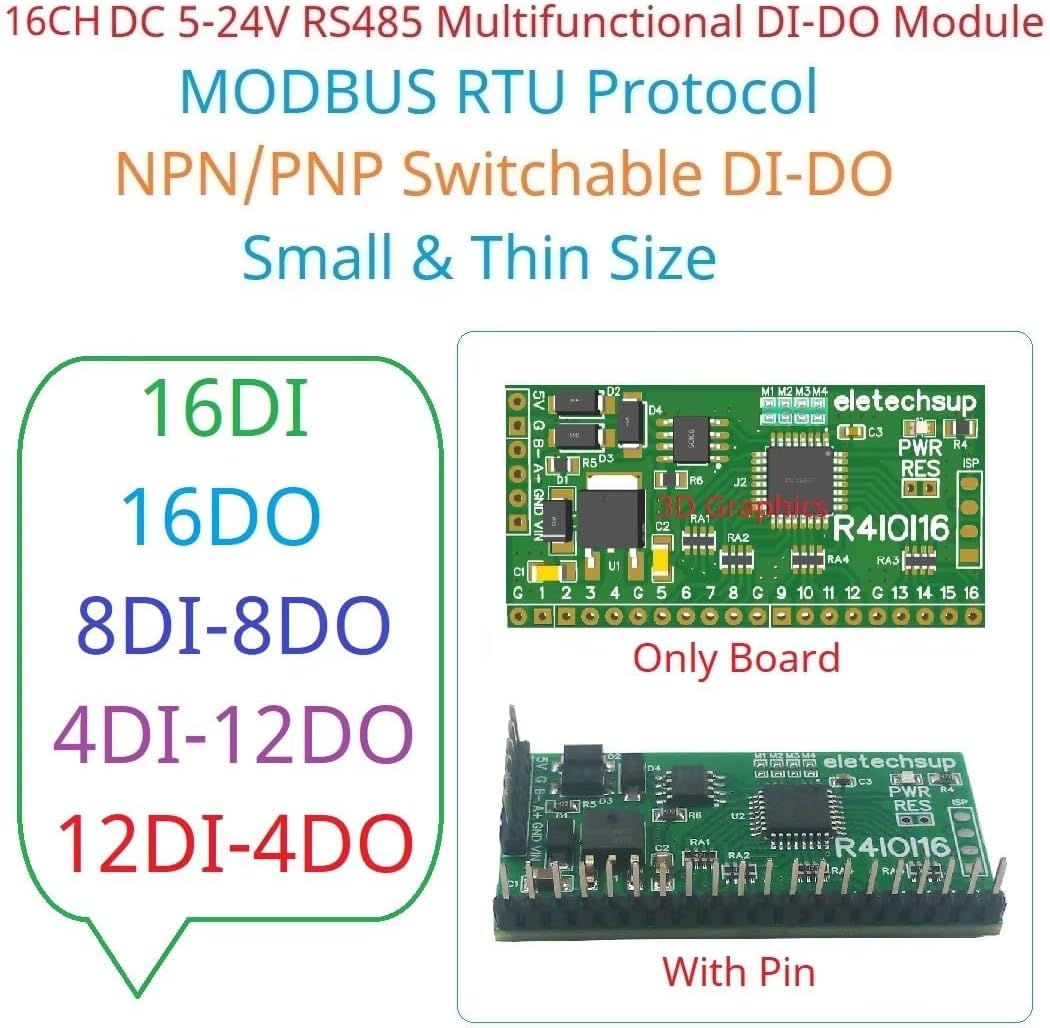
Image: R4IOI16 board showing both 'Only Board' and 'With Pin' versions.
5. Operating Instructions
5.1 MODBUS RTU Communication
The R4IOI16 communicates using the MODBUS RTU protocol. It supports standard function codes for reading and writing data:
- Write Functions: 05 (Write Single Coil), 06 (Write Single Register), 15 (Write Multiple Coils), 16 (Write Multiple Registers).
- Read Functions: 01 (Read Coils), 02 (Read Discrete Inputs), 03 (Read Holding Registers).
The board can support up to 247 devices in parallel on the MODBUS network.
5.2 Baud Rate and Parity Settings
The default baud rate is 9600. Other supported baud rates include 1200, 2400, 4800, 19200, 38400, 57600, and 115200. Parity options are None, Odd, or Even. These settings must match the master device for proper communication.
5.3 Input and Output Levels
- Input Mode: Supports 3.3V/5V TTL level input. The default input mode is low level, with an option for high level input.
- Output Mode: Provides 5V TTL level output. The default output mode is low level, with an option for high level output.
5.4 Input Port Status
The status of input ports can be queried (default behavior) or configured for automatic reporting, depending on your application requirements.
6. Configuration
6.1 IO Mode Selection
The R4IOI16 offers five configurable IO modes, which can be selected using jumpers (0603 0Ω resistor or wire) on the board:
- 16DI: 16 Digital Inputs
- 16DO: 16 Digital Outputs
- 8DI-8DO: 8 Digital Inputs and 8 Digital Outputs
- 4DI-12DO: 4 Digital Inputs and 12 Digital Outputs
- 12DI-4DO: 12 Digital Inputs and 4 Digital Outputs

Image: Visual representation of the five configurable IO modes.
6.2 NPN/PNP Input and Output Level Switching
The input and output levels (NPN/PNP) can be switched by modifying specific registers:
- NPN Input & NPN Output: Register 0X00F5=0, 0X00F6=0 (Default)
- PNP Input & NPN Output: Register 0X00F5=1, 0X00F6=0
- NPN Input & PNP Output: Register 0X00F5=0, 0X00F6=1
- PNP Input & PNP Output: Register 0X00F5=1, 0X00F6=1

Image: Detailed wiring diagrams illustrating NPN and PNP input/output configurations.
6.3 Communication Anomaly Settings
The board provides settings to manage communication anomalies:
- Restart on Anomaly: By setting register 0X00F3, the board can be configured to restart if communication becomes abnormal.
- Close Outputs on Anomaly: By setting register 0X00F4, all output ports can be configured to close when communication is abnormal.
7. Maintenance
To ensure the longevity and reliable operation of your eletechsup R4IOI16 board, follow these general maintenance guidelines:
- Keep Clean: Regularly inspect the board for dust or debris. Use a soft, dry brush or compressed air to gently clean the surface.
- Environmental Conditions: Operate the board within its specified temperature and humidity ranges. Avoid exposure to extreme temperatures, moisture, or corrosive environments.
- Power Off Before Handling: Always disconnect power before making any physical connections, disconnections, or adjustments to the board.
- Inspect Connections: Periodically check all wiring and pin header connections to ensure they are secure and free from damage.
8. Troubleshooting
If you encounter issues with your R4IOI16 board, consider the following troubleshooting steps:
- No Power: Verify that the power supply is connected correctly and providing the specified voltage (DC 6-25V or DC 4-5V). Check for proper polarity, especially with the 4-5V input.
- Communication Failure:
- Ensure the RS485 wiring (A+, B-) is correct and secure.
- Confirm that the baud rate and parity settings on the R4IOI16 match those of your Modbus master device.
- Check the Modbus address of the R4IOI16 and ensure it is unique on the bus.
- Verify that the Modbus commands being sent are correct according to the supported function codes.
- Incorrect IO Behavior:
- Review the jumper settings for the selected IO mode (16DI, 16DO, etc.) to ensure it matches your intended configuration.
- Check the register settings (0X00F5, 0X00F6) for NPN/PNP input/output levels to ensure they are set correctly for your sensors/actuators.
- Verify the input/output signal levels (3.3V/5V TTL) and ensure they are compatible with connected devices.
- Intermittent Operation: Check for loose connections, power supply fluctuations, or electromagnetic interference in the environment.
If problems persist after following these steps, please contact eletechsup customer support for further assistance.
9. Warranty and Support
For warranty information, technical support, or any inquiries regarding your eletechsup R4IOI16 board, please refer to the official eletechsup website or contact their customer service directly. Keep your purchase receipt as proof of purchase for any warranty claims.
You can visit the eletechsup store on Amazon for additional product information and support resources: eletechsup Amazon Store


