
1. Product Overview
The TOPPING B100 is a high-performance mono block power amplifier designed to deliver exceptional audio reproduction. It features advanced circuit technology, ultra-low distortion, and precise power output, making it suitable for demanding audio setups. The B100 is engineered to provide a clean and powerful signal to your speakers, enhancing your listening experience with remarkable clarity and detail.

Figure 1: Front angled view of the TOPPING B100 Mono Block Power Amplifier.

Figure 2: Side angled view of the TOPPING B100, showcasing its compact design.
2. Key Features
- Advanced T'ang-ku-la Module: Incorporates innovative three-stage feedback circuit technology to reduce noise and distortion, achieving a dynamic range of 151 dB. This technology also manages heat effectively, enhancing reliability and extending the product's lifespan.

Figure 3: The T'ang-ku-la Module, a core component for high-fidelity audio.
- Exquisite Audio Reproduction: The B100 captures every musical nuance with a remarkable Signal-to-Noise Ratio (SNR) and Dynamic Noise Ratio (DNR) of 151 dB. It delivers exceptional clarity with an actual noise level of less than 0.3 uVrms at G=L.

Figure 4: The B100's front panel, symbolizing its capability for exquisite audio detail.
- Ultra-Low Distortion for True Sound: Achieves authentic sound reproduction with a Total Harmonic Distortion plus Noise (THD+N) of less than 0.00008%, significantly surpassing industry standards. This ensures high-fidelity audio that preserves every detail.

Figure 5: Visual representation of the B100's ultra-low distortion performance.
- Powerful and Precise Output: Delivers low distortion across a wide power range, with THD under 0.00007% at 4Ω/8Ω 5W. It maintains exceptional accuracy even at high outputs, making it ideal for both 4-ohm and 8-ohm loads. Includes three gain adjustments (H/M/L) for optimal control.

Figure 6: The B100 amplifier providing powerful output to speakers.
- Seamless System Integration: Designed to perfectly complement TOPPING E70 and E70 Velvet DACs for a unified and powerful audio system. These components connect easily via XLR, TRS balanced, or RCA cables.

Figure 7: Example of the B100 integrated with TOPPING E70 Velvet DACs.
- Convenient 12V Trigger Control: The B100 amplifier's 12V Trigger input allows for synchronized power control with other compatible devices. This feature enhances convenience by enabling multiple devices to be turned on or off with a single action.

Figure 8: Rear panel connections illustrating the 12V Trigger input.
3. Setup Guide
3.1 Unpacking and Placement
Carefully remove the B100 amplifier from its packaging. Place the unit on a stable, flat surface with adequate ventilation to prevent overheating. Ensure there is sufficient space around the amplifier for air circulation.
3.2 Connecting Audio Sources
The B100 supports both balanced (XLR) and single-ended (RCA) inputs. Connect your audio source (e.g., DAC, preamplifier) to the corresponding input jacks on the rear panel of the B100.
- For balanced connection, use XLR cables to connect your source's balanced output to the B100's BAL input.
- For single-ended connection, use RCA cables to connect your source's RCA output to the B100's SE input.
3.3 Connecting Speakers
Connect your passive speakers to the output terminals on the rear of the B100. Ensure correct polarity (positive to positive, negative to negative) for each speaker. Since the B100 is a mono block amplifier, you will need two B100 units for a stereo setup (one for the left channel, one for the right channel).
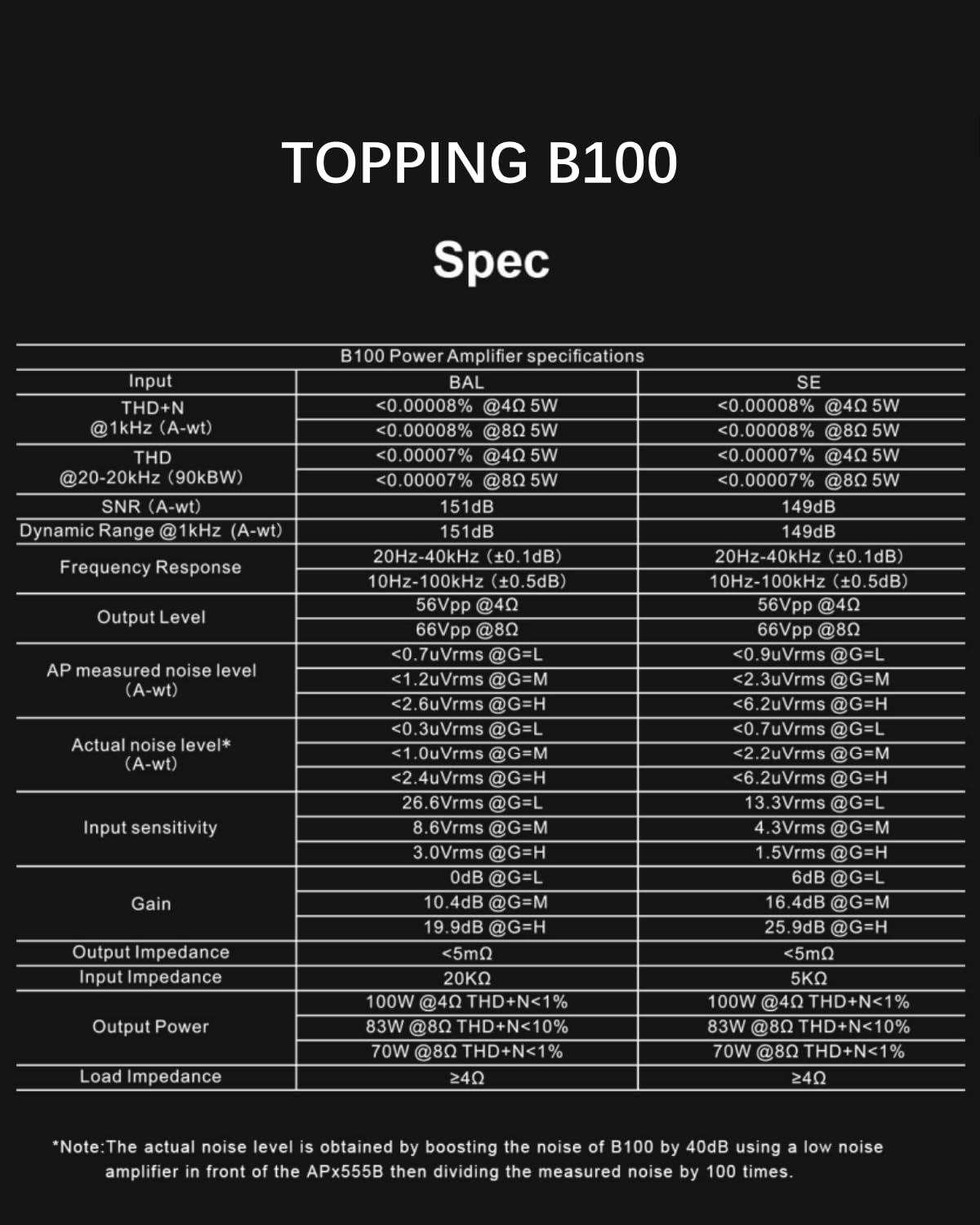
Figure 9: Rear panel connections of the B100 amplifier.

Figure 10: Stereo system connection diagram using two B100 amplifiers.
3.4 Power Connection
Connect the provided power cable to the power input on the rear of the B100, then plug it into a suitable AC power outlet. Ensure the power switch is in the OFF position before connecting to power.
4. Operating Instructions
4.1 Powering On/Off
Press the power button on the front panel to turn the B100 amplifier on or off. The indicator light will illuminate when the unit is powered on.
4.2 Gain Adjustment
The B100 features three gain modes: High (H), Medium (M), and Low (L). These can be adjusted via a switch on the rear panel. Select the gain setting that best matches the output level of your audio source and the sensitivity of your speakers to achieve optimal performance and avoid clipping.
- High (H): For low-output sources or less sensitive speakers.
- Medium (M): A balanced setting for most common setups.
- Low (L): For high-output sources or highly sensitive speakers.
4.3 12V Trigger Function
If you have other audio components with a 12V trigger input/output, you can connect them to the B100's 12V Trigger port. This allows for synchronized power control, where turning on/off one device (e.g., your DAC) can automatically power on/off the connected B100 amplifier(s).
5. Maintenance
- Cleaning: Use a soft, dry cloth to clean the exterior of the amplifier. Avoid using abrasive cleaners, solvents, or chemical sprays, as these can damage the finish.
- Ventilation: Ensure that the ventilation slots on the amplifier are not blocked. Proper airflow is crucial for dissipating heat and maintaining optimal performance and longevity.
- Environment: Keep the amplifier away from direct sunlight, heat sources, excessive dust, moisture, and strong electromagnetic fields.
- Power Off: Always power off and unplug the amplifier from the wall outlet before performing any cleaning or maintenance.
6. Troubleshooting
If you encounter issues with your TOPPING B100 amplifier, refer to the following common troubleshooting steps:
- No Power:
- Check if the power cable is securely connected to both the amplifier and the wall outlet.
- Verify that the wall outlet is functional by plugging in another device.
- Ensure the power button on the front panel is pressed.
- No Sound:
- Confirm that your audio source (DAC, preamplifier) is powered on and functioning correctly.
- Check all audio cables (XLR/RCA) for secure connections between the source and the B100, and between the B100 and your speakers.
- Ensure speaker cables are correctly connected to the B100's output terminals and your speakers, observing polarity.
- Verify that the correct input (BAL or SE) is selected on the B100, if applicable (though the B100 automatically detects input).
- Distorted Sound or Low Volume:
- Check the gain setting on the rear panel of the B100. Adjust it to match your source's output level and speaker sensitivity.
- Ensure the volume level on your audio source or preamplifier is not set too high, which could cause clipping.
- Inspect audio cables for damage or loose connections.
- Hum or Noise:
- Ensure all connections are secure.
- Try moving the amplifier away from other electronic devices that might be causing interference.
- If using single-ended RCA connections, ensure the cables are of good quality and properly shielded. Balanced XLR connections are generally less susceptible to noise.
- Check for ground loops. Try plugging all audio components into the same power strip.
If the issue persists after trying these steps, please contact TOPPING customer support for further assistance.
7. Specifications
The following table provides detailed technical specifications for the TOPPING B100 Mono Block Power Amplifier:
| Parameter | BAL (Balanced Input) | SE (Single-Ended Input) |
|---|---|---|
| Input | BAL | SE |
| THD+N @1kHz (A-wt) | <0.00008% @4Ω 5W | <0.00008% @4Ω 5W |
| THD @20-20kHz (90KBW) | <0.00007% @8Ω 5W | <0.00007% @8Ω 5W |
| SNR (A-wt) | 151dB | 149dB |
| Dynamic Range @1kHz (A-wt) | 151dB | 149dB |
| Frequency Response | 20Hz-40kHz (±0.1dB) | 20Hz-40kHz (±0.1dB) |
| 10Hz-100kHz (±0.5dB) | 10Hz-100kHz (±0.5dB) | |
| Output Level | 56Vpp @4Ω | 56Vpp @4Ω |
| 66Vpp @8Ω | 66Vpp @8Ω | |
| AP measured noise level (A-wt) | <0.7uVrms @G=L | <0.9uVrms @G=L |
| <1.2uVrms @G=M | <2.3uVrms @G=M | |
| <2.6uVrms @G=H | <6.2uVrms @G=H | |
| Actual noise level* (A-wt) | <0.3uVrms @G=L | <0.7uVrms @G=L |
| <1.0uVrms @G=M | <2.2uVrms @G=M | |
| <2.4uVrms @G=H | <5.9uVrms @G=H | |
| Input sensitivity | 8.6Vrms @G=H | 4.3Vrms @G=H |
| 3.0Vrms @G=M | 1.5Vrms @G=M | |
| 0dB @G=L | 6dB @G=L | |
| Gain | 19.9dB @G=H | 16.4dB @G=H |
| 10.4dB @G=M | 25.9dB @G=M | |
| 0dB @G=L | 6dB @G=L | |
| Output Impedance | <5mΩ | <5mΩ |
| Input Impedance | 20KΩ | 5KΩ |
| Output Power | 100W @4Ω THD+N<1% | 100W @4Ω THD+N<1% |
| 83W @8Ω THD+N<10% | 83W @8Ω THD+N<10% | |
| 70W @8Ω THD+N<1% | 70W @8Ω THD+N<1% | |
| Load Impedance | ≥4Ω | ≥4Ω |
*Note: The actual noise level is obtained by boosting the noise of B100 by 40dB using a low noise amplifier in front of the APx555B then dividing the measured noise by 100 times.

Figure 11: Detailed technical specifications of the TOPPING B100.
Physical Specifications:
- Product Dimensions: 8.7 x 3.5 x 2.1 inches
- Item Weight: 4.5 Pounds
- Voltage: 12 Volts (DC)
- Maximum Supply Voltage: 15 Volts (DC)
- Mounting Type: Freestanding
8. What's in the Box
Upon opening the TOPPING B100 package, you should find the following items:
- TOPPING B100 Mono Block Power Amplifier Unit
- Power Cable
- Quick Start Guide
- Warranty Card (if applicable)
Note: Contents may vary slightly based on region or specific package.
9. Warranty and Support
TOPPING products typically come with a manufacturer's warranty. Please refer to the warranty card included with your product for specific terms, conditions, and duration. Retain your proof of purchase for warranty claims.
For technical support, troubleshooting assistance beyond this manual, or warranty inquiries, please contact TOPPING customer service through their official website or the retailer from whom you purchased the product.
For more information, you may visit the official TOPPING store: TOPPING Official Store on Amazon.

