
RADIOMASTER R88 V2
Radiomaster R88 V2 8ch SFHSS Compatible PWM Sbus Receiver User Manual
Model: R88 V2
1. Introduction
The Radiomaster R88 V2 receiver is an advanced 8-channel receiver designed for remote control applications. It offers compatibility with D8, D16, and SFHSS signal formats, providing versatile connectivity for various transmitters. This receiver supports both PWM and Sbus output formats, making it suitable for a wide range of RC models. This manual provides essential information for the proper setup, operation, and maintenance of your R88 V2 receiver.
2. Safety Information
Important: Please refer to this instruction manual before use. Improper handling or installation can lead to damage to the receiver or connected components. Always ensure correct polarity when connecting power. Do not exceed the specified input voltage range.
3. Product Overview
The R88 V2 receiver features a compact design with clearly labeled ports and indicators. It is equipped with dual antennas for improved signal reception and reliability.

This image displays the main body of the Radiomaster R88 V2 receiver, highlighting its compact form factor. The top surface features the "RADIOMASTER" logo, "R88 8 CHANNEL RECEIVER" text, and "2.4GHz V2" designation. On the left, a small button labeled "BIND" and an "LED" indicator are visible. The right side shows eight PWM channel outputs (CH1-CH8) and an Sbus output, along with power input markings (S, +, -). The power input range "DC4.5-8.4V" is also printed on the casing. Two antenna wires extend from the left side.

This image shows the Radiomaster R88 V2 receiver with its physical dimensions overlaid. The length is indicated as 40mm, the width as 26mm, and the height as 16mm. These measurements highlight the receiver's compact size, suitable for various installations.

The image displays the Radiomaster R88 V2 receiver placed on a digital scale, which reads "11.00" grams. This demonstrates the lightweight nature of the receiver, an important factor for RC applications.

This close-up image focuses on the output side of the R88 V2 receiver. It clearly shows the pin headers for channels CH1 through CH8, as well as the dedicated Sbus port labeled 'S'. The standard servo connector pinout (+, -) is also visible, indicating the power and signal connections for each channel.
4. Specifications
| Feature | Detail |
|---|---|
| Channels | 8 |
| Frequency Range | 2400-2483.5Mhz |
| Power Input Range | 4.5-8.4V DC |
| Signal Format Compatibility | D8, D16, SFHSS (Note: Does not support Frsky transmitter, only for MPM radio) |
| Output Format | PWM / Sbus |
| Range | More than 1km |
| Antenna Length | 15 cm |
| Dimensions (L x W x H) | 40 x 26 x 16 mm |
| Weight | 11 grams |
5. Package Contents
Upon opening the package, you should find the following items:
- 1 x Radiomaster R88 V2 Receiver

This image shows the Radiomaster R88 V2 receiver sealed within its clear plastic retail packaging. The packaging includes a header card with the "RADIOMASTER" logo and product information. The receiver itself is visible inside, along with its antenna wires and a small connecting cable.
6. Setup and Installation
6.1. Power Connection
Connect the receiver to a power source within the specified voltage range of 4.5V to 8.4V DC. Ensure correct polarity (+ and -) to prevent damage. The receiver typically draws power from one of its channel ports or a dedicated power input if available.
6.2. Antenna Placement
Proper antenna placement is crucial for optimal signal reception and range. Position the two 15 cm antennas at a 90-degree angle to each other, away from carbon fiber, metal, or other conductive materials that could shield the signal. Avoid bending the last 31mm (unshielded part) of the antenna wire.
6.3. Connecting Servos and Other Devices
Connect your servos, ESCs, or other PWM-controlled devices to the corresponding channel outputs (CH1-CH8). For Sbus compatible flight controllers or devices, connect to the dedicated 'S' port. Refer to your flight controller or device manual for specific wiring diagrams.
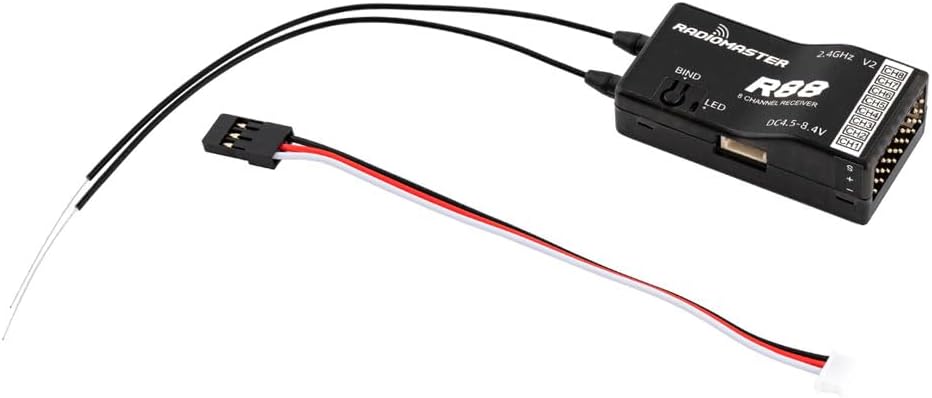
This image shows the Radiomaster R88 V2 receiver alongside a standard servo connection cable. The cable has a three-pin connector on one end, typically used for connecting to a flight controller or power source, and bare wires or another connector on the other end, depending on the application. This illustrates how the receiver connects to other components in an RC system.

This image provides a close-up view of a three-pin cable inserted into one of the ports on the Radiomaster R88 V2 receiver. This demonstrates a typical connection for either a PWM channel or the Sbus output, depending on which port the cable is plugged into. The connection is secure and flush with the receiver's casing.
7. Operating Instructions
7.1. Binding Procedure
To establish communication between your transmitter and the R88 V2 receiver, a binding procedure is required. The steps may vary slightly depending on your transmitter's firmware and mode (D8, D16, or SFHSS). Generally, the process involves:
- Power on your transmitter and select the appropriate protocol (D8, D16, or SFHSS) and binding mode.
- While holding down the BIND button on the R88 V2 receiver, apply power to the receiver. The LED on the receiver should start flashing rapidly, indicating it is in binding mode.
- Initiate the binding process on your transmitter.
- Once binding is successful, the LED on the receiver will turn solid, indicating a stable connection.
- Power cycle both the transmitter and receiver to confirm the binding.
Note: The R88 V2 receiver is designed for MPM radio compatibility and does not support direct binding with Frsky transmitters.
7.2. Signal Output Formats (PWM/Sbus)
- PWM Output: Each of the 8 channels (CH1-CH8) provides a standard PWM signal, suitable for direct connection to servos, ESCs, and other PWM-controlled devices.
- Sbus Output: The 'S' port provides a single Sbus serial output, which carries all channel data on one wire. This is commonly used with flight controllers that support Sbus input, simplifying wiring.
8. Maintenance
The Radiomaster R88 V2 receiver is a robust electronic component. To ensure its longevity and reliable performance:
- Keep the receiver clean and free from dust, dirt, and moisture.
- Avoid exposing the receiver to extreme temperatures or direct sunlight for prolonged periods.
- Regularly inspect antenna wires for damage and ensure they are securely connected.
- Ensure all connections to the receiver are secure and free from corrosion.
9. Troubleshooting
| Problem | Possible Cause | Solution |
|---|---|---|
| Receiver LED not lighting up | No power or incorrect polarity. | Check power connections and ensure correct voltage and polarity. |
| Receiver LED flashing rapidly (not solid after binding) | Not bound to transmitter or binding failed. | Repeat the binding procedure. Ensure transmitter is in binding mode and correct protocol is selected. |
| Loss of signal / Short range | Poor antenna placement, interference, or damaged antenna. | Check antenna placement (90-degree angle, away from carbon/metal). Avoid operating near strong interference sources. Inspect antennas for damage. |
| Servos not responding | Receiver not bound, incorrect channel connection, or faulty servo. | Verify binding. Ensure servos are connected to the correct PWM channels with correct polarity. Test servos with another receiver if possible. |
10. Warranty and Support
For warranty information and technical support, please refer to the official Radiomaster website or contact your authorized dealer. Keep your proof of purchase for any warranty claims.
Manufacturer: Greathobby RC
Related documentsR88 V2


Ask a question about this manual
Ask about setup, troubleshooting, compatibility, parts, safety, or missing instructions. Manuals+ will review the question and use this page’s manual context to help answer it.