
Introduction
Welcome to the NYJLGD Physics Optics Experiment Kit, Model H424. This comprehensive set is designed to bring fundamental physics concepts to life through hands-on optical experiments. It is an ideal tool for educational demonstrations in classrooms, allowing students and teachers to explore principles of light reflection, refraction, and focal points. This manual provides essential information for the proper setup, operation, maintenance, and troubleshooting of your experiment kit.
Product Components
The NYJLGD Physics Optics Experiment Kit includes a variety of precision-crafted components essential for conducting a wide range of optical experiments. Please verify that all items listed below are present in your kit.

Image: An overview of the kit's contents, displaying the main components such as the three-way laser source, various lenses (circular, double concave, concave mirror, glass tile, double convex, triangular prism), water boxes (triangular, semi-circular), and a multi-function reflector.
- Three-way Laser Source: A linear light source for clear beam visualization and demonstrating light paths.
- Optical Parallel Lens Suit: A set of six different lenses and mirrors for diverse experiments:
- Circular Lens
- Double Concave Lens
- Concave Mirror
- Glass Tile Lens
- Double Convex Lens
- Triangular Prism: For studying light refraction and dispersion.
- Triangular Water Box: Used for experiments involving light passing through water.
- Semi-circular Water Box: Used for experiments involving light passing through water, particularly for demonstrating total internal reflection.
- Multi-function Reflector: For various reflection experiments.
- Eye Experiment Demonstration Card: A visual aid for understanding the optics of the human eye.
- Protractor/Dial Mechanism: For precise angle measurements during experiments.

Image: A close-up view of the "Optical parallel lens suit" box and its contents, highlighting the individual lenses and mirrors.
Setup
The NYJLGD Physics Optics Experiment Kit requires minimal assembly to begin experiments. Follow these steps to set up your kit:
- Unpack Components: Carefully remove all components from the packaging. Inspect each item for any damage.
- Prepare Work Surface: Choose a flat, stable surface for your experiments. A dark or dimly lit room can enhance the visibility of laser beams.
- Position Laser Source: Place the three-way laser source on the work surface. Ensure it is stable and can be easily aimed.
- Arrange Optical Elements: Depending on the experiment, select the appropriate lenses, mirrors, or prisms. Place them on the work surface, often on a protractor or a marked diagram for precise positioning.
- Power On Laser: If the laser source requires batteries, ensure they are correctly installed. Turn on the laser using the designated switch.
- Adjust Dial Mechanism: For experiments requiring angle measurements, ensure the protractor or dial mechanism is correctly aligned and readable.
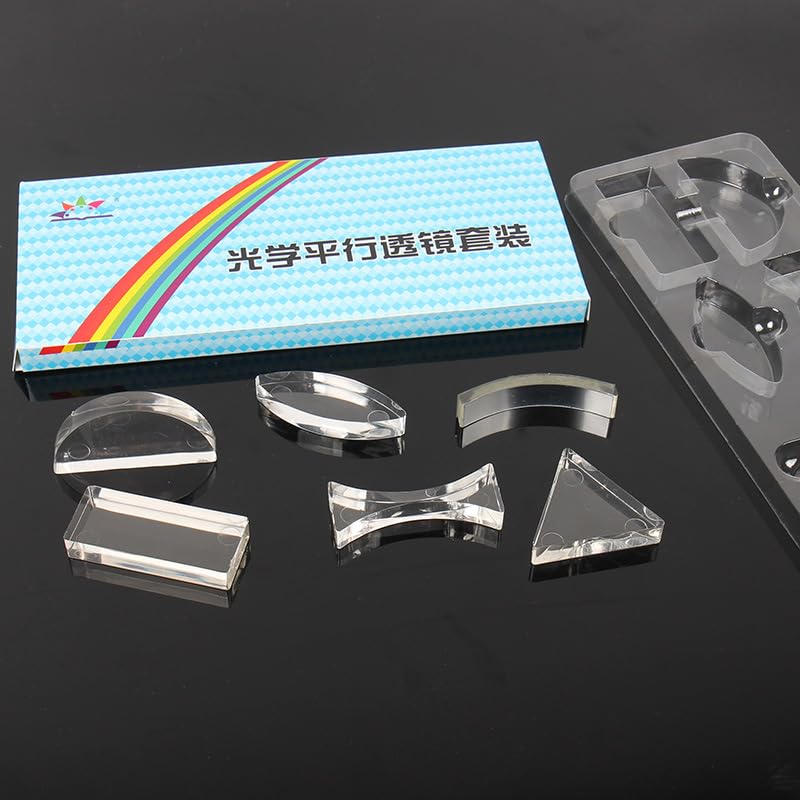
Image: The exterior packaging of the NYJLGD Physics Optics Experiment Kit, indicating its purpose for geometric optics experiments.
Operating Instructions
This kit allows for various experiments demonstrating fundamental optical principles. Always handle optical components with care to avoid scratches or damage. Never look directly into the laser beam.
General Experiment Procedure:
- Select Experiment: Choose the specific optical phenomenon you wish to demonstrate (e.g., reflection, refraction, focal points).
- Arrange Components: Place the chosen optical elements (lenses, mirrors, prisms) on the work surface according to the experiment's requirements. Use the protractor for accurate angle placement.
- Activate Laser: Turn on the three-way laser source.
- Observe Light Path: Direct the laser beam(s) towards the optical element(s). Observe how the light interacts with the material – whether it reflects, refracts, or disperses.
- Adjust and Measure: Adjust the position or angle of the optical elements and the laser source to observe different effects. Use the dial mechanism to measure angles of incidence and refraction/reflection.
- Record Observations: Document your observations, measurements, and conclusions for educational purposes.
Example Experiments:
- Reflection with Mirrors: Use the concave mirror or multi-function reflector to demonstrate the law of reflection and image formation.
- Refraction with Lenses: Use convex and concave lenses to show how light bends and to find focal points.
- Dispersion with Prism: Use the triangular prism to split white light into its constituent colors.
- Total Internal Reflection: Use the semi-circular water box to demonstrate total internal reflection at the water-air interface.

Image: An example of an experiment being conducted, illustrating laser beams interacting with an optical element on a graduated scale to measure angles.
Maintenance
Proper maintenance ensures the longevity and accuracy of your optics kit.
- Cleaning Optical Components: Use a soft, lint-free cloth specifically designed for optics to gently wipe lenses, mirrors, and prisms. Avoid abrasive materials or harsh chemicals.
- Storage: Store all components in their original packaging or a dedicated storage box to protect them from dust, scratches, and impact. Keep the kit in a cool, dry place away from direct sunlight.
- Battery Replacement: If the laser source's light dims, replace its batteries with the recommended type.
- Handling: Always handle glass components by their edges to avoid leaving fingerprints on optical surfaces.
Troubleshooting
If you encounter issues with your experiment kit, refer to the following common problems and solutions:
| Problem | Possible Cause | Solution |
|---|---|---|
| Laser beam is dim or not visible. | Low batteries in laser source; ambient light too bright. | Replace batteries; conduct experiments in a darker environment. |
| Light path is unclear or distorted. | Optical components are dirty or smudged; incorrect alignment. | Clean components with an optics cloth; re-align elements carefully. |
| Difficulty observing specific optical effects. | Incorrect setup for the experiment; insufficient understanding of the principle. | Review experiment instructions; consult physics textbooks or online resources for guidance on the specific optical principle. |
Specifications
| Brand | NYJLGD |
| Model Number | H424 |
| UPC | 726189210107 |
| Material Type | Glass |
| Item Dimensions (L x W x H) | 16 x 12 x 6 inches |
| Item Weight | 1.5 Pounds |
| Educational Objective | Physics Learning |
| Recommended Age Range | 8 Years And Up (Manufacturer Minimum Age: 18 Months) |
| Assembly Required | Yes |
Warranty Information
Specific warranty details for the NYJLGD Physics Optics Experiment Kit are not provided in this manual. For information regarding product warranty, returns, or replacements, please refer to the retailer's return policy or contact the manufacturer directly through their official channels. Typically, products are covered by a standard return period from the date of purchase.
Support
For further assistance, technical support, or inquiries regarding the NYJLGD Physics Optics Experiment Kit, please contact the seller or manufacturer. Refer to your purchase documentation for specific contact information. Online resources and educational forums may also provide additional guidance for conducting physics experiments.