Introduction
This manual provides essential information for the proper setup, operation, and maintenance of your Roland RD-2000 EX 88-key Digital Piano Essentials Bundle. Please read this manual thoroughly before using the product and keep it for future reference.
Safety Information
To ensure safe operation, always observe the following precautions:
- Do not expose the unit to extreme temperatures, humidity, or direct sunlight.
- Avoid placing the unit near heat sources or in areas with poor ventilation.
- Do not place objects containing liquids on the unit.
- Use only the specified power adapter.
- Keep the unit away from children.
- Disconnect the power cord during lightning storms or when unused for long periods.
Package Contents
Verify that all items listed below are included in your package:
- Roland RD-2000 EX 88-Key Digital Stage Piano
- Knox Gear Adjustable X-Style Keyboard Bench
- FocusProAudio Adjustable Double X Keyboard Stand
- On Stage KSP100 Keyboard Piano Style Sustain Pedal (Black)
- Power Adapter
- Music Rest
Setup
1. Assembling the Keyboard Stand
Unfold the FocusProAudio Adjustable Double X Keyboard Stand and adjust it to a comfortable playing height. Ensure all locking mechanisms are securely fastened to provide stable support for the digital piano.

Image: FocusProAudio Adjustable Double X Keyboard Stand, shown in its unfolded position.
2. Setting up the Keyboard Bench
Unfold the Knox Gear Adjustable X-Style Keyboard Bench. Adjust the bench height to your preference. The bench features a 2-inch padded cushion for comfort and rubber-tipped feet for stability.

Image: Knox Gear Adjustable X-Style Keyboard Bench, showing its X-frame design.

Image: Features of the Knox Gear Adjustable X-Style Keyboard Bench, highlighting its adjustability and X-style design.

Image: Close-up of the Knox Gear Adjustable X-Style Keyboard Bench's 2-inch padded cushion.
3. Placing the Digital Piano
Carefully place the Roland RD-2000 EX Digital Piano onto the assembled keyboard stand. Ensure it is centered and stable.

Image: Roland RD-2000 EX 88-key Digital Piano, showcasing its full keyboard and control panel.
4. Connecting the Sustain Pedal
Connect the On Stage KSP100 Keyboard Piano Style Sustain Pedal to the designated pedal input on the rear panel of the RD-2000 EX. This pedal provides sustain control for your playing.
5. Powering On/Off
Connect the power adapter to the DC IN jack on the rear panel of the digital piano, then plug the adapter into a power outlet. Press the power button located on the control panel to turn the unit ON or OFF.

Image: Rear panel of the Roland RD-2000 EX, showing various input/output connections including power, pedal, and audio outputs.
Operating Instructions
1. Basic Controls
The RD-2000 EX features a streamlined control panel for intuitive operation. Adjust the master volume using the dedicated slider. The power button controls the unit's on/off state.
2. Sound Engines and Keybed
The digital piano is equipped with dual sound engines and a PHA-50 Progressive Hammer-action Keybed, providing a realistic piano playing experience. The keybed offers a graded hammer feel, mimicking an acoustic grand piano.
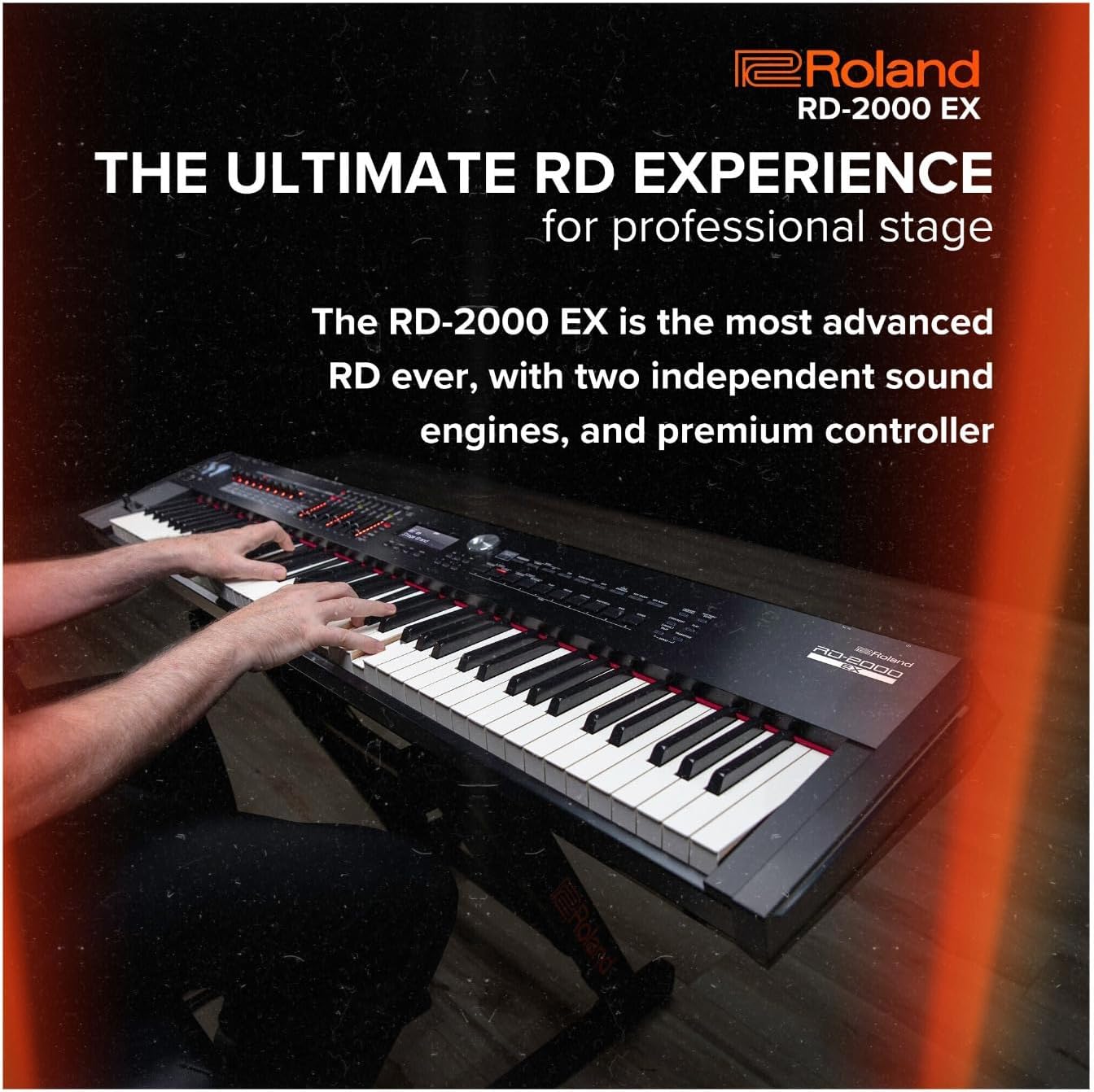
Image: A person playing the Roland RD-2000 EX Digital Piano, demonstrating its use in a performance setting.
3. Sound Selection
Access a variety of sounds, including advanced V-Piano modeling technology, for diverse musical expression. The intuitive interface allows for quick selection and customization of tones.
4. Controller Functionality
The RD-2000 EX includes advanced controller functionality, allowing seamless integration with external software and hardware. Utilize the onboard controls for real-time sound manipulation and performance adjustments.
5. USB Audio/MIDI Interface
The piano features an onboard 24-bit/192kHz USB Audio/MIDI Interface. Connect the piano to a computer via USB to record audio and MIDI data, or to use the piano as a MIDI controller for software instruments.
Official Product Video
Watch this official product video from Roland US for a detailed overview of the RD-2000 EX Digital Stage Piano.
Video: Roland Premium Digital Stage Piano RD-2000 EX. This video provides an in-depth look at the features and capabilities of the digital piano.
Specifications
| Feature | Detail |
|---|---|
| Brand | Roland |
| Model Name | RD-2000 EX |
| Number of Keys | 88 |
| Keybed Type | PHA-50 Progressive Hammer-action |
| Sound Engines | Dual Sound Engines, V-Piano Modeling |
| Connectivity | USB Audio/MIDI Interface (24-bit/192kHz) |
| Color | Black |
| Item Weight | 16 ounces (0.45 kg) - Note: Product description states 1 pound, specification states 16 ounces. |
| Product Dimensions | 9.1 x 9.1 x 9.1 inches (23.1 x 23.1 x 23.1 cm) |
Maintenance
To maintain your Roland RD-2000 EX Digital Piano and accessories in optimal condition:
- Cleaning: Use a soft, dry cloth to wipe the surface of the piano and accessories. For stubborn dirt, slightly dampen the cloth with water and a mild detergent, then wipe dry immediately. Avoid abrasive cleaners or solvents.
- Storage: When not in use, cover the piano with a dust cover to protect it from dust and debris. Store in a stable environment away from direct sunlight and extreme temperature changes.
- Transportation: When moving the piano, ensure it is properly secured in a protective case to prevent damage. Disassemble the stand and bench for easier and safer transport.
Troubleshooting
If you encounter issues with your Roland RD-2000 EX, refer to the following common solutions:
- No Sound: Check if the power is on, the volume is turned up, and headphones are not plugged in (unless intended). Ensure all cables (audio, pedal) are securely connected.
- Keys Not Responding: Verify the unit is powered on. If specific keys are unresponsive, contact customer support.
- Distorted Sound: Check the volume levels of the piano and any connected audio equipment. Ensure cables are not damaged and connections are secure.
- Pedal Not Working: Confirm the sustain pedal is correctly plugged into the designated jack on the rear panel.
Warranty & Support
For warranty information and technical support, please refer to the official Roland website or contact your authorized Roland dealer. Keep your purchase receipt as proof of purchase for warranty claims.
Online resources, including FAQs and additional documentation, may be available on the Roland support page.


