
1. Introduction and Overview
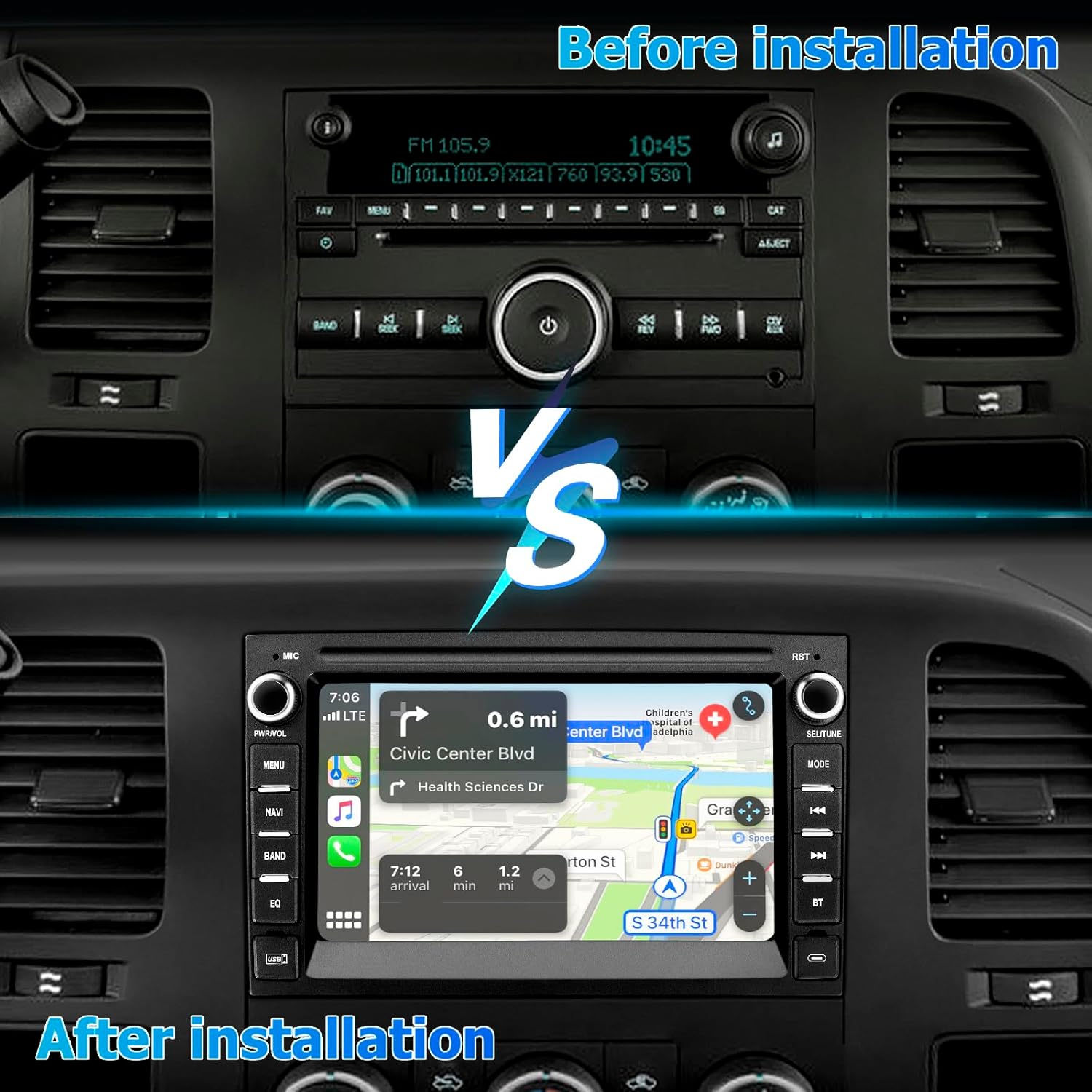
This manual provides detailed instructions for the installation, operation, and maintenance of your KOBANOICA Android 13 Car Radio Stereo. Please read this manual thoroughly before use to ensure proper functionality and safety. This head unit features a 7-inch touch screen, Android 13 operating system, 2GB RAM, 64GB ROM, wireless Apple CarPlay, Android Auto, Bluetooth, and GPS navigation.
2. Package Contents
Please verify that all items listed below are included in your package:
- Head unit radio
- Installation harness
- GPS Module
- Speaker (for door chime/alerts in compatible vehicles)
- Microphone
- Antenna Adapter Cable
- Reversing line
- Screwdriver
- Crowbar
- USB Cable
- USB Adaptor
- RCA Cable
- Power Cable
- Can Bus

3. Compatible Vehicle Models
This KOBANOICA Android Car Stereo Radio is compatible with the following vehicle models and years:
- Chevy Silverado: 1500HD, 2500HD, 3500HD (2007-2014, Second Generation)
- Chevy Tahoe: (2007-2014, Third Generation)
- GMC Sierra: (2007-2011)
- GMC Savana: (2008-2013)
- GMC Yukon: (2007-2013)
- Buick Enclave: (2008-2012)

4. Installation
Professional installation is recommended. Ensure the vehicle's battery is disconnected before beginning installation. Refer to the wiring diagram provided in the package for specific connections.
4.1 General Installation Steps
- Carefully remove the factory radio and trim using appropriate tools (a crowbar and screwdriver are included).
- Connect the main wiring harness from the new head unit to the vehicle's factory harness. Ensure all connections are secure.
- Connect the GPS antenna and microphone. Position the GPS antenna in a location with a clear view of the sky.
- If installing a backup camera, connect the reversing line and video input cable.
- Carefully slide the new head unit into the dashboard opening and secure it.
- Reinstall any removed trim pieces.
- Reconnect the vehicle's battery and test the unit.
4.2 Wiring Diagram and Specific Connections

4.3 Rear Camera Installation

4.4 No Sound After Installation
If you experience no sound or only partial sound (e.g., rear speakers not working) after installation, please check the following:
- Try swapping the positions of the two plugs (purple and gray) for the Audio CAN.
- Check whether the audio input and output wires are connected correctly.
- Ensure the AMP wire and AMP CON (amplifier control) wire are properly connected.

4.5 Installation Videos
Video 4.5.1: Installation overview for Sierra, Yukon, Chevrolet, Chevy Silverado, Hummer H2, and Tahoe radios.
Video 4.5.2: Product introduction before installation.
Video 4.5.3: Car radio installation for Chevy Silverado, Tahoe, GMC Sierra, and Yukon.
Video 4.5.4: Stereo installation video for GMC Sierra, Yukon, Buick, and Silverado.
5. Initial Setup and Configuration
After successful installation, power on the unit and follow these steps for initial setup.
5.1 Language Settings
To change the display language:
- Go to Settings > More Settings > Language & input > Language Settings > Add a language.
- Select your desired language from the list.
Video 5.1.1: Adjusting Language Settings (starts at 0:05).
5.2 Time Settings
To set the date and time:
- Go to Settings > More Settings > Date and time.
- Select Use GPS-provided time for automatic synchronization.
Video 5.2.1: Adjusting Time Settings (starts at 0:27).
5.3 Screen Brightness Adjustment
To adjust screen brightness:
- Go to Settings > Display > Automatic Brightness Adjustment.
- You can also manually adjust Day and Night brightness levels.
Video 5.3.1: Adjusting Screen Brightness (starts at 0:36).
5.4 Wi-Fi Connection
To connect to Wi-Fi:
- Go to Settings > Network > Wi-Fi.
- Turn Wi-Fi On. Select your Wi-Fi network and enter the password.
- For subsequent connections, swipe down the screen and turn Wi-Fi on; it will connect automatically.
Video 5.4.1: Wi-Fi Connection (starts at 0:40).
5.5 Touch Calibration
If the touch screen is unresponsive or inaccurate, perform a calibration:
- Go to Settings > Factory Setup. Enter password 1234.
- Select Touch Calibration. Follow the on-screen instructions to tap the crosshairs.
- Alternatively, place five fingers spread out on the screen to activate the five-point touch calibration interface.
Video 5.5.1: Touch Calibration (starts at 0:59).
5.6 Touch Screen Button Learning (Glass Screen Radio)
For units with touch screen buttons:
- Go to Settings > Factory Setup. Enter password 1234.
- Select Touch Button Learning. Follow the on-screen instructions to assign functions to the touch buttons.
Video 5.6.1: Touch Screen Button Learning (starts at 1:27).
5.7 Button Settings (Radio with Physical Buttons)
For units with physical buttons:
- Go to Settings > Factory Setup. Enter password 1234.
- Select Knob Panel Button Learning. Follow the on-screen instructions to assign functions to the physical buttons.
Video 5.7.1: Button Settings (starts at 1:54).
5.8 Steering Wheel Control Learning
To configure steering wheel controls:
- Go to Settings > Factory Setup. Enter password 1234.
- Select Party Control Learning. Follow the on-screen instructions to assign functions to your steering wheel buttons.
Video 5.8.1: Steering Wheel Control Learning (starts at 2:22).
5.9 Reverse Camera Format Selection
To select the correct reverse camera format:
- Go to Settings > Factory Setup. Enter password 1234.
- Select Backcar Source Settings and choose the appropriate format (e.g., CVBS, AHD, TVI).
Video 5.9.1: Reverse Camera Format Selection (starts at 2:47).
5.10 Car System Protocol Settings
To configure car system protocols:
- Go to Settings > Factory Setup. Enter password 1234.
- Select Can Settings. Configure Brand, Model, Year, and Protocol as required for your vehicle.
Video 5.10.1: Car System Protocol Settings (starts at 2:54).
5.11 UI Theme Settings
To customize the user interface theme:
- Long press the bottom of the main screen to enter the theme selection page.
- Swipe left or right to view more themes and select your preferred one.
Video 5.11.1: UI Theme Settings (starts at 3:10).
5.12 Speed Unit Switch
To switch between km/h and mph:
- Tap the speed unit on the main screen to toggle between units.
Video 5.12.1: Speed Unit Switch (starts at 5:18).
5.13 Clear Memory
To clear system memory and optimize performance:
- Swipe down the screen to access the quick settings panel.
- Tap the System Optimize icon to clear memory.
Video 5.13.1: Clear Memory (starts at 5:22).
6. Operating Instructions
6.1 Bluetooth Connectivity
The unit supports Bluetooth for hands-free calling and audio streaming. The Bluetooth connection password is 0000.
- Enter the radio Bluetooth interface.
- Turn on Bluetooth on your phone.
- Find the radio Bluetooth name (Car BT) on your phone, select it, and complete the authorization to successfully connect.
- You can make calls and stream music after a successful Bluetooth connection.

Video 6.1.1: Bluetooth Settings (starts at 3:59).
6.2 Wireless Apple CarPlay
Connect your iPhone wirelessly for navigation, music, and more.
- Open the Zlink5 app on the head unit.
- Confirm the Bluetooth name of the device (e.g., Car BT).
- Turn on Bluetooth on your iPhone and pair with Car BT.
- Turn on Wi-Fi on your iPhone and connect to the device's Wi-Fi hotspot.
- After successful connection, CarPlay will launch automatically.

Video 6.2.1: How to connect wireless CarPlay.
Video 6.2.2: CarPlay Settings (starts at 4:20).
6.3 Wireless Android Auto
Connect your Android phone wirelessly for navigation, music, and more.
- Open the Zlink5 app on the head unit.
- Confirm the Bluetooth name of the device (e.g., Car BT).
- Turn on Bluetooth on your Android phone and pair with Car BT.
- Turn on Wi-Fi on your Android phone and connect to the device's Wi-Fi hotspot.
- After successful connection, Android Auto will launch automatically.

Video 6.3.1: How to connect wireless Android Auto.
Video 6.3.2: Android Auto Settings (starts at 4:51).
6.4 GPS Navigation
The unit supports both online and offline GPS navigation. Connect to Wi-Fi to download maps and use online navigation apps like Google Maps.

6.5 FM/AM Radio
Enjoy your favorite radio stations with the built-in FM/AM tuner. The FM radio is preset with 18 stations.

Video 6.5.1: Radio Settings (starts at 3:33).
6.6 EQ Adjustment
Customize your audio experience with the built-in equalizer.
- Access the EQ settings from the main menu or quick settings.
- Adjust frequency bands or select from preset sound modes (e.g., Pop, Rock, Jazz).

Video 6.6.1: EQ Settings (starts at 3:42).
7. Maintenance
Proper maintenance ensures the longevity and optimal performance of your car radio stereo.
- Screen Cleaning: Use a soft, dry, lint-free cloth to clean the touchscreen. Avoid using abrasive cleaners, solvents, or harsh chemicals, as these can damage the screen.
- Connection Checks: Periodically check all wiring connections to ensure they are secure and free from corrosion. Loose connections can lead to intermittent issues.
- Software Updates: Regularly check for available software updates through the unit's settings menu. Updates can provide new features, performance improvements, and bug fixes.
- Environmental Care: Avoid exposing the unit to extreme temperatures, direct sunlight for prolonged periods, or excessive moisture.
8. Troubleshooting
If you encounter any issues, refer to the following troubleshooting guide before contacting support.
| Problem | Possible Cause | Solution |
|---|---|---|
| No Power | Loose power connection, blown fuse. | Check power connections. Inspect vehicle's fuse box and replace any blown fuses. |
| No Sound / Partial Sound | Incorrect speaker wiring, audio settings, AMP-CON wire issue. | Verify speaker connections. Check audio settings (EQ, balance). Ensure AMP-CON wire is correctly connected if using an external amplifier (refer to Section 4.4). |
| Bluetooth/CarPlay/Android Auto Connection Issues | Bluetooth/Wi-Fi off, pairing error, Zlink settings. | Ensure Bluetooth and Wi-Fi are enabled on both the head unit and your phone. Forget and re-pair devices. Check Zlink settings (refer to Sections 6.2 and 6.3). |
| GPS Signal Loss | Improper GPS antenna placement or connection. | Ensure GPS antenna is properly installed and has a clear view of the sky. Check antenna connection. |
| Steering Wheel Controls Not Working | Controls not learned or incorrect protocol. | Perform the steering wheel control learning procedure in the settings (refer to Section 5.8). Check car system protocol settings (Section 5.10). |
| Touch Screen Unresponsive/Inaccurate | Calibration needed. | Perform touch calibration in factory settings (refer to Section 5.5). |
9. Specifications
| Feature | Detail |
|---|---|
| Display Size | 7 Inches |
| Operating System | Android 13 |
| RAM | 2GB |
| ROM | 64GB |
| Connectivity Technology | Bluetooth, USB, Wi-Fi |
| Special Features | Android Auto, Apple CarPlay, Touchscreen, Built-In Wi-Fi |
| Audio Output Mode | Stereo |
| Item Weight | 2.88 pounds |
| Package Dimensions | 11.54 x 9.41 x 4.02 inches |
10. Warranty and Support
Your KOBANOICA Car Radio Stereo comes with a 2-Year Manufacturer Warranty.
For technical support, warranty claims, or any questions regarding your product, please contact KOBANOICA customer service through the retailer where the product was purchased. Please have your model number (B0DJVRWLNB) and proof of purchase ready when contacting support.