
1. Introduction
Thank you for choosing the Reboot RBM2000 200Amp 5-in-1 Welding Machine. This versatile welder is designed for various welding applications, offering five distinct welding processes: Flux Core Gasless MIG, Solid Wire Gas MIG, Lift TIG, MMA (Manual Metal Arc)/Stick, and MAG (Metal Active Gas). This manual provides essential information for safe operation, setup, maintenance, and troubleshooting to ensure optimal performance and longevity of your welding equipment.
2. Safety Information
WARNING: Welding can be dangerous. Always follow safety precautions to prevent injury or death.
- Always wear appropriate personal protective equipment (PPE), including a welding helmet with proper shade, flame-resistant clothing, welding gloves, and safety shoes.
- Ensure adequate ventilation to avoid inhaling welding fumes, which can be hazardous to your health.
- Protect bystanders from arc rays and hot metal. Use welding screens or barriers.
- Never touch live electrical parts. Ensure the machine is properly grounded.
- Keep a fire extinguisher nearby and know how to use it. Remove flammable materials from the welding area.
- Disconnect power before performing any maintenance or changing accessories.
- Read and understand all instructions in this manual before operating the welder.
3. Package Contents
Carefully unpack your Reboot RBM2000 welder and verify that all components are present. If any items are missing or damaged, contact customer support immediately.
- Reboot RBM2000 5-in-1 Welding Machine
- MIG Torch (MB15 type)
- Lift TIG Torch
- Electrode Holder (for MMA/Stick welding)
- Ground Clamp
- Gas Hose
- Power Cord (120V/240V compatible)
- Consumables Kit (42 pieces):
- 2 x Gas Nozzles
- 20 x Contact Tips 0.8mm (.030")
- 20 x Contact Tips 1.0mm (.040")
- User Manual

Image 3.1: The Reboot RBM2000 welding machine with all standard accessories, including the MIG torch, Lift TIG torch, electrode holder, ground clamp, gas hose, power cord, and a selection of consumables.
4. Product Overview
4.1. Main Unit
The RBM2000 features a compact design with a robust casing, designed for portability and durability. The front panel houses the control interface and output connections, while the rear panel includes the power input and gas connection.
4.2. Control Panel
The digital display and control knobs allow for precise adjustment of welding parameters. The synergic control feature simplifies setup by automatically recommending settings based on wire type and thickness.
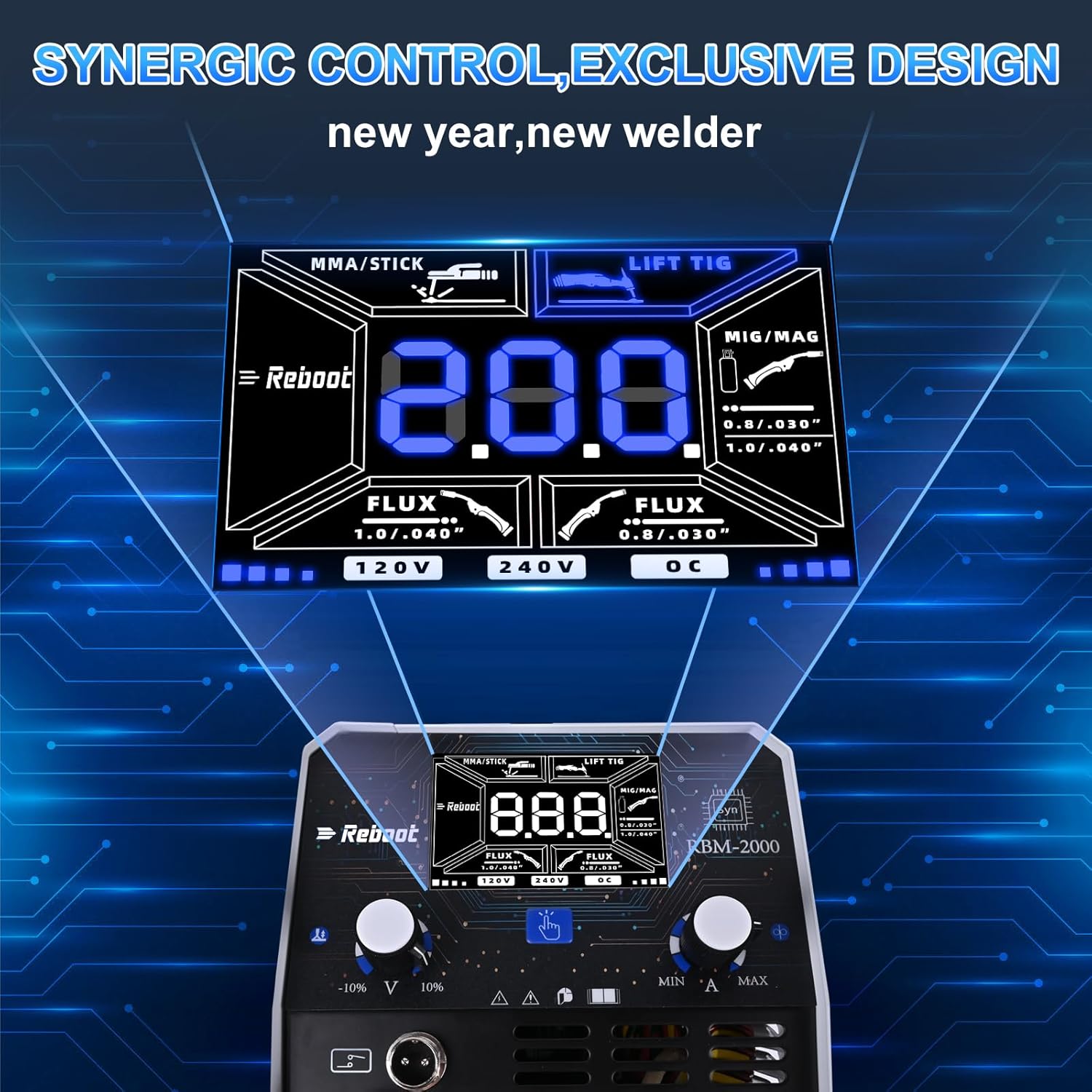
Image 4.1: Detailed view of the RBM2000's control panel, showing the digital display for current and voltage, mode selection, and synergic control options for MIG, Flux Core, Lift TIG, and MMA/Stick welding.
- Digital Display: Shows welding current (Amps) and voltage (Volts).
- Mode Selection: Switch between MIG/MAG, Flux Core, Lift TIG, and MMA/Stick.
- Synergic Control: For MIG/MAG and Flux Core, select wire diameter and material, and the machine will suggest optimal settings.
- Adjustment Knobs: Fine-tune current, voltage, and wire feed speed.
- Input Voltage Indicator: Displays whether the machine is operating on 120V or 240V.
5. Setup
5.1. Power Connection
The RBM2000 is a dual-voltage machine, compatible with both 120V and 240V power sources. The machine automatically detects the input voltage.
- Ensure the power source matches the machine's requirements.
- Connect the power cord securely to the welder and a grounded electrical outlet.
5.2. Gas Connection (for Gas MIG/MAG)
For Gas MIG/MAG welding, a shielding gas cylinder is required.
- Connect one end of the gas hose to the gas inlet on the rear of the welder.
- Connect the other end of the gas hose to your gas regulator on the shielding gas cylinder.
- Ensure all connections are tight to prevent gas leaks.
5.3. Wire Installation (MIG/Flux Core)
- Open the wire feed compartment.
- Mount the wire spool onto the spindle, ensuring it rotates freely.
- Feed the welding wire through the guide tube and into the drive rollers.
- Adjust the drive roller tension to prevent slipping or crushing the wire.
- With the MIG torch pointed away from yourself and others, press the trigger to feed the wire through the torch liner until it exits the contact tip.
5.4. Torch and Ground Clamp Connection
- MIG Torch: Connect the MIG torch cable to the appropriate connector on the front panel.
- Lift TIG Torch: Connect the Lift TIG torch cable to the designated connector. Ensure the gas line (if used) is also connected.
- MMA/Stick: Connect the electrode holder cable to the positive (+) terminal and the ground clamp cable to the negative (-) terminal for most electrodes (DCEN). Reverse for DCEP if required by your electrode.
- Ground Clamp: Always attach the ground clamp securely to the workpiece or a clean, bare metal work surface. A poor ground connection can lead to unstable arcs and poor weld quality.

Image 5.1: Illustration of the cable and gas hose connections on the welding machine, highlighting the importance of secure and correct attachment for safe and effective operation.
6. Operating Modes
6.1. MIG Welding (Gas MIG / Flux Core Gasless MIG)
MIG welding is ideal for various metals and thicknesses, offering high productivity.
- Mode Selection: Select 'MIG/MAG' or 'Flux Core' on the control panel.
- Synergic Control: Utilize the synergic function by selecting your wire diameter (e.g., 0.8mm or 1.0mm) and material type. The machine will automatically suggest optimal voltage and wire feed speed.
- Adjustments: Fine-tune voltage and wire feed speed as needed for your specific application.
- Gas (Gas MIG): Ensure shielding gas is flowing at the correct rate (typically 10-15 L/min).
- No Gas (Flux Core): No external shielding gas is required as the flux-cored wire produces its own shielding. Ensure polarity is set correctly for flux core (usually DCEN).
6.2. Lift TIG Welding
Lift TIG provides precise control and high-quality welds, especially on thinner materials.
- Torch Connection: Connect the Lift TIG torch to the machine.
- Electrode: Insert a tungsten electrode into the collet and tighten the cap. Ensure the tungsten is properly ground.
- Gas: Connect an argon gas cylinder and set the flow rate (typically 5-10 L/min).
- Operation: Select 'Lift TIG' mode. Gently touch the tungsten to the workpiece, then lift slightly to initiate the arc. Maintain a consistent arc length and feed filler rod manually.

Image 6.1: An exploded diagram illustrating the various components of a Lift TIG torch, including the ceramic cup, collet body, collet, tungsten electrode, and back caps.

Image 6.2: The Lift TIG torch shown with its accompanying accessories, such as collect bodies, collects, ceramic cups, and short and long back caps, essential for TIG welding.

Image 6.3: This image demonstrates the multi-angle rotation capability of the Lift TIG torch, allowing for flexible positioning during welding tasks, compared to fixed-port torches.
6.3. MMA/Stick Welding
MMA/Stick welding is robust and suitable for outdoor use and thicker materials.
- Connections: Connect the electrode holder and ground clamp as described in Section 5.4.
- Electrode Selection: Choose the appropriate electrode type and diameter for your material and application.
- Mode Selection: Select 'MMA/Stick' mode.
- Current Adjustment: Set the welding current according to the electrode manufacturer's recommendations.
- Operation: Strike the arc by lightly scratching the electrode on the workpiece. Maintain a consistent arc length and travel speed.
7. Maintenance
Regular maintenance ensures the longevity and safe operation of your welding machine.
- Cleaning: Periodically clean the machine's exterior with a dry, soft cloth. Use compressed air to blow out dust from inside the machine, ensuring power is disconnected first.
- Consumables: Regularly inspect and replace worn-out contact tips, gas nozzles, and TIG ceramic cups/collets. Worn consumables can negatively impact weld quality.
- Cables: Check welding cables for cuts, cracks, or damaged insulation. Replace damaged cables immediately.
- Wire Feed System: Clean the drive rollers and wire liner to prevent wire feeding issues.

Image 7.1: A collection of welding consumables, specifically contact tips and gas nozzles, which are crucial for MIG welding and require regular inspection and replacement.

Image 7.2: This image provides detailed dimensions for MIG welding contact tips (0.8mm and 1.0mm aperture) and conical nozzles, aiding in proper selection and replacement.
8. Troubleshooting
This section addresses common issues you might encounter during operation.
| Problem | Possible Cause | Solution |
|---|---|---|
| No power to the machine | Power cord unplugged, circuit breaker tripped, faulty power switch. | Check power cord connection, reset circuit breaker, contact service if switch is faulty. |
| No arc / Unstable arc | Poor ground connection, incorrect settings, worn consumables, wrong polarity. | Ensure ground clamp is on clean metal, verify settings for mode, replace consumables, check polarity. |
| Wire feeding issues (MIG/Flux Core) | Drive roller tension incorrect, clogged liner, wrong size contact tip, tangled wire spool. | Adjust drive roller tension, clean or replace liner, use correct contact tip, untangle wire. |
| Poor weld quality | Incorrect settings, improper technique, contaminated workpiece, insufficient shielding gas. | Adjust parameters, practice technique, clean workpiece, check gas flow and connections. |
| Overheating / Thermal overload | Exceeding duty cycle, blocked ventilation. | Allow machine to cool down, ensure proper ventilation, reduce welding time. |
9. Specifications
| Feature | Description |
|---|---|
| Model | RBM2000 |
| Input Voltage | 120V / 240V (Auto-sensing) |
| Max Output Current | 200 Amp |
| Welding Processes | MIG (Gas/Gasless Flux Core), Lift TIG, MMA/Stick, MAG |
| Synergic Control | Yes (for MIG/MAG) |
| Consumables Included | 42 PCS (2x Gas Nozzle, 20x 0.8mm Contact Tip, 20x 1.0mm Contact Tip) |
| TIG Torch Type | Lift TIG Torch (suitable for 10-25 mm² interface) |
10. Warranty and Support
Reboot products are manufactured to high-quality standards. For warranty information, technical support, or service inquiries, please refer to the warranty card included with your product or visit the official Reboot website. Please have your model number (RBM2000) and purchase date available when contacting support.


