
1. Product Overview
The MakerHawk 3.7V 950mAh LiPo Battery is a rechargeable lithium polymer battery designed for various electronic projects, including Arduino and ESP32 development boards. It features a built-in protection circuit to ensure safe operation and a Micro JST 1.25 plug for easy connectivity. This manual provides essential information for the safe and effective use of your battery.

Image 1.1: MakerHawk 3.7V 950mAh LiPo Batteries. Each battery is labeled with its capacity (950mAh), voltage (3.7V), and energy (3.5Wh), and includes a warning to use according to specifications.
2. Package Contents
Your package should contain the following items:
- MakerHawk 3.7V 950mAh LiPo Batteries (quantity as per purchase, e.g., 4 Pack)
- Insulated Rubber Tape (pre-applied or included)
3. Specifications
Refer to the table below for detailed technical specifications of the MakerHawk 3.7V 950mAh LiPo Battery:
| Specification | Value |
|---|---|
| Capacity | 950mAh |
| Rated Voltage | 3.7V |
| Battery Cell Composition | Lithium Polymer |
| Energy | 3.5Wh |
| BMS Overcharge Voltage | 4.2V |
| BMS Over-discharge Voltage | 3.0V |
| Maximum Charging Current | 0.5C |
| Charging Temperature Range | 0-45°C |
| Discharge Temperature Range | -10-60°C |
| Connector Type | Micro JST 1.25 Plug |
| Lead Length | 50 ± 3mm |
| Dimensions (L x W x H) | 43mm x 25mm x 9mm (approximate, excluding lead) |
| Item Weight | Approx. 25g per battery |
| Model Number | 952540 |

Image 3.1: Battery Specifications. This image visually presents the key electrical and physical specifications of the battery.
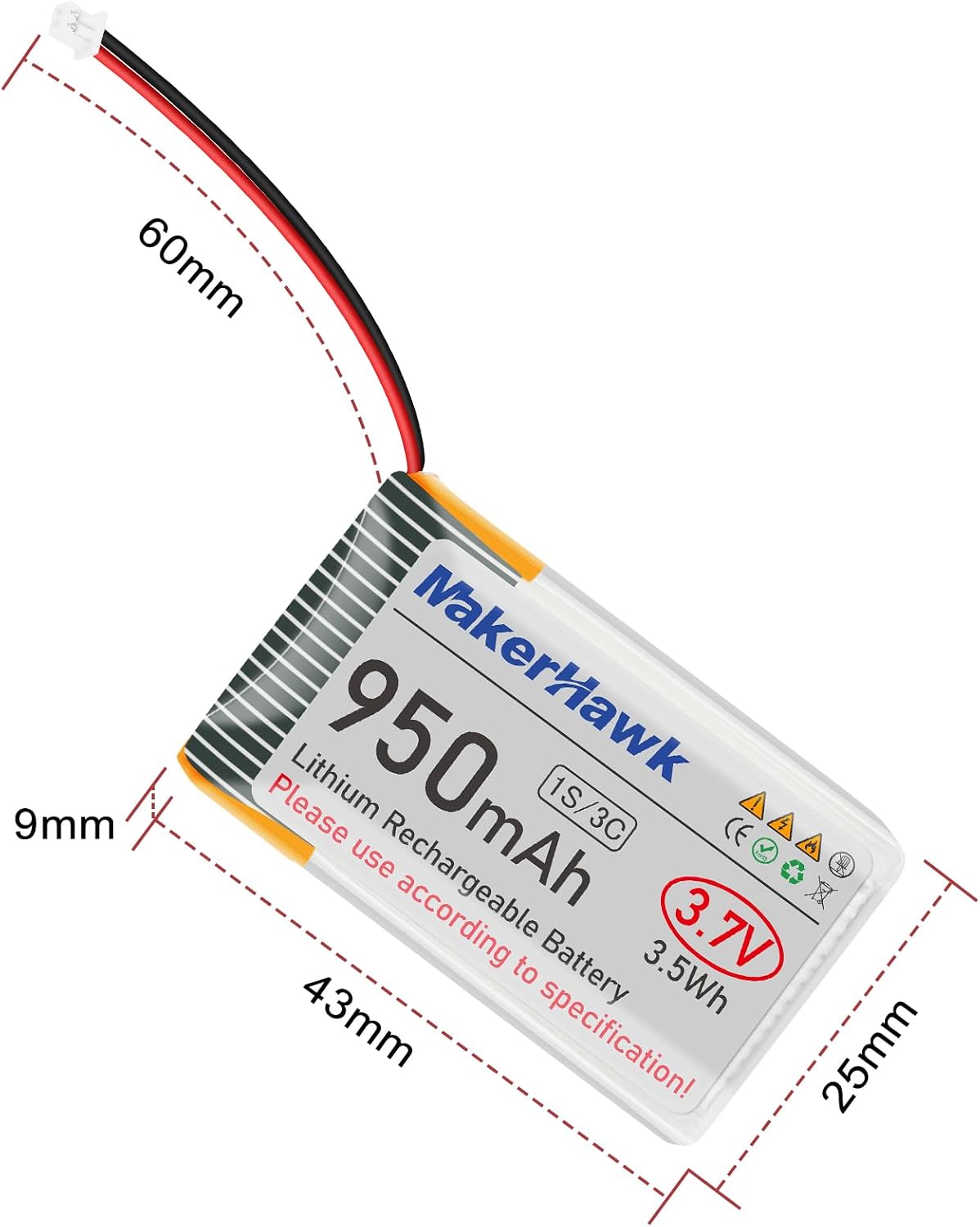
Image 3.2: Battery Dimensions. A diagram illustrating the physical measurements of the battery, including its length, width, thickness, and the length of its connecting wires.
4. Safety Instructions
Lithium Polymer batteries require careful handling. Failure to follow these safety instructions can result in fire, personal injury, or property damage.
4.1 General Safety Precautions
- Do not puncture, disassemble, short circuit, or expose the battery to fire or high temperatures.
- Use only chargers specifically designed for LiPo batteries.
- Do not charge unattended.
- Keep batteries away from children and pets.
- If the battery shows signs of swelling, leakage, or damage, discontinue use immediately and dispose of it properly.
- Avoid dropping or subjecting the battery to strong impacts.
4.2 Integrated Protection Features
This battery is equipped with a Protection Circuit Module (PCM) that includes the following safety functions:
- Overcharge Protection: Prevents the battery from being charged beyond its safe voltage limit (4.2V).
- Over-discharge Protection: Prevents the battery from being discharged below its safe voltage limit (3.0V).
- Overcurrent Protection: Limits the current drawn from the battery to prevent damage. Instantaneous overcurrent protection is rated at 4.8A-6A.
- Short Circuit Protection: Automatically cuts off power in case of a short circuit.
- Overheating Protection: Monitors battery temperature to prevent overheating during operation or charging.

Image 4.1: Battery Protection Features. This image highlights the key safety mechanisms integrated into the battery's protection board.
4.3 Important Note on Overcurrent Protection
While the battery's overcurrent protection feature is in place, it may not be entirely foolproof. It is advisable to avoid charging and discharging the battery at excessively high currents or at currents and voltages beyond the recommended range. Doing so could potentially damage the protection circuitry, rendering it ineffective.

Image 4.2: Overcurrent Protection Warning. This image emphasizes the importance of adhering to recommended current and voltage limits to prevent damage to the protection circuitry.
5. Setup and Connection
5.1 Connector Type
The MakerHawk LiPo battery features a Micro JST 1.25 plug. This connector is commonly used in small electronic devices and development boards.

Image 5.1: Micro JST 1.25 Plug. A detailed view of the connector, indicating the polarity (P- and P+).
5.2 Compatibility
This battery is designed for compatibility with various development boards that utilize a 1.25mm plug, such as Arduino and ESP32 boards. Ensure your device has a matching Micro JST 1.25 receptacle.

Image 5.2: Compatible Development Boards. This image illustrates the battery's compatibility with several common Arduino and ESP32-based development boards.
5.3 Connection Procedure
- Identify the Micro JST 1.25 port on your development board or device.
- Align the battery's Micro JST 1.25 plug with the port, ensuring correct polarity. The red wire typically indicates positive (+), and the black wire indicates negative (-).
- Gently insert the plug into the port until it is securely seated. Do not force the connection.
- Verify the connection is firm before operating your device.
6. Operation
6.1 Charging the Battery
To charge the MakerHawk LiPo battery:
- Use a compatible LiPo battery charger that supports 3.7V (1S) batteries.
- The recommended maximum charging current is 0.5C (approximately 475mA for a 950mAh battery).
- The recommended charging voltage setting is 4.2V.
- Charge the battery within the specified temperature range of 0-45°C.
- Always monitor the battery during charging.
6.2 Discharging the Battery
The battery provides stable discharge characteristics across various temperatures and environmental conditions. It is suitable for powering devices such as GPS units, cameras, and microcontrollers.
- Operate the battery within the specified discharge temperature range of -10-60°C.
- Avoid drawing currents that exceed the battery's instantaneous overcurrent protection (4.8A-6A) to prevent triggering the protection circuit or damaging the battery.
- The protection board will automatically cut off power if the voltage drops below 3.0V (over-discharge protection) to prevent irreversible damage to the battery.
7. Maintenance and Storage
7.1 General Maintenance
- Keep the battery clean and free from dust and moisture.
- Regularly inspect the wires and connector for any signs of damage.
7.2 Storage
For optimal longevity and safety, store the battery:
- In a cool, dry place.
- Away from direct sunlight, heat sources, and flammable materials.
- At a storage voltage of approximately 3.8V per cell for long-term storage. Do not store fully charged or fully discharged for extended periods.
8. Troubleshooting
If you encounter issues with your MakerHawk LiPo battery, consider the following:
- Battery not charging: Ensure the charger is compatible with LiPo batteries and correctly connected. Check the charging temperature is within the 0-45°C range.
- Device not powering on: Verify the battery is charged. Check the connection to the device. Ensure the device's power requirements do not exceed the battery's discharge capabilities or trigger its overcurrent protection.
- Battery swelling or overheating: Immediately discontinue use and safely dispose of the battery. This indicates a serious issue.
- Sudden power cut-off: This may indicate the battery's protection circuit has activated due to over-discharge, overcurrent, or short circuit. Recharge the battery or reduce the load on your device.
9. Warranty and Support
For warranty information, technical support, or any inquiries regarding your MakerHawk 3.7V 950mAh LiPo Battery, please refer to the official MakerHawk website or contact MakerHawk customer service directly. Keep your purchase receipt for warranty claims.