
1. Introduction
This manual provides essential information for the safe and effective installation, operation, and maintenance of your DIHOOL DC Circuit Breaker, Model DZ47-DC12V-2P-50A. This 2-pole, 50A circuit breaker is designed for DC circuits ranging from 12V to 240V, making it suitable for various applications including photovoltaic solar panel arrays, solar charge controllers, batteries, power inverters, and DC motor protection. It features multiple protection mechanisms including isolation, short circuit protection, and overload protection with a B-curve thermal magnetic trip.

Image: DIHOOL 50A 2 Pole DC Circuit Breaker, showing its compact design and specifications.
2. Safety Information
WARNING: Electrical work should only be performed by qualified personnel. Failure to follow these instructions may result in serious injury or death.
- Always disconnect power before installing or servicing the circuit breaker.
- Ensure the circuit breaker's voltage and current ratings match your system requirements.
- Do not operate the circuit breaker if it appears damaged.
- Wear appropriate personal protective equipment (PPE), including insulated gloves and eye protection.
- Ensure proper grounding as per local electrical codes.
- The product is made of flame-retardant material, but proper installation and wiring are crucial to prevent fire hazards.
3. Product Overview
The DIHOOL DC Circuit Breaker is constructed with a flame-retardant enclosure, silver alloy contacts, and pure copper coils for durability and reliable performance. It provides essential protection for DC electrical systems.
Key Features:
- Flame-Retardant Enclosure: Ensures safety in various operating conditions.
- Multiple Protection: Offers isolation, short circuit protection, and overload protection.
- Thermal Magnetic Trip: B-curve trip characteristic for effective fault interruption.
- Wide Voltage Range: Operates from 12V to 240V DC.
- DIN Rail Mount: Designed for easy installation on standard 35mm DIN rails.
- Tunnel Type Terminals: Provides secure and strong current-carrying capacity for wiring.

Image: Diagram illustrating the internal components of the circuit breaker, including the arc extinction chamber, electromagnetic trip, silver contacts, and tunnel type terminals.
4. Specifications
| Feature | Specification |
|---|---|
| Brand | DIHOOL |
| Model | DZ47-DC12V-2P-50A |
| Current Rating | 50 A |
| Number of Poles | 2 |
| Voltage Range | 12V to 240V DC |
| Circuit Breaker Type | Standard, Thermal Magnetic Trip (B-curve) |
| Mounting Type | DIN Rail Mount (35mm) |
| Product Dimensions (D x W x H) | 3"D x 3.2"W x 1.6"H (approx. 75mm x 80mm x 36mm) |
| Wiring Range | 14AWG ~ 4AWG (1.5mm² ~ 25mm²) |
| Included Components | Circuit Breaker, DIN Rail, Screws, Copper Crimp Terminals |
| Enclosure Material | Flame-retardant |
5. Setup and Installation
Careful installation is crucial for the safe and proper functioning of the circuit breaker. Ensure all power sources are disconnected before proceeding.
5.1. Dimensions

Image: Detailed dimensions of the circuit breaker, showing 36mm width and 80mm height.
5.2. DIN Rail Mounting
The circuit breaker is designed for easy installation on a standard 35mm DIN rail.
- Install the 35mm DIN rail horizontally in a stable and secure environment.
- Installation: Hang the top slot of the circuit breaker onto the DIN rail. Push the lower end of the circuit breaker firmly into the DIN rail until it clicks into place.
- Dismounting: Pull the buckle located at the bottom of the circuit breaker. Tilt the circuit breaker out and lift it off the DIN rail.

Image: Visual guide for installing and dismounting the circuit breaker on a 35mm DIN rail.
5.3. Wiring
The circuit breaker uses tunnel type terminals for secure wire connections. The wiring range is 1.5mm² to 25mm² (14AWG to 4AWG).
- Ensure all power is off before wiring.
- Strip the insulation from the wire ends to the appropriate length for the terminals.
- Insert the wires into the designated terminals. The circuit breaker is marked with '+' and '-' for polarity. Ensure correct polarity for DC applications.
- Use the provided copper crimp terminals for a more secure connection, if necessary.
- Tighten all terminal screws firmly to prevent loose connections, which can lead to overheating and fire risks.

Image: Close-up of the circuit breaker terminals with wires inserted, illustrating the wiring range of 14AWG to 4AWG.
5.4. Typical Wiring Diagram (Solar System)
Below is a typical wiring diagram illustrating how the DIHOOL DC Circuit Breaker can be integrated into a solar power system. This diagram shows the connection between a solar panel, solar charge controller, battery, and a DC load.
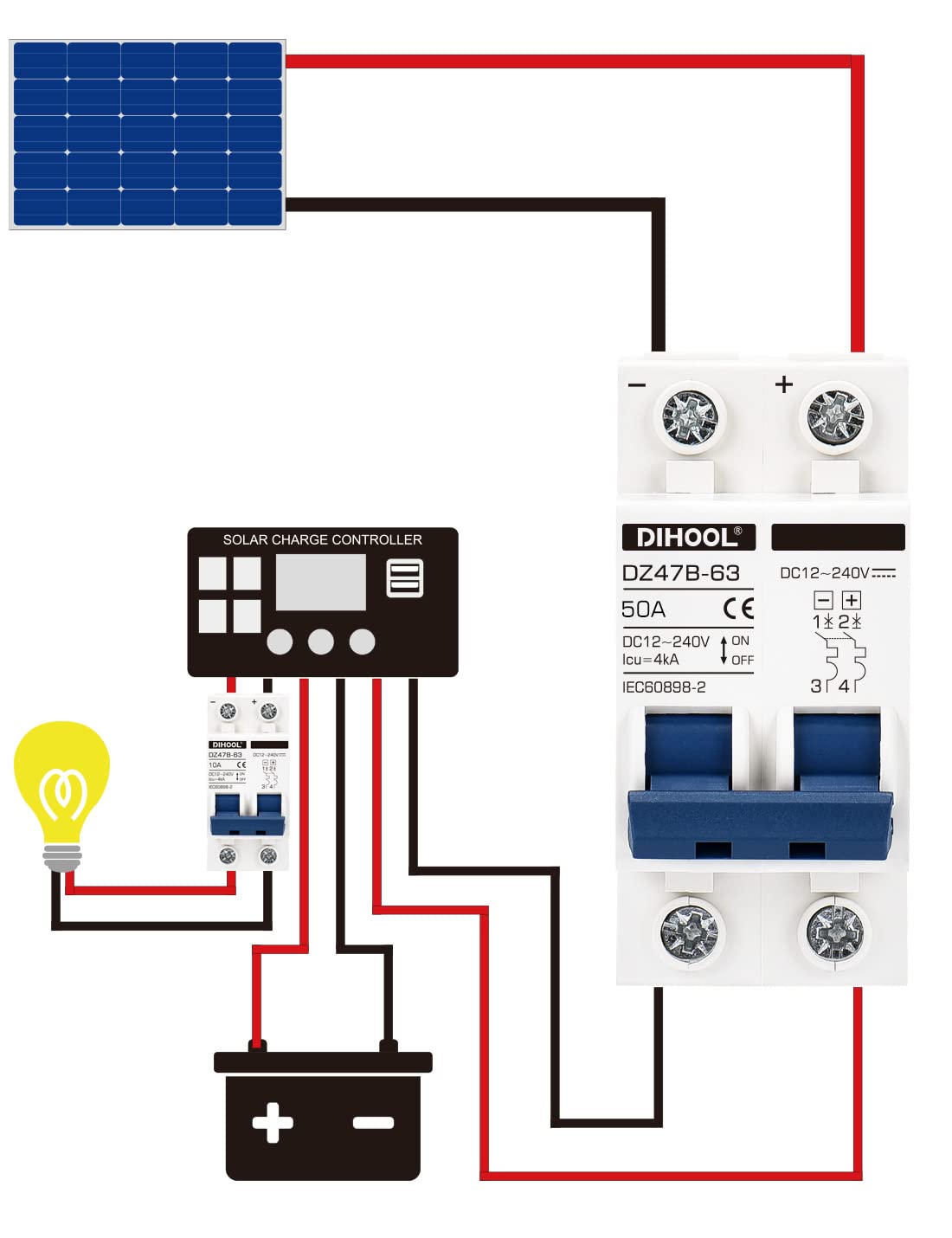
Image: A schematic diagram showing the DIHOOL DC Circuit Breaker connected within a solar power system, including solar panels, a charge controller, a battery, and a load.
6. Operation
Operating the DIHOOL DC Circuit Breaker is straightforward:
- Power On: Push the switch lever UP to the 'ON' position to close the circuit and allow current flow.
- Power Off/Isolation: Push the switch lever DOWN to the 'OFF' position to open the circuit and stop current flow. This isolates the downstream circuit.
- Trip Condition: If an overload or short circuit occurs, the circuit breaker will automatically trip to the 'OFF' position, protecting your system. Investigate and resolve the fault before attempting to reset the breaker.

Image: Illustration of the circuit breaker's quick disconnect function, showing the 'ON' (switch up) and 'OFF' (switch down) positions.
7. Maintenance
The DIHOOL DC Circuit Breaker is designed for minimal maintenance. However, periodic checks are recommended to ensure optimal performance and safety:
- Visual Inspection: Regularly inspect the circuit breaker for any signs of physical damage, discoloration, or loose connections.
- Terminal Tightness: Periodically check and re-tighten terminal screws to ensure secure wire connections. Loose connections can cause resistance, heat buildup, and potential failure.
- Cleanliness: Keep the circuit breaker free from dust, dirt, and moisture. Use a dry, soft cloth for cleaning. Do not use liquid cleaners.
- Functionality Test: If your system allows for safe testing, periodically switch the breaker ON and OFF to ensure smooth operation.
8. Troubleshooting
If you encounter issues with your DIHOOL DC Circuit Breaker, consider the following common troubleshooting steps:
- Breaker Trips Frequently:
Possible Cause: Overload or short circuit in the connected system.
Solution: Disconnect all loads and check for short circuits or excessive current draw. Ensure the total current of your loads does not exceed the breaker's 50A rating. - Breaker Does Not Reset:
Possible Cause: Persistent fault (short circuit/overload) or internal damage.
Solution: Ensure the fault has been cleared. If the breaker still does not reset, it may be damaged and require replacement. Do not force the lever. - No Power Through Breaker (when ON):
Possible Cause: Loose wiring, internal fault, or upstream power issue.
Solution: Check all wire connections for tightness. Verify power supply to the breaker. If connections are secure and power is present, the breaker may be faulty and need replacement. - Overheating:
Possible Cause: Loose connections, undersized wiring, or continuous overload.
Solution: Immediately disconnect power. Check and tighten all connections. Ensure wiring gauge is appropriate for the current (14AWG-4AWG). Verify that the load does not exceed 50A.
If problems persist after troubleshooting, consult a qualified electrician.
9. Warranty and Support
For warranty information or technical support regarding your DIHOOL DC Circuit Breaker, please refer to the product packaging or contact DIHOOL customer service directly through their official channels. Keep your purchase receipt for warranty claims.