
Introduction
This manual provides detailed instructions for the installation, use, maintenance, and troubleshooting of the Ferroli Pegaso Eco 14 gas water heater. Please read all instructions carefully before use to ensure safe and efficient operation of the appliance.
Safety Information
Safety is paramount when using a gas appliance. Always follow local regulations and manufacturer's instructions. Installation and maintenance must only be performed by qualified personnel.
- Do not install in confined areas with poor ventilation, such as bathrooms, unless specifically permitted by local regulations and the appliance type (open chamber).
- Ensure the installation area is well-ventilated.
- Regularly check for gas leaks.
- Do not obstruct ventilation openings.
- In case of gas odor, immediately shut off the gas supply, open windows, and contact a qualified technician.
Setup
1. Dimensions and Mounting
The Ferroli Pegaso Eco 14 water heater is designed for compact installation. Refer to the diagram below for dimensions and connection points.
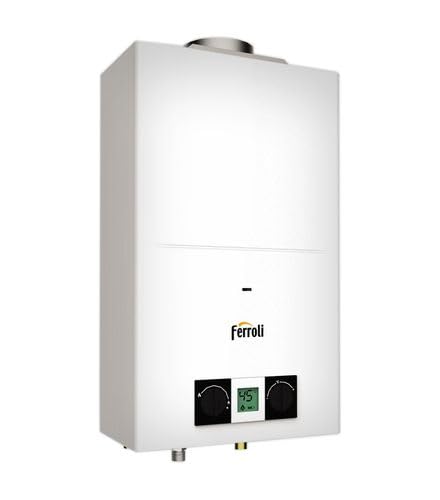
Image: Technical diagram with dimensions and connection points for Pegaso Eco 11 and 14 models. It shows front, side, and bottom views of the unit, with measurements in millimeters (L, B, C, P, E, F, H, H1). Connections for gas (1), domestic hot water inlet (2), cold water outlet (3), and flue gas outlet (4) are indicated.
Connection Point Legend:
- 1: Gas Inlet Ø ½"
- 2: Domestic Hot Water Inlet Ø ½"
- 3: Cold Water Outlet Ø ½"
- 4: Flue Gas Outlet: mod. 11 Ø 110 mm / mod. 14 Ø 130 mm
Dimensions (Pegaso Eco 14 Model):
- L (mm): 400
- B (mm): 220
- C (mm): 130
- P (mm): 187
- E (mm): 200
- F (mm): 93
- H (mm): 650
- H1 (mm): 678
2. Connections
Ensure all connections are tight and leak-free. Use appropriate gaskets for all joints.
Video: Detailed instructions for water heater installation and use, including unpacking, wall mounting, connecting water and gas pipes, and battery insertion.
Gas Connection:
Connect the gas pipe to the gas inlet (1). Ensure the rubber gasket is correctly positioned to prevent leaks. A pressure reducer with a pressure of 2800Pa is required for LPG gas.
Water Connection:
Connect the cold water pipe to the inlet (3) and the hot water pipe to the outlet (2). Verify that gaskets are present and intact to prevent leaks.
Battery Installation:
Open the battery compartment and insert 1.5V D-cell batteries, paying attention to positive and negative polarity. Batteries are not included.
Operating Instructions
1. Initial Startup
- Open the gas valve on the cylinder (if LPG) or the main gas valve (if natural gas).
- Turn on the power switch of the water heater.
- Open the water tap to start the flow. The water heater will automatically ignite and begin heating the water.
2. Temperature and Flow Adjustment
Use the knobs on the front panel to adjust the water temperature and gas flow. The digital display will show the current water temperature.
- Gas Knob (left): Adjusts the flame power. Turn towards 'Min' for a lower flame and cooler water, towards 'Max' for a higher flame and hotter water.
- Water Knob (right): Adjusts the water flow. Turn towards 'Min' for a slower water flow and higher temperature, towards 'Max' for a faster flow and lower temperature.
- Winter/Summer Mode: Select the appropriate mode to optimize gas consumption based on the season.
Maintenance
1. General Cleaning
Regularly clean the exterior of the water heater with a damp cloth. Do not use abrasive cleaners or solvents.
2. Polyphosphate Cartridge Replacement
If the water heater is equipped with a polyphosphate dispenser, the cartridge must be replaced periodically to prevent limescale buildup. Follow the specific instructions for the dispenser.
Video: Instructions on how to replace the polyphosphate tablet in a dispenser. The process includes unscrewing the container, extracting the bellows, inserting the new refill, and screwing the container back on.
3. Winter Drainage (Antifreeze)
To prevent freezing and damage to the appliance during cold periods or prolonged disuse, it is advisable to drain the water from the water heater. Close the gas and water supply, then open the hot and cold water taps to empty the circuit.
Troubleshooting
In case of problems, consult the following table for common solutions. If the problem persists, contact a qualified technician.
Video: Troubleshooting guide for common water heater issues, including water pressure problems, ignition problems, and battery issues. It demonstrates how to adjust knobs and check connections.
Common Issues:
- No Ignition or Weak Ignition:
- Check that the gas supply is open.
- Check the battery status and replace if discharged.
- Ensure ignition cable connectors are secure.
- Insufficient Water Pressure:
- Adjust the water flow knob to increase pressure.
- If pressure is consistently low, a booster pump at the water inlet may be necessary.
- Water Too Hot/Cold:
- Adjust the gas and water knobs to achieve the desired temperature.
- Check the Winter/Summer mode selection.
Technical Specifications
| Feature | Detail |
|---|---|
| Brand | Ferroli |
| Model | Pegaso Eco 14 (GCC1PKAA) |
| Type | Open Chamber |
| Gas Type | Natural Gas (convertible to LPG by authorized service) |
| Hot Water Production | 14 Liters/Minute |
| Delivery | Instantaneous |
| Dimensions (H x W x D) | 678 x 400 x 187 mm |
| Emissions | LOW NOx - Class 6 |
| Heat Exchanger | Finned copper tubes with anti-corrosion treatment |
| Power Supply | Battery-powered |
Warranty
This product is covered by a Ferroli Italia warranty for a duration of 2 years from the date of purchase. Please retain your proof of purchase for any warranty claims. The warranty covers manufacturing defects and malfunctions under normal use conditions.
Support
For technical assistance, installation, or maintenance, please contact an Authorized Ferroli Technical Service Center. Intervention by unqualified personnel may void the warranty and compromise the safety of the appliance.