
FEIYUE FYe300
FEIYUE FYe300 Full Size Sewing Machine Instruction Manual
Model: FYe300
1. Introduction
This manual provides detailed instructions for the safe and efficient operation of your FEIYUE FYe300 Full Size Sewing Machine. Please read this manual thoroughly before using the machine to ensure proper setup, operation, and maintenance. Keep this manual for future reference.
2. Product Overview
The FEIYUE FYe300 is a versatile sewing machine designed for various sewing projects, suitable for both beginners and experienced users. It features a powerful servo motor, 105 stitch applications, and an automatic needle threader for ease of use.
Key Features:
- Thread Jam Protection: Automatic stop and light blink alert for tangled threads or overload, protecting the motor and fabric.
- Powerful Servo Motor: Improved efficiency by 10% and up to 35% power saving compared to traditional induction motors.
- 105 Stitch Applications: Includes 25 built-in stitches, buttonhole stitches, decorative, and stretch stitches.
- Automatic Needle Threader: Simplifies threading, saving time and effort.
- Stabilized Stitch: Integrated metal frame ensures ultra-low speed sewing with large torque, delivering consistent results on various fabrics from delicate silk to heavy denim.
Included Components:
The FEIYUE FYe300 domestic sewing machine comes with the following accessories:
- 6 Bobbins
- 3 Needles
- 4 Sewing Feet (Buttonhole Foot, Guide Presser Foot, Zipper Foot, Button Fitting Foot)
- Embroiderer Plate
- Multi-function Screwdriver
- Instructional DVD
- Instructional USB Flash Drive
- Foot Pedal
- Seam ripper/brush

Image: Overview of the FEIYUE FYe300 sewing machine and its standard accessories, including bobbins, needles, various presser feet, and tools.
3. Setup
3.1 Unpacking and Placement
Carefully remove the sewing machine and all accessories from the packaging. Place the machine on a stable, flat surface with adequate lighting. Ensure the power cord can reach an electrical outlet without strain.
3.2 Winding the Bobbin
Before you begin sewing, the bobbin needs to be wound with thread. Place a spool of thread on the spool pin. Guide the thread through the tension disc and around the bobbin. Place the bobbin onto the bobbin winder spindle and push it to the right. Press the foot pedal to start winding. Stop when the bobbin is full.

Image: A close-up view of the bobbin winding process on the machine, showing the thread spool and the bobbin on its spindle.
3.3 Inserting the Bobbin
Open the bobbin cover located on the sewing machine's bed. Insert the wound bobbin into the bobbin case, ensuring the thread unwinds in the correct direction (usually counter-clockwise). Guide the thread through the tension spring and pull it out a few inches. Close the bobbin cover securely.

Image: A detailed view of the bobbin case area, showing how to correctly insert the bobbin with the thread guided through the tension spring.
3.4 Threading the Upper Thread and Automatic Needle Threader
Place the upper thread spool on the spool pin. Follow the numbered threading path indicated on the machine, guiding the thread through the thread guides, tension discs, and take-up lever. For the needle, use the automatic needle threader: lower the presser foot, pull down the threader lever, hook the thread, and release the lever to thread the needle quickly.

Image: Close-up of the automatic needle threader mechanism, showing how it guides the thread through the needle eye.
4. Operating Instructions
4.1 Selecting Stitches
The FEIYUE FYe300 offers 25 built-in stitches, including utility, decorative, and buttonhole stitches, providing 105 stitch applications. To select a stitch, turn the Pattern Selector Dial to the desired letter (A-L) or symbol corresponding to the stitch pattern. Adjust the stitch length and width as needed using the appropriate dials.
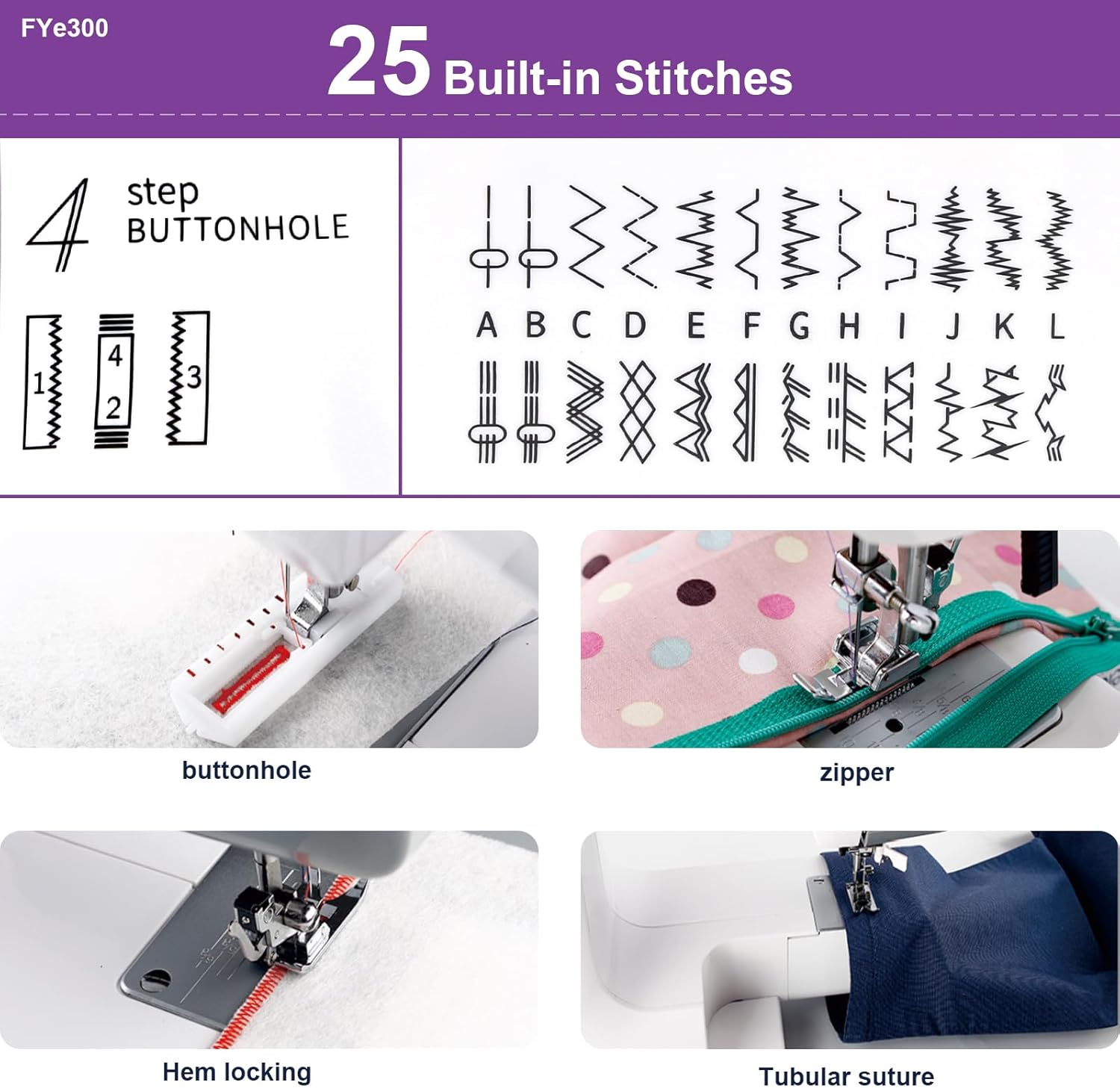
Image: The stitch selection dial and a diagram showing the 25 built-in stitch patterns available on the FEIYUE FYe300.

Image: A close-up of the 4-step buttonhole selector, indicating the sequence for creating buttonholes.
4.2 Basic Sewing (Straight Stitch)
After threading, place your fabric under the presser foot. Lower the presser foot lever. Gently press the foot pedal to start sewing. The machine will create a straight stitch. To reinforce the stitch at the beginning and end, use the reverse sewing lever.
4.3 Reverse Sewing
To sew in reverse, press and hold the reverse sewing lever (usually a button or lever on the front of the machine). The machine will sew backward. Release the lever to resume forward sewing. This is useful for securing seams.

Image: A close-up of the reverse sewing button, which allows the machine to sew backward to reinforce stitches.
4.4 Sewing Buttonholes
Attach the buttonhole foot. Select the 4-step buttonhole setting on the pattern selector dial. Follow the steps (1-4) indicated on the machine or in the detailed instructional DVD/USB to create a perfectly sized buttonhole. Ensure the fabric is properly positioned.

Image: The buttonhole foot attached to the machine, demonstrating its use for sewing buttonholes on fabric.
4.5 Cutting the Thread
After completing a seam, lift the presser foot and pull the fabric towards the back. Use the thread cutter located on the side of the machine to cleanly cut both the upper and bobbin threads.

Image: A close-up of the built-in thread cutter, showing how to use it to trim threads after sewing.
4.6 General Operation Video Guide
For a visual guide on the basic operations of the FEIYUE FYe300 sewing machine, including bobbin winding, threading, stitch selection, and reverse sewing, please watch the video below.
Video: A comprehensive demonstration of the FEIYUE FYe300 sewing machine's features and basic operations, including bobbin winding, threading, stitch selection, and reverse sewing.
5. Maintenance
Regular maintenance ensures the longevity and optimal performance of your sewing machine.
- Cleaning: Regularly clean lint and dust from the bobbin area, feed dogs, and tension discs using the provided brush or a soft cloth.
- Oiling: Refer to the instructional DVD/USB for specific oiling points and frequency. Use only high-quality sewing machine oil.
- Needle Replacement: Replace needles frequently (after 8-10 hours of sewing or when bent/dull) to prevent skipped stitches and fabric damage.
- Storage: When not in use, cover the machine to protect it from dust and store it in a dry place.
6. Troubleshooting
If you encounter issues with your sewing machine, refer to the following common problems and solutions:
| Problem | Possible Cause | Solution |
|---|---|---|
| Skipped Stitches | Incorrect needle, bent needle, improper threading, incorrect tension. | Replace needle with correct type/size, re-thread machine, adjust tension. |
| Thread Breaking | Poor quality thread, incorrect threading, high tension, bent needle, burr on needle plate. | Use quality thread, re-thread, adjust tension, replace needle, check for burrs. |
| Fabric Puckering | Incorrect tension, wrong needle for fabric, too short stitch length. | Adjust tension, use appropriate needle, increase stitch length. |
| Machine Jams | Thread tangled in bobbin area, fabric pulled too hard, machine overloaded. | Clear thread jam (refer to Thread Jam Protection feature), avoid forcing fabric, reduce load. |
For more detailed troubleshooting, consult the instructional DVD or USB flash drive included with your machine.
7. Specifications
| Feature | Detail |
|---|---|
| Brand | FEIYUE |
| Model Number | FYe300 |
| Colour | White |
| Material | Metal, Plastic |
| Product Dimensions (D x W x H) | 16D x 36.8W x 33.8H Centimetres |
| Item Weight | 6 Kilograms |
| Power Source Type | Corded Electric |
| Stitch Applications | 105 (25 built-in stitches) |
| Motor Type | Powerful Servo Motor |
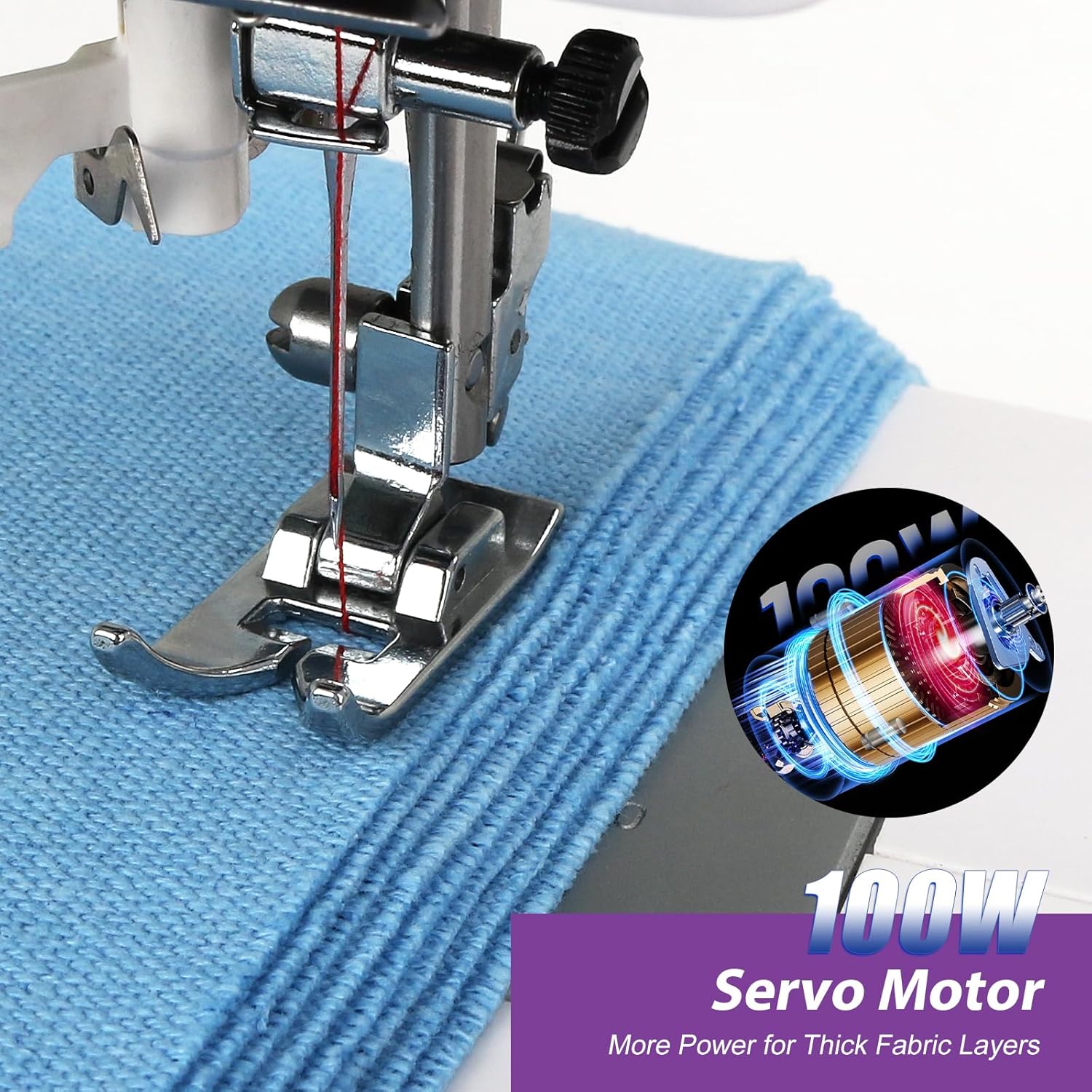
Image: Diagram showing the dimensions (length, width, height) of the FEIYUE FYe300 sewing machine.

Image: An internal view of the FEIYUE FYe300, highlighting its durable metal frame construction.

Image: A close-up illustrating the powerful servo motor, emphasizing its capability for sewing thick fabrics.
8. Warranty and Support
For warranty information, please refer to the documentation included with your purchase or contact FEIYUE customer support. If you require assistance or have questions not covered in this manual, please reach out to the manufacturer's support channels.
Related documentsFYe300


Ask a question about this manual
Ask about setup, troubleshooting, compatibility, parts, safety, or missing instructions. Manuals+ will review the question and use this page’s manual context to help answer it.