
1. Introduction
Thank you for choosing the Asani Indoor Air Quality Monitor. This device is designed to provide real-time, comprehensive monitoring of various air pollutants and environmental factors in your indoor spaces. With its advanced sensors, it detects 8 major air pollutants including Carbon Dioxide (CO2), Volatile Organic Compounds (VOCs), Formaldehyde (HCHO), Air Quality Index (AQI), Particulate Matter (PM2.5, PM10), as well as humidity and temperature. This manual provides essential information for the proper setup, operation, and maintenance of your monitor to ensure accurate readings and long-lasting performance.
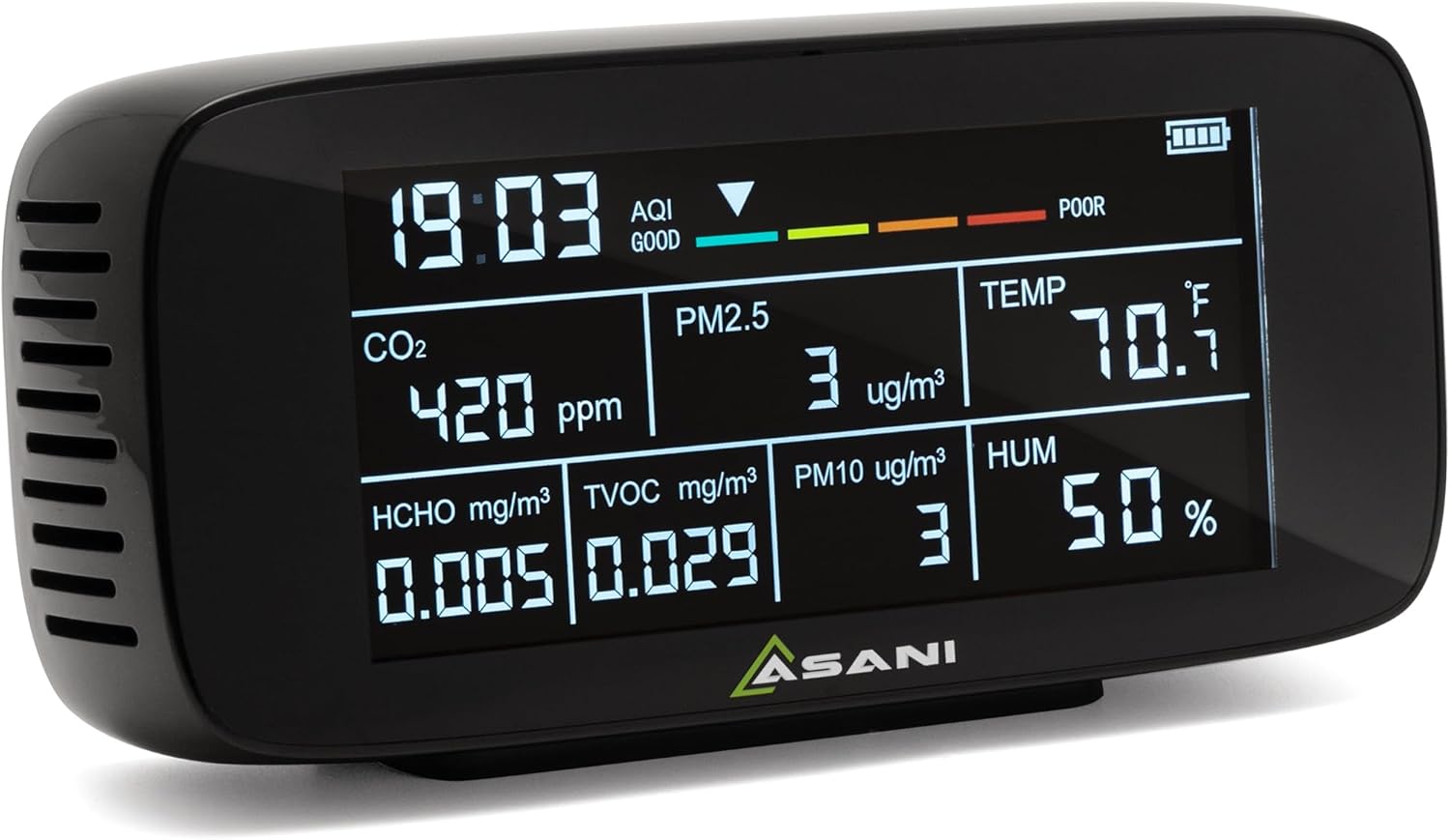
Image: Asani Indoor Air Quality Monitor, front view showing the display with time, AQI, CO2, PM2.5, PM10, HCHO, TVOC, temperature, and humidity readings.
2. Product Features
- Comprehensive Monitoring: Equipped with ultra-precise sensors to detect CO2, VOCs, formaldehyde, AQI, PM2.5, PM10, humidity, and temperature.
- Portable and Versatile: Designed for easy portability, suitable for monitoring air quality in homes, offices, vehicles, and areas affected by environmental factors like wildfires.
- User-Friendly Interface: Features a clear, easy-to-read display for stress-free setup and operation, without the need for Wi-Fi or app-based controls.
- Extended Battery Life: Powered by a 3000 mAh rechargeable lithium polymer battery, offering up to 11 hours of continuous operation.
- Automatic Shutdown: Includes an "Auto-Shutdown" feature that powers down the device after 11 hours to extend its lifespan and maintain performance.
- Real-time Data: Provides instant readings for all detected parameters, allowing for immediate assessment of air quality.

Image: A visual representation of the 9-in-1 functionality, listing pollutant types (CO2, PM2.5, PM10, HCHO, TVOC) with common sources, and additional functions (AQI, Time, Temperature, Humidity).
3. Device Components
Familiarize yourself with the key components and display indicators of your Asani Air Quality Monitor:

Image: Front and top view of the Asani Air Quality Monitor with labels pointing to: Time, AQI (Air Quality Index), Battery Level, CO2 (Carbon Dioxide), HCHO (Formaldehyde), TVOC (Total Volatile Organic Compounds), PM2.5, PM10, Temperature, Humidity, and USB-C Rechargeable port.
- Display Screen: Shows all real-time readings and indicators.
- Power Button: Located on the back/side for turning the device on/off.
- USB-C Charging Port: For recharging the internal battery.
- Air Vents: Located on the sides and back for air circulation to the sensors.
- Indicators:
- Time: Current time display.
- AQI (Air Quality Index): Overall air quality indicator (Good, Moderate, Caution, Unhealthy).
- Battery Level: Indicates remaining battery charge.
- CO2 (Carbon Dioxide): Measured in parts per million (ppm).
- PM2.5 / PM10: Particulate matter measured in micrograms per cubic meter (µg/m³).
- HCHO (Formaldehyde): Measured in milligrams per cubic meter (mg/m³).
- TVOC (Total Volatile Organic Compounds): Measured in milligrams per cubic meter (mg/m³).
- TEMP (Temperature): Measured in degrees Fahrenheit (°F) or Celsius (°C).
- HUM (Humidity): Measured in percentage (%).
4. Setup
- Unboxing: Carefully remove the Asani Air Quality Monitor from its packaging. Ensure all components are present: the monitor unit, USB-C charging cable, and this manual.
- Initial Charge: Before first use, it is recommended to fully charge the device. Connect the provided USB-C charging cable to the monitor's USB-C port and plug the other end into a compatible USB power adapter (not included). The battery indicator on the display will show charging status.
- Power On: Press and hold the power button (usually located on the back or side) for a few seconds until the display lights up.
- Initial Calibration:
IMPORTANT: For accurate readings, the device requires a calibration process upon startup and whenever it is moved to a new location. Allow the monitor to run for approximately 10 minutes in the desired environment for the air to circulate through its sensors and for calibration to complete. During this time, HCHO values may initially decrease as the device stabilizes.
- Placement: Place the monitor in a central location within the area you wish to monitor. Ensure air vents are not obstructed. Avoid placing it directly next to windows, air conditioners, heaters, or in direct sunlight, as this can affect temperature and humidity readings.
5. Operating Instructions
5.1. Understanding the Display
The large, clear display provides real-time readings for all monitored parameters. The Air Quality Index (AQI) bar at the top offers a quick visual summary of overall air quality:

Image: Chart explaining AQI levels: Good (Green), Moderate (Yellow), Caution (Orange), Unhealthy (Red), with descriptions for each category.
- Good (Green): Air quality is satisfactory, and air pollution poses little or no risk.
- Moderate (Yellow): Air quality is acceptable. However, there may be a risk for some people, particularly those who are unusually sensitive to air pollutant.
- Caution (Orange): Members of sensitive groups may experience health effects. The general public is less likely to be affected.
- Unhealthy (Red): Some members of the general public may experience health effects; members of sensitive groups may experience more serious health effects.
5.2. Continuous Monitoring
Once powered on and calibrated, the monitor will continuously display the current air quality data. You can move the device between rooms as needed, remembering to allow for a brief recalibration period (approx. 10 minutes) after relocation for optimal accuracy.
5.3. CO2 Alarm Function
The device may include an audible alarm function for high CO2 levels. If CO2 levels exceed a preset threshold (e.g., 1000 ppm), the monitor may beep to alert you to potentially poor ventilation. Refer to the device's specific button functions (if any) for adjusting or silencing this alarm.
5.4. Automatic Shutdown Feature
To conserve battery and extend the device's lifespan, the monitor is equipped with an automatic shutdown feature. It will power down automatically after approximately 11 hours of continuous operation. To resume monitoring, simply press the power button again.
6. Maintenance
- Cleaning: Gently wipe the device with a soft, dry cloth. Do not use abrasive cleaners, solvents, or immerse the device in water. Ensure no liquid enters the air vents.
- Sensor Care: The sensors are delicate. Avoid exposing the device to excessive dust, moisture, or extreme temperatures, which can affect sensor accuracy and lifespan. Do not attempt to clean the internal sensors.
- Storage: When not in use for extended periods, store the monitor in a cool, dry place away from direct sunlight and extreme temperatures. It is advisable to fully charge the battery before long-term storage.
- Battery: The device uses a built-in rechargeable lithium polymer battery. Do not attempt to replace the battery yourself. If the battery performance significantly degrades, contact customer support.
7. Troubleshooting
| Problem | Possible Cause | Solution |
|---|---|---|
| Device does not turn on. | Battery is depleted. | Connect the device to a power source using the USB-C cable and allow it to charge for at least 30 minutes before attempting to power on again. |
| Readings seem inaccurate or fluctuate wildly. | Device not fully calibrated or recently moved. Air vents are obstructed. Exposure to strong fumes or drafts. | Ensure the device has been running for at least 10 minutes in its current location for calibration. Check that air vents are clear. Move the device away from direct sources of pollution (e.g., cleaning products, cooking fumes) or strong air currents. |
| CO2 alarm sounds frequently. | High CO2 levels detected. | Increase ventilation in the room by opening windows or doors. Reduce the number of occupants in the space if possible. |
| Battery life is shorter than expected. | Battery degradation over time. Continuous operation without auto-shutdown. | Ensure the auto-shutdown feature is functioning. If significant degradation occurs, contact customer support for assistance. |
8. Specifications
| Parameter | Detail |
|---|---|
| Model Number | DM197 |
| Brand | Asani |
| Detected Pollutants | CO2, VOCs, Formaldehyde (HCHO), PM2.5, PM10 |
| Additional Measurements | AQI (Air Quality Index), Temperature, Humidity |
| Power Source | Battery Powered (Rechargeable Lithium Ion) |
| Battery Capacity | 3000 mAh |
| Operating Time | Up to 11 hours (continuous) |
| Charging Port | USB-C |
| Item Weight | 12.32 ounces (approx. 349 grams) |
| Dimensions | Approx. 7.4 x 3.46 x 1.65 inches (based on image PT01) |
| Sensor Type | Ionization (for some parameters) |
| Measurement Accuracy | 1 ppm (for CO2, as per spec) |
9. Warranty Information
Asani products are manufactured with high-quality standards. For specific warranty details, including coverage period and terms, please refer to the warranty card included with your product packaging or visit the official Asani website. Please retain your proof of purchase for any warranty claims.
10. Customer Support
If you encounter any issues or have questions regarding your Asani Indoor Air Quality Monitor, please do not hesitate to contact our customer support team.
- Online Support: Visit the official Asani website for FAQs, troubleshooting guides, and contact forms.
- Email Support: Refer to your product packaging or the official website for the customer service email address.
- Phone Support: Check the official Asani website for available phone support numbers and operating hours.
When contacting support, please have your product model number (DM197) and purchase details ready.