
1. Introduction
Thank you for choosing the OVONIC 6S LiPo Battery 4000mAh 22.2V 150C with XT90 Plug. This high-performance LiPo battery is engineered for demanding RC applications, including FPV drones, RC cars, trucks, and other hobby vehicles. It features a 4000mAh capacity, 22.2V (6S) voltage, and a 150C continuous discharge rate, providing reliable power and agility for your RC adventures. This manual provides essential information for safe operation, charging, maintenance, and storage of your battery.
2. Important Safety Precautions
Lithium Polymer (LiPo) batteries are powerful and can be dangerous if not handled correctly. Failure to follow these instructions can result in fire, personal injury, and property damage. Always read and understand all safety warnings before use.
- Charging Safety:
- Always use a LiPo-compatible charger with a balance function.
- Never charge unattended.
- Charge in a fire-safe area, away from flammable materials, and preferably in a LiPo-safe bag or container.
- Do not overcharge. The maximum voltage per cell is 4.2V (25.2V for a 6S battery).
- Do not charge damaged or swollen batteries.
- Ensure correct polarity when connecting to the charger.
- Discharging Safety:
- Do not over-discharge. The minimum safe voltage per cell is 3.0V (18.0V for a 6S battery). Over-discharging can permanently damage the battery.
- Monitor battery voltage during use, especially in RC applications.
- Storage Safety:
- Store batteries at room temperature (15-25°C or 59-77°F) in a dry, well-ventilated area.
- Store at a storage voltage of 3.8V-3.85V per cell (22.8V-23.1V for a 6S battery).
- Keep away from direct sunlight, heat sources, and flammable materials.
- Store in a LiPo-safe bag or container.
- Handling Safety:
- Do not puncture, disassemble, short-circuit, or expose to water or extreme temperatures.
- If the battery swells, immediately place it in a fire-safe container outdoors and observe it. Do not use a swollen battery.
- Keep out of reach of children and pets.
- Disposal:
- Do not dispose of LiPo batteries in regular trash.
- Discharge the battery completely before disposal.
- Recycle at a local battery recycling center or follow local regulations for LiPo battery disposal.
3. Product Specifications
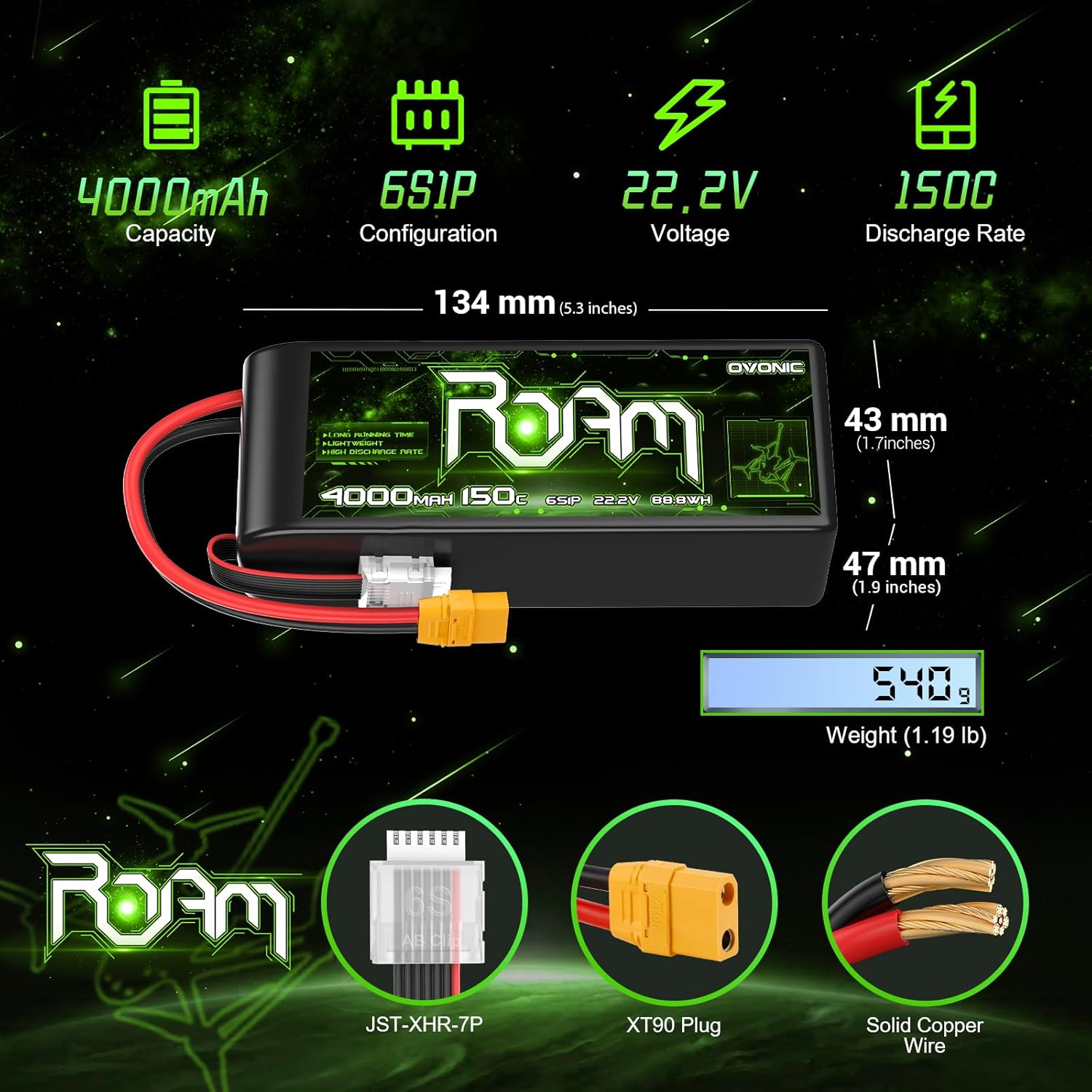
Image: Detailed view of the OVONIC 6S LiPo battery, highlighting its capacity, configuration, voltage, discharge rate, dimensions, weight, and connector types (JST-XHR-7P, XT90 Plug, Solid Copper Wire).
| Feature | Specification |
|---|---|
| Chemistry | Li-polymer (LiPo) |
| Capacity | 4000mAh |
| Voltage | 22.2V (6S) |
| Continuous Discharge Rate | 150C |
| Max Burst Discharge Rate | 300C |
| Charge Plug | JST-XHR-7P |
| Discharge Plug | XT90 Plug |
| Pack Type | Softcase |
| Net Weight | 566g / 1.25lb (with ±20g variance) |
| Size (L x W x H) | 134x43x47mm / 5.3x1.7x1.9inch (with ±5mm variance) |
4. Setup and Charging
Before using your OVONIC LiPo battery, it is crucial to properly charge it. Always follow the safety precautions outlined in Section 2.
- Inspect the Battery: Before each charge, visually inspect the battery for any signs of damage, swelling, or exposed wires. Do not charge a damaged battery.
- Prepare the Charger: Use a high-quality LiPo balance charger. Set the charger to the correct battery type (LiPo), cell count (6S), and charging current (typically 1C, which is 4.0A for a 4000mAh battery). Refer to your charger's manual for specific settings.
- Connect the Battery: Connect the main XT90 discharge plug to the charger's output port. Then, connect the JST-XHR-7P balance plug to the charger's balance port. Ensure both connections are secure and correctly oriented.
- Start Charging: Initiate the balance charging process on your charger. Stay near the battery and charger during the entire charging cycle.
- Monitor Charging: The charger will monitor individual cell voltages and stop charging when the battery reaches its full capacity (4.2V per cell, 25.2V total for 6S). Do not attempt to charge beyond this voltage.
- Disconnect: Once charging is complete, disconnect the balance plug first, then the main discharge plug from the charger.

Image: Illustrates the importance of real capacity and safety design in LiPo batteries, contrasting OVONIC's performance and safety features with inferior alternatives. Highlights up to 350 cycle times.
5. Operating Instructions
Proper operation ensures optimal performance and longevity of your OVONIC LiPo battery.
- Connect to Device: Securely connect the XT90 discharge plug of the battery to the corresponding connector on your RC vehicle or drone. Ensure the connection is firm to prevent power interruptions during operation.
- Monitor Voltage: During use, continuously monitor the battery voltage, especially if your device does not have a low-voltage cut-off. Do not allow the voltage to drop below 3.0V per cell (18.0V for a 6S battery) to prevent irreversible damage.
- Avoid Over-Discharge: When you notice a significant drop in power or performance, stop using the battery immediately. Continuing to discharge past the safe voltage limit will damage the battery.
- Temperature Management: Avoid operating the battery in extremely hot conditions. If the battery becomes excessively hot during use, allow it to cool down before recharging or further use.

Image: The OVONIC 6S LiPo battery securely mounted within an FPV drone, demonstrating its application in high-performance RC vehicles.
6. Maintenance and Storage
Proper maintenance and storage are essential for maximizing the lifespan and safety of your LiPo battery.
- Storage Voltage: For long-term storage (more than 3 days), charge or discharge the battery to a storage voltage of 3.8V-3.85V per cell (22.8V-23.1V for a 6S battery). Most LiPo chargers have a dedicated 'Storage' mode.
- Storage Environment: Store the battery in a cool, dry place, away from direct sunlight, heat sources, and flammable materials. An ideal temperature range is 15-25°C (59-77°F).
- Physical Inspection: Regularly inspect the battery for any physical damage, swelling, or signs of wear on the wires and connectors. Discontinue use if any damage is observed.
- Cycle Life: The OVONIC LiPo battery is designed for extended cycle life, with a stacking process that extends it to 350+ times when properly maintained.
- Connector Care: Keep the XT90 and JST-XHR-7P connectors clean and free from dirt or corrosion to ensure reliable connections.

Image: Illustrates the internal stacking process of the OVONIC LiPo battery, which contributes to its extended cycle life of 350+ times, high energy density (128Wh/L), and low micro internal resistance (<5mΩ).
7. Troubleshooting
If you encounter issues with your OVONIC LiPo battery, refer to the following common problems and solutions:
- Battery Not Charging:
- Ensure all connections (main and balance plugs) are secure and correctly inserted into the charger.
- Verify that the charger settings (battery type, cell count, current) are correct for a 6S LiPo battery.
- Check if the battery is severely over-discharged (below 3.0V per cell). Some chargers may refuse to charge such batteries for safety.
- Inspect the battery and charger for any visible damage.
- Battery Swelling:
- Immediately discontinue use and charging.
- Place the battery in a fire-safe container outdoors.
- Swelling indicates internal damage, often due to overcharging, over-discharging, or physical impact. Do not attempt to use or repair a swollen battery. Dispose of it safely according to Section 2.
- Reduced Run Time/Performance:
- Ensure the battery is fully charged and balanced before use.
- Check for signs of aging or damage. LiPo batteries naturally degrade over many cycles.
- Verify that the battery's C-rating and capacity are appropriate for your application's power demands.
- Ensure proper storage conditions are maintained when not in use.
- Overheating During Use:
- This can indicate that the battery is being pushed beyond its limits (e.g., too high current draw for the C-rating) or has internal damage.
- Reduce the load on the battery or consider a battery with a higher C-rating or capacity for your application.
- If overheating persists, discontinue use and inspect for damage.
8. Compatibility
The OVONIC 6S LiPo Battery is designed for a wide range of high-performance RC applications, including:
- 7-10 inch 400mm-450mm X8 FPV Drones
- 10-inch X-CLASS Vehicles
- Long Range Drones
- 6S HD Cinelifters
- Multirotors
- 1/7 and 1/8 Scale RC Vehicles (Truck, Truggy, Buggy, Tank, Car)
- FMS EDF Jets and 3D Planes
- Size 700mm to 800mm Helicopters
- RC Airplanes, MultiCopters, RC Boats, and other RC Hobbies
Specific Drone Compatibility:
- G-EPRC: MARK4, MK5D-LR7, MARK4 LR8, MARK4 LR10, Crocodile75 V3
- i-flight: Helion 10 O3 6S HD, Proxima 6 6S HD Cinelifter, Centurion X8 O3 6S HD, Taurus X8 V3 O3 6S HD Cinelifter, Chimera7 Pro, Chimera 7.5
9. Package Contents
The OVONIC 6S LiPo Battery package includes the following items:
- 1 x OVONIC 6S Lipo Battery 4000mAh 22.2V with XT90 Plug
- 2 x Brand Stickers
- 1 x User Manual (this document)

Image: The OVONIC 6S LiPo battery package contents, including the battery, brand stickers, and user manual, presented in its retail packaging.
10. Warranty and Support
OVONIC is committed to providing high-quality products and customer satisfaction. For any questions, technical support, or warranty inquiries regarding your OVONIC 6S LiPo Battery, please contact our customer service team through the retailer where you purchased the product or visit the official OVONIC website for contact information.
Please retain your proof of purchase for warranty claims.


