
1. Introduction
Thank you for choosing the GoolRC Triple Channel Dash Cam. This device is designed to enhance your driving safety by providing comprehensive video recording from the front, inside, and rear of your vehicle. This manual provides detailed instructions for installation, operation, and maintenance to ensure optimal performance and longevity of your dash cam.
2. Package Contents
Please verify that all items listed below are included in your package:
- Host with Front Camera and In-Car Camera
- Rearview Camera
- Car-use Power Cable
- User Manual (this document)
- Installation Tools Set
- Memory Card (if included with your specific model)
3. Product Overview
The GoolRC Triple Channel Dash Cam features a compact design with integrated front and cabin cameras, and a separate rear camera for comprehensive coverage.

Figure 3.1: Front view of the GoolRC Dash Cam, displaying the main screen, front camera lens, and control buttons. This image illustrates the primary components visible from the driver's perspective.
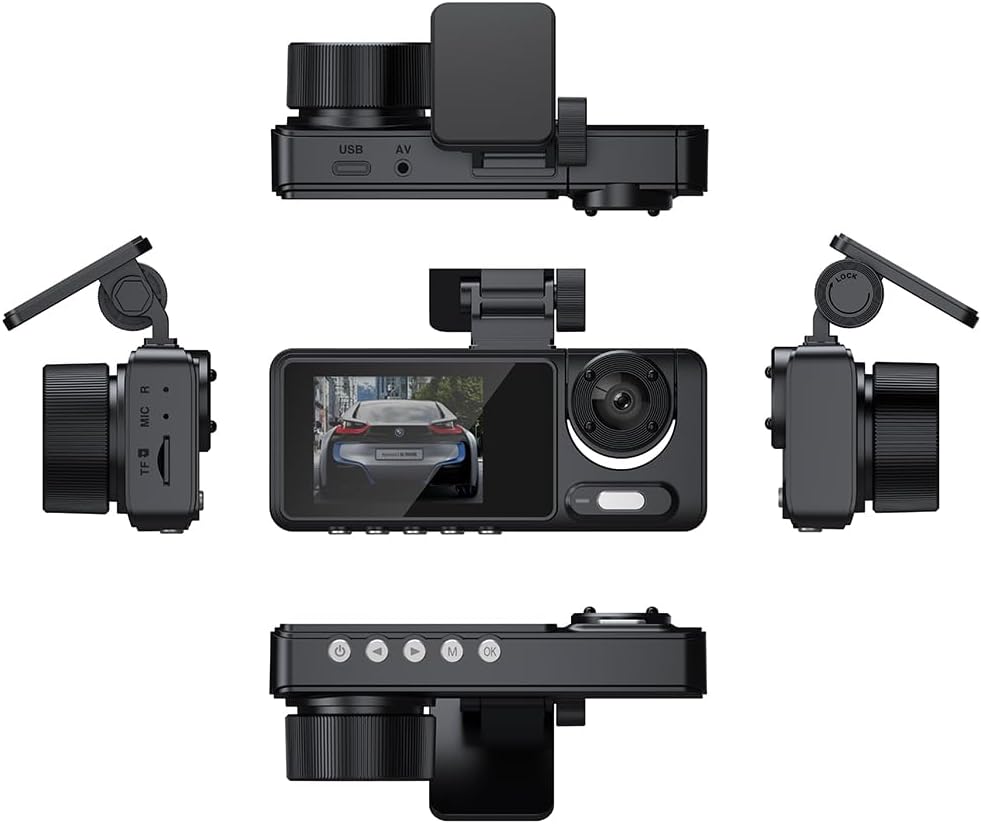
Figure 3.2: Multiple views of the GoolRC Dash Cam, including top, bottom, front, back, and side profiles. This provides a detailed look at all ports, buttons, and camera lenses for better understanding of the device's physical layout.
The dash cam is equipped with a triple channel system:
- Front Camera: 140° wide-angle lens to capture the road ahead.
- Cabin Inside Camera: 90° lens to record the vehicle's interior.
- Rear Camera: 90° lens for recording the view behind the vehicle.

Figure 3.3: A visual representation of the dash cam's triple channel system, showing the coverage areas of the front (140°), cabin (90°), and rear (90°) cameras. This diagram clarifies how the three cameras provide comprehensive surveillance.
4. Installation
Follow these steps for proper installation of your GoolRC Dash Cam:
- Prepare the Mounting Location: Choose a location on your windshield that does not obstruct your view of the road. Typically, this is behind the rearview mirror. Clean the area thoroughly to ensure proper adhesion.
- Mount the Main Unit: Attach the main dash cam unit to the windshield using the provided suction cup mount or adhesive pad. Ensure it is securely fastened and the front camera has a clear view of the road.
- Install the Rear Camera: Connect the rear camera to the main unit using the provided cable. Route the cable neatly along the vehicle's headliner and pillars to the rear of the vehicle. Mount the rear camera on the rear windshield, ensuring a clear view.
- Connect Power: Plug the car-use power cable into the dash cam's power port and then into your vehicle's 12V power outlet (cigarette lighter socket). Route the cable discreetly to avoid interference with driving.
- Insert Memory Card: Insert a compatible MicroSD card (up to 128GB, not included) into the designated slot on the dash cam. Ensure the card is inserted correctly.

Figure 4.1: The GoolRC Dash Cam installed on a car windshield, illustrating its user-friendly setup process. The image shows the dash cam positioned to capture the road ahead without obstructing the driver's view.
5. Initial Setup
After installation, perform the following initial setup steps:
- Power On: Start your vehicle. The dash cam should automatically power on and begin recording.
- Format Memory Card: It is highly recommended to format the MicroSD card within the dash cam's settings menu before first use and periodically thereafter. This ensures optimal performance and prevents data corruption.
- Set Date and Time: Navigate to the settings menu to set the correct date and time. This is crucial for accurate timestamps on your recordings.
- Language Selection: Select your preferred language from the available options (Russian, Japanese, French, Italian, German, English, Chinese (simplified), Chinese (Traditional), Korean, Spanish, Portuguese).
6. Operating Instructions
The GoolRC Dash Cam is designed for automatic operation, but also offers various features for enhanced recording.
6.1. Automatic Recording
Once powered on, the dash cam will automatically begin recording. When the vehicle is turned off, the dash cam will save the current recording and power down.
6.2. Loop Recording
The dash cam continuously records video in short segments (e.g., 1, 3, or 5 minutes). When the memory card is full, the oldest unlocked recordings are automatically overwritten by new footage. This ensures continuous recording without manual intervention.

Figure 6.1: An illustration depicting the automatic deletion feature of the GoolRC Dash Cam, where older, unlocked video files are overwritten to make space for new recordings once the memory card reaches its capacity.
6.3. G-Sensor (Collision Lock)
The built-in G-sensor detects sudden impacts or collisions. When a collision is detected, the current video segment is automatically locked and protected from being overwritten by loop recording. These locked files serve as crucial evidence.

Figure 6.2: This image highlights the seamless loop recording and collision lock function of the GoolRC Dash Cam. It shows a car accident scenario with a lock icon, indicating that video footage of the event is automatically secured by the G-sensor.
6.4. Parking Monitoring (24-Hour)
When enabled, the dash cam can monitor your vehicle even when parked. If a collision or vibration is detected while the vehicle is off, the dash cam will automatically power on, record a short video, and then power off. This feature requires a continuous power supply (e.g., hardwire kit, not included) to function for 24 hours.
6.5. Clear Night Viewing
Equipped with advanced night viewing technology, the dash cam ensures clear and detailed footage even in low-light conditions, improving visibility during nighttime driving or in dark environments.

Figure 6.3: A visual comparison demonstrating the effectiveness of the GoolRC Dash Cam's night viewing technology, with a split screen showing how visibility is enhanced in low-light conditions compared to standard recording.
7. WiFi Connectivity (Optional)
For models equipped with a built-in WiFi module, you can connect the dash cam to your mobile phone for real-time viewing, video playback, and settings adjustments.
- Download App: Search for the designated dash cam application on your smartphone's app store (iOS or Android).
- Enable WiFi: Turn on the WiFi function on your dash cam via the settings menu.
- Connect to Dash Cam: On your smartphone, go to WiFi settings and connect to the dash cam's WiFi network (SSID and password usually displayed on the dash cam screen or in the manual).
- Access Features: Open the app to view live footage, download recordings, or modify settings directly from your phone.
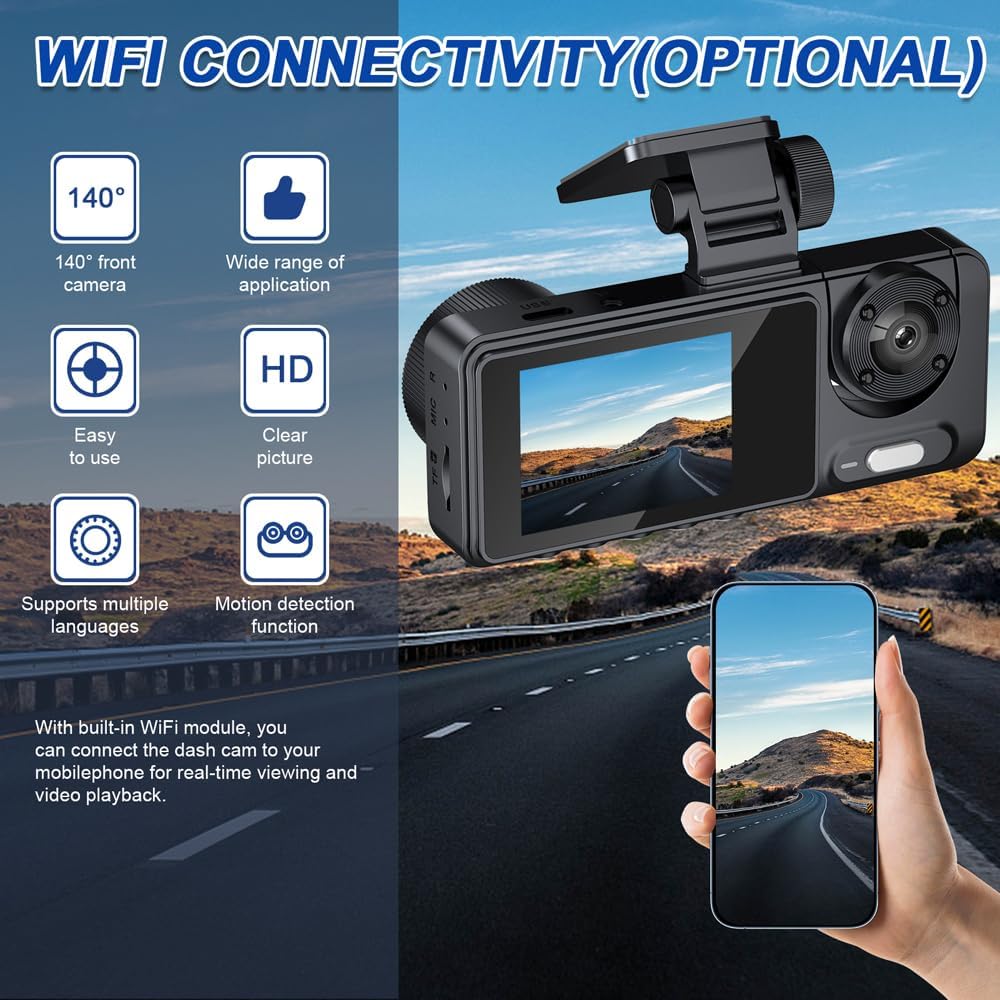
Figure 7.1: This image illustrates the optional WiFi connectivity feature of the GoolRC Dash Cam, showing how it can connect to a smartphone for remote access and control. Various icons highlight key features such as wide-angle front camera, HD resolution, multi-language support, and motion detection.
8. Maintenance
Proper maintenance ensures the longevity and reliable operation of your dash cam.
- Cleaning: Use a soft, dry cloth to clean the dash cam's lenses and screen. Avoid using abrasive cleaners or solvents.
- Memory Card: Format the MicroSD card regularly (e.g., once a month) to prevent data corruption and ensure smooth recording. Back up important files before formatting.
- Temperature: Avoid exposing the dash cam to extreme temperatures for extended periods. If the vehicle is parked in direct sunlight, consider removing the dash cam or using a sunshade.
- Firmware Updates: Check the GoolRC official website periodically for any available firmware updates. Follow the instructions carefully for updating the device.
9. Troubleshooting
If you encounter issues with your dash cam, refer to the following common problems and solutions:
| Problem | Possible Cause | Solution |
|---|---|---|
| Dash cam does not power on. | No power supply; faulty cable; vehicle's 12V outlet not working. | Check power cable connection. Test 12V outlet with another device. Try a different power cable if available. |
| Dash cam stops recording. | Memory card full; memory card error; power interruption. | Format the memory card. Replace with a new, high-speed MicroSD card. Ensure stable power connection. |
| Video footage is blurry or unclear. | Protective film on lens; dirty lens; incorrect focus. | Remove any protective film. Clean lenses with a soft cloth. Ensure dash cam is securely mounted and not vibrating. |
| WiFi connection issues. | Incorrect password; app issues; dash cam WiFi not enabled. | Verify WiFi password. Restart dash cam and smartphone. Reinstall the app. Ensure WiFi is enabled on the dash cam. |
| Dash cam freezes or crashes. | Memory card error; firmware issue. | Format or replace memory card. Perform a factory reset (refer to settings menu). Check for firmware updates. |
10. Specifications
Technical specifications for the GoolRC Triple Channel Dash Cam:
- Type: With WiFi, Without WiFi (optional)
- Resolution: 1920*1080P (Front) + 1280*720P (Cabin) + 640*480P (Rear)
- Display: 2-inch screen
- View Angle: 140° (Front) + 90° (Cabin) + 90° (Rear)
- Pixel: 1.3 million (Front) + 500,000 (Cabin) + 300,000 (Rear)
- Battery: 3.7V, 150mAh
- Current Frequency: 50/60HZ
- Language Support: Russian, Japanese, French, Italian, German, English, Chinese (simplified), Chinese (Traditional), Korean, Spanish, Portuguese
- Memory Card: Max. 128GB (not included)
- Item Size: 105 * 44 * 40mm / 4.1 * 1.7 * 1.6in
- Item Weight: Approximately 12.5 ounces
- Connectivity Technology: Wi-Fi (optional)
- Control Method: Touch
11. Warranty and Support
GoolRC products are manufactured to high-quality standards. For warranty information, technical support, or service inquiries, please refer to the contact information provided on the product packaging or the official GoolRC website. Please retain your proof of purchase for warranty claims.