
Riester 49962
RIESTER RBP 100 Wall-Mounted Blood Pressure Monitor User Manual
Model: 49962
Brand: Riester
Introduction
The RIESTER RBP 100 is a clinically validated digital blood pressure monitor designed for professional use. It provides fast and reliable measurements of systolic, diastolic, and mean arterial pressure (MAP), along with heart rate. This manual provides essential information for the safe and effective operation, maintenance, and troubleshooting of your RBP 100 device.
Important Safety Information
- Always consult a healthcare professional for interpretation of blood pressure readings. Self-diagnosis and treatment based on measurements can be dangerous.
- Do not use the device on infants or individuals unable to express consent.
- Keep the device away from strong electromagnetic fields.
- Ensure the correct cuff size is used for accurate measurements.
- Do not disassemble or attempt to repair the device yourself. Contact qualified service personnel.
- Store the device in a dry place, away from direct sunlight and extreme temperatures.
Components Included
The RIESTER RBP 100 package typically includes the following components:
- RBP 100 Blood Pressure Monitor unit
- Rechargeable Battery
- Blood Pressure Cuff(s) (Adult cuff is standard, other sizes may be included or sold separately)
- Power Adapter with various international plugs
- Instruction Manual
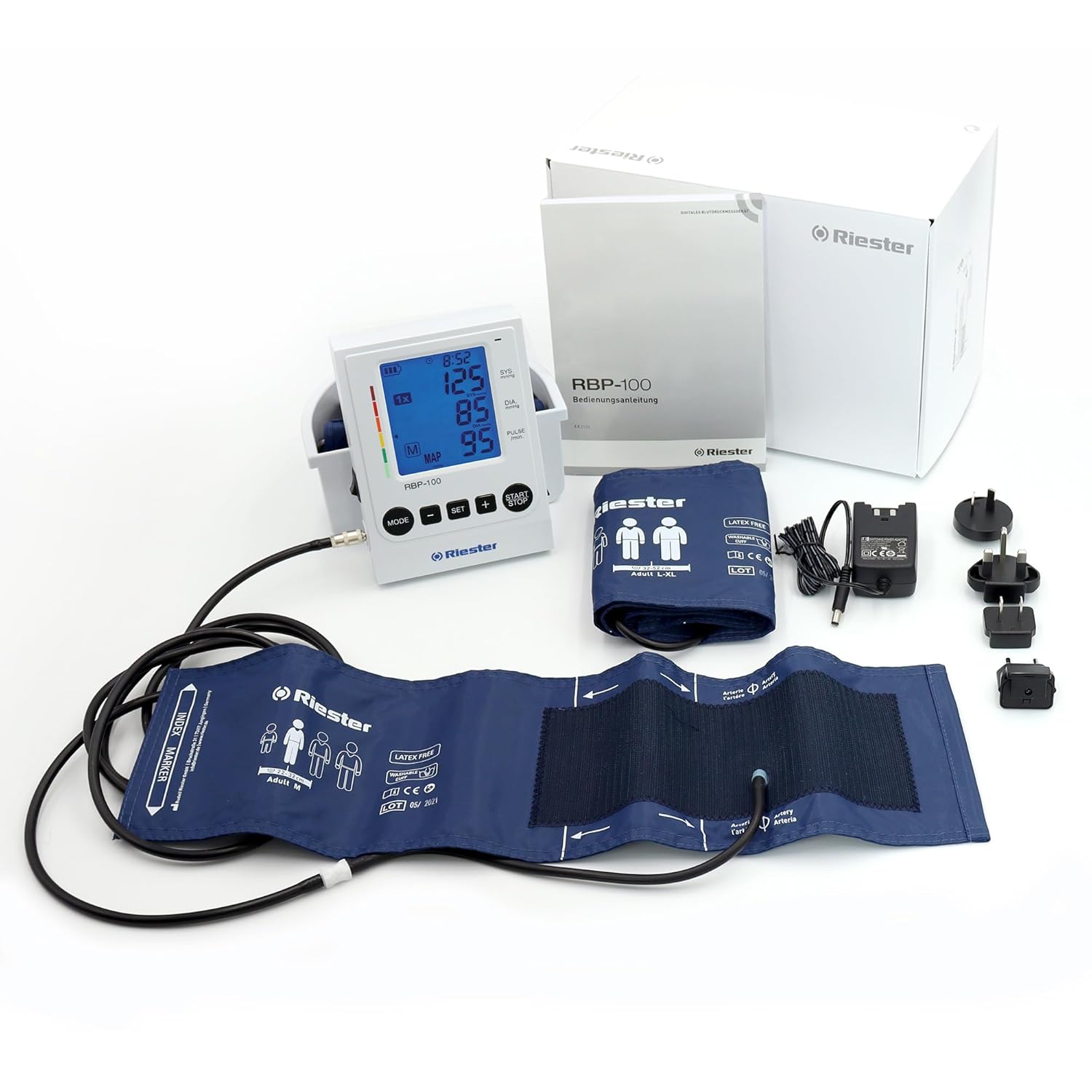
Figure 1: Overview of the RBP 100 product contents. This image displays the main RBP 100 monitor unit, a blue blood pressure cuff, a power adapter with multiple interchangeable international plug types, and the user manual, all neatly arranged on a white surface.
Setup Instructions
- Unpacking: Carefully remove all components from the packaging. Retain the packaging for future storage or transport.
- Power Connection: Connect the power adapter to the monitor's power input port. Plug the adapter into a suitable electrical outlet. The device can operate on battery power once charged.
- Cuff Connection: Insert the air tube connector from the blood pressure cuff firmly into the air outlet port on the side of the RBP 100 monitor. Ensure a secure connection to prevent air leakage during measurement.
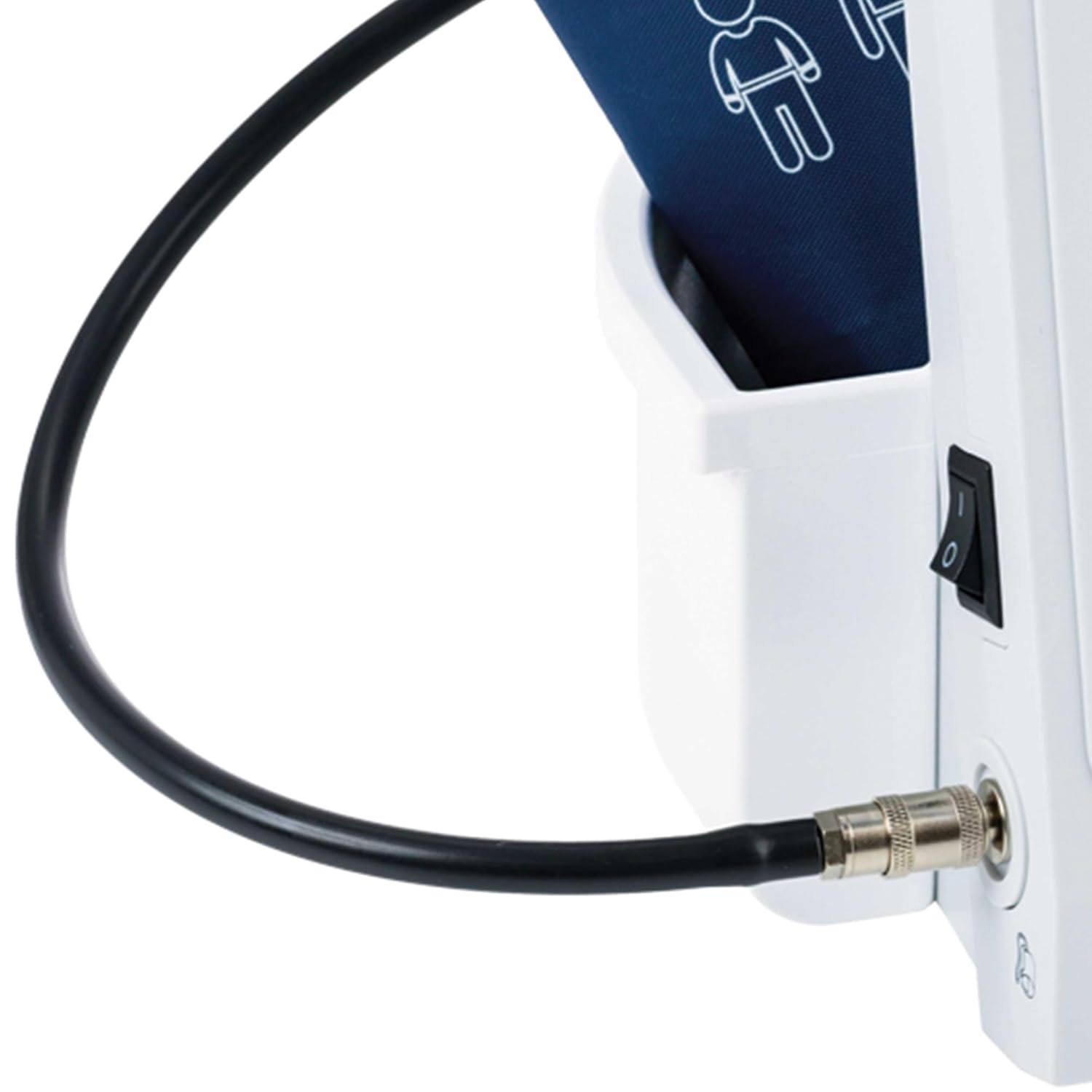
Figure 2: Detail of the cuff connection and power switch. This image shows the black air tube connected to the monitor's port, and the power switch positioned above it, indicating the device is ready for operation.
- Initial Charge: For first-time use, it is recommended to fully charge the internal battery. The battery indicator on the display will show charging status.
- Placement: Position the RBP 100 monitor on a stable surface or mount it on a wall using the integrated bracket (if applicable to your model). Ensure the display is at eye level for easy reading.

Figure 3: The RBP 100 monitor with its cuff stored in the integrated holder. This image provides a clear view of the monitor's display and control buttons, along with the connected cuff, illustrating its wall-mounted configuration.
Operating Instructions
The RBP 100 offers two primary measurement modes: Auscultatory (manual) and Oscillometric (automatic).
Applying the Cuff
- Ensure the patient is relaxed and seated comfortably with their arm supported at heart level.
- Select the appropriate cuff size. The cuff should fit snugly around the upper arm without being too tight or too loose.
- Wrap the cuff around the bare upper arm, approximately 2-3 cm above the elbow joint. The artery mark on the cuff should align with the brachial artery.
- Secure the cuff firmly using the hook-and-loop fastener.

Figure 4: The blue Riester blood pressure cuff neatly folded and placed in the integrated storage holder beneath the monitor. This highlights the convenient storage solution for the cuff when not in use.
Automatic (Oscillometric) Measurement
- Press the START/STOP button to begin an automatic measurement. The cuff will inflate automatically.
- Remain still and silent during the measurement.
- Once the measurement is complete, the systolic, diastolic, MAP, and pulse rate will be displayed on the screen.
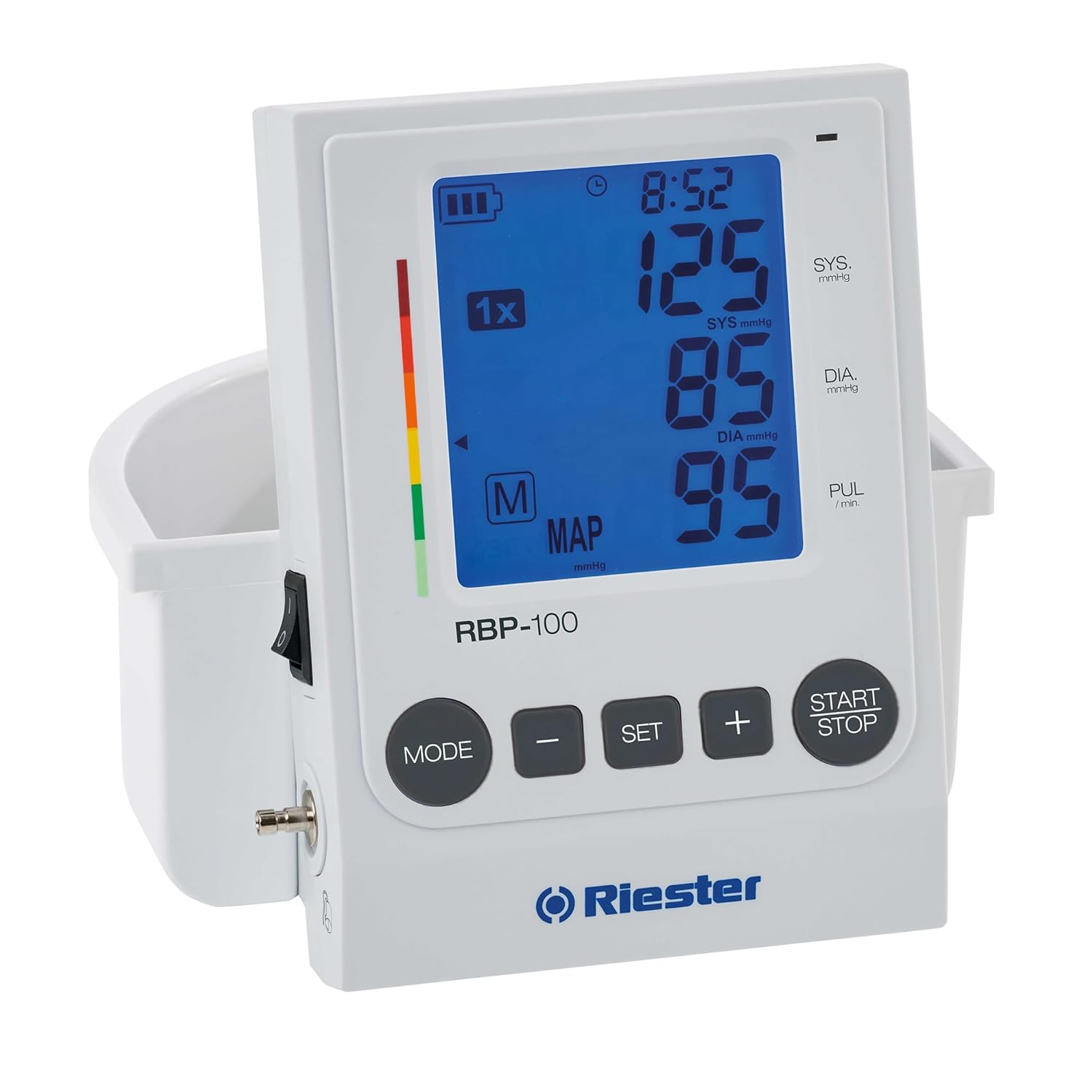
Figure 5: A detailed view of the RBP 100's digital display. The screen shows current time (8:52), battery level, and large numerical readings for systolic (125 mmHg), diastolic (85 mmHg), and MAP (95 mmHg) pressures, along with pulse rate. A color-coded WHO classification bar is visible on the left.
- The device will automatically deflate the cuff.
Manual (Auscultatory) Measurement
This mode allows for manual auscultation with a stethoscope while the device controls cuff inflation and a controlled deflation rate (3 mmHg/s).
- Connect a stethoscope to the patient's brachial artery.
- Press the MODE button to select the auscultatory mode.
- Press START/STOP to inflate the cuff. Inflate to the desired pressure.
- The device will automatically deflate at 3 mmHg/s. Listen for Korotkoff sounds to determine systolic and diastolic pressures.
- The device will record the pressures entered manually or detected during the controlled deflation.
Average Mode (3 Readings)
The average mode takes three consecutive measurements and calculates their average, providing a more objective reading and reducing the impact of "white coat hypertension."
- Intervals between measurements can be adjusted (15, 30, 45, 60 seconds).
- Follow the on-screen prompts for each measurement.

Figure 6: An angled perspective of the RBP 100 monitor with the cuff. This view highlights the compact design and the clear digital display, showing active measurement readings and the intuitive button layout.
Data Management and Features
- Memory: The device has a large memory capacity, storing up to 210 readings. Use the MODE button to navigate through stored measurements.
- Arrhythmia Detection: The RBP 100 can detect irregular heartbeats during measurement. An icon will appear on the display if an arrhythmia is detected.
- WHO Classification Panel: The display includes a color-coded panel based on the World Health Organization (WHO) blood pressure classification, providing an immediate visual indication of the measurement's category.

Figure 7: A detailed shot of the RBP 100's control panel. The buttons for 'MODE', '-', 'SET', '+', and 'START/STOP' are clearly visible, indicating the user interface for operating the device and navigating its features.
Maintenance and Care
- Cleaning: Wipe the monitor and cuff with a soft, dry cloth. For disinfection, use a cloth lightly dampened with a mild disinfectant solution. Do not immerse the device in water.
- Storage: Store the device in a clean, dry place at room temperature, away from direct sunlight, dust, and moisture.
- Battery: Ensure the battery is charged regularly, especially if the device is not used for extended periods.
- Cuff Care: Inspect the cuff regularly for wear and tear. Replace if damaged.
Troubleshooting
| Problem | Possible Cause | Solution |
|---|---|---|
| Device does not turn on. | Low battery or power adapter not connected. | Connect power adapter and charge battery. Ensure power switch is ON. |
| Inaccurate readings. | Incorrect cuff size, improper cuff placement, patient movement, or speaking during measurement. | Ensure correct cuff size and proper placement. Remain still and silent during measurement. Repeat measurement after a few minutes. |
| Cuff does not inflate or deflates too quickly. | Loose cuff connection or air leakage. | Check that the air tube is securely connected to the monitor and the cuff. Inspect cuff for damage. |
| "Error" message on display. | Measurement interference or internal error. | Turn off the device, wait a few moments, then restart. If the error persists, contact customer support. |
Specifications
- Model: RBP 100 (49962)
- Measurement Method: Oscillometric and Auscultatory
- Clinical Validation: BHS, ESH, AAMI standards
- Measurement Range:
- Blood Pressure: 0-300 mmHg (typical)
- Pulse Rate: 40-200 beats/minute (typical)
- Memory: 210 readings
- Power Source: Rechargeable NiMH Battery, AC Adapter
- Weight: Approximately 510 g
- Dimensions: Approximately 29 x 20.5 x 17 cm (packaging dimensions)
- Features: Arrhythmia detection, WHO classification panel, Average mode (3 readings)
Warranty and Support
For warranty information, technical support, or service, please contact Riester customer service or your local authorized distributor. The manufacturer's address is:
Rudolf Riester GmbHBruckstraße 31
72417 Jungingen
Germany
Please refer to the official Riester website or the documentation included with your product for the most up-to-date warranty terms and contact information.
Related documents49962


Ask a question about this manual
Ask about setup, troubleshooting, compatibility, parts, safety, or missing instructions. Manuals+ will review the question and use this page’s manual context to help answer it.