
1. Introduction
The Gustard H26 is a high-performance discrete Class A headphone amplifier and preamplifier designed for audiophiles. It features a fully balanced circuit design, robust power delivery, and versatile input/output options for an exceptional audio experience. This manual provides detailed instructions for setting up, operating, and maintaining your H26 amplifier.
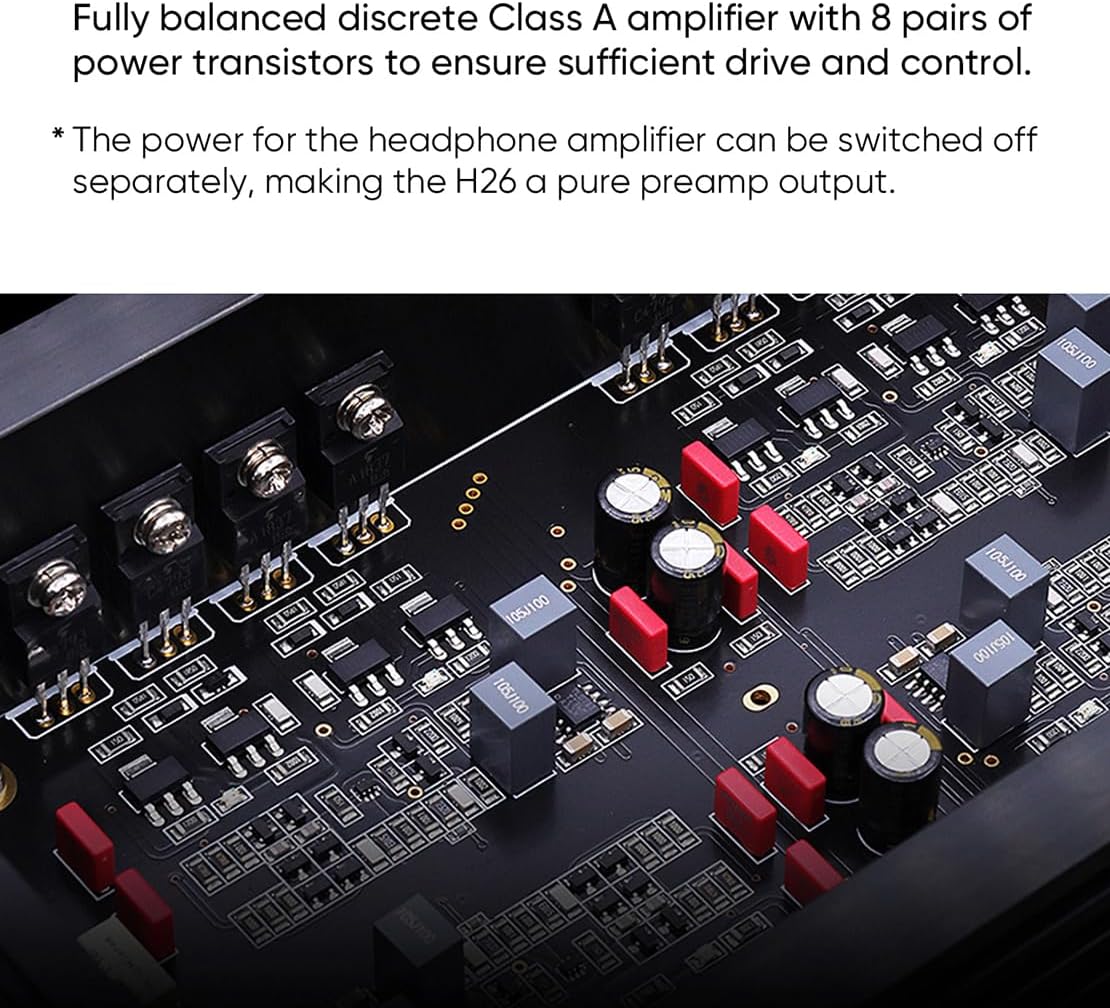
Figure 1.1: Front view of the Gustard H26 headphone amplifier, showcasing its sleek black design with a central volume knob and headphone jacks.
2. Product Features
- Fully Balanced Discrete Class A Amplifier: Utilizes 8 pairs of power transistors for sufficient drive and control, ensuring high-fidelity audio reproduction.
- Versatile Headphone Connectivity: Equipped with 6.35mm unbalanced, 4.4mm balanced, and 4-pin XLR balanced headphone outputs.
- Precision Volume Control: Features a matrix relay volume system, ensuring consistent 4-way volume adjustment without distortion or bias.
- Dual Toroidal Transformers: Incorporates two custom 50W audio-specific toroidal transformers, one for each channel, to prevent interference and provide stable power.
- High-Performance Preamplifier: The preamplifier stage uses two direct-inserted LME49720 dual op-amps for clear signal processing.
- Flexible Output Modes: The headphone amplifier power can be switched off separately, allowing the H26 to function as a pure preamplifier output. Preamplifier outputs can also be deactivated for easy switching between headphone and speaker listening.

Figure 2.1: Internal view of the Gustard H26, highlighting the eight pairs of power transistors used in its fully balanced discrete Class A amplifier design.

Figure 2.2: Close-up of the two 50W audio-specific custom toroidal transformers inside the Gustard H26, designed to prevent channel interference.

Figure 2.3: Internal view illustrating the matrix relay volume control and the LME49720 dual op-amps used in the preamplifier stage of the Gustard H26.
3. Setup
3.1 Unpacking
Carefully remove the Gustard H26 from its packaging. Inspect the unit for any signs of damage during transit. Retain the packaging for future transport or storage.
3.2 Connecting Your Devices
Refer to the diagram below for a clear understanding of the rear panel connections. Ensure all connections are secure before powering on the device.

Figure 3.1: Detailed diagram of the Gustard H26 rear panel, showing all input and output ports, power connections, and controls.
- Input Connections:
- RCA Input (x1): Connect your single-ended audio source (e.g., DAC, CD player) to the RCA input jacks (Right/Left).
- XLR Input (x2): Connect your balanced audio sources to the XLR input jacks. The H26 provides two sets of balanced XLR inputs (XLR1 and XLR2).
- Preamplifier Output Connections:
- RCA Preamplifier Output: Connect to your power amplifier or active speakers using RCA cables.
- XLR Preamplifier Output: Connect to your balanced power amplifier or active speakers using XLR cables.
- Power Connection:
- AC Power Input: Connect the provided power cable to the AC input.
- Voltage Selection: Ensure the voltage selector switch is set to the correct voltage for your region (100-120V or 220-240V). Incorrect voltage selection can damage the unit.
- Power Switch: Use this to turn the unit on or off.
- Fuse: The fuse holder is integrated into the AC input for protection.
3.3 Initial Power On
After all connections are made and the voltage is correctly selected, press the power switch on the rear panel to turn on the H26. The front panel display will illuminate.
4. Operating Instructions
4.1 Volume Control
The H26 features a precise matrix relay volume control. Rotate the large knob on the front panel clockwise to increase volume and counter-clockwise to decrease it. The current volume level will be displayed on the front panel.
4.2 Input Selection
Use the input selector button (typically on the front panel, refer to the device for exact location) to cycle through the available RCA and XLR inputs. The selected input will be indicated on the display.
4.3 Headphone Output Usage
Connect your headphones to one of the three front panel jacks: 6.35mm (unbalanced), 4.4mm (balanced), or 4-pin XLR (balanced). Ensure your headphones are compatible with the selected output type. The H26 can drive a wide range of headphones.
4.4 Preamplifier Functionality
The H26 can function as a dedicated preamplifier. To use it as a pure preamplifier, you can switch off the headphone amplifier power separately. Consult the front panel controls or menu options (if available) for this setting. This ensures that only the preamplifier section is active, optimizing performance for connected power amplifiers or active speakers.

Figure 4.1: The Gustard H26 integrated into a home audio system, demonstrating its use with a remote control for convenient operation.
5. Maintenance
5.1 Cleaning
To clean the exterior of the H26, use a soft, dry, lint-free cloth. Do not use abrasive cleaners, solvents, or chemical sprays, as these can damage the finish. Ensure the unit is powered off and unplugged before cleaning.
5.2 Environmental Considerations
Place the H26 in a well-ventilated area to prevent overheating, especially given its Class A operation. Avoid direct sunlight, heat sources, and areas with high humidity or dust. Do not block the ventilation openings.
6. Troubleshooting
If you encounter issues with your Gustard H26, please refer to the following common troubleshooting steps:
- No Power:
- Check if the power cable is securely connected to both the H26 and the wall outlet.
- Verify that the power switch on the rear panel is in the 'ON' position.
- Ensure the voltage selector switch is set correctly for your region.
- Check the fuse in the AC input. If blown, replace it with a fuse of the same type and rating.
- No Sound:
- Confirm that the correct input source is selected on the H26.
- Check all audio cables (RCA, XLR, headphone) for secure connections.
- Ensure the volume level is not set to minimum or muted.
- If using as a preamplifier, ensure the connected power amplifier or active speakers are powered on and functioning correctly.
- If using headphones, ensure they are properly plugged into the correct jack and are functional.
- Distorted Sound or Noise:
- Check for loose or damaged audio cables.
- Ensure the input source is not sending an excessively strong signal that could cause clipping.
- Verify that the H26 is placed away from potential sources of electromagnetic interference (e.g., Wi-Fi routers, mobile phones).
- If using balanced connections, ensure both ends are properly balanced.
7. Specifications
The following table details the technical specifications of the Gustard H26 Discrete Class A Headphone Amplifier:

Figure 7.1: Official technical specifications table for the Gustard H26, detailing input, preamplifier, and headphone amplifier performance metrics.
| Category | Specification |
|---|---|
| Input (RCA x1) | Typical Input Sensitivity: 2-3Vrms; Input Impedance: 4kΩ |
| Input (XLR x2) | Typical Input Sensitivity: 4-6Vrms (max 12Vrms); Input Impedance: 8kΩ |
| Preamplifier Output (RCA/XLR) | Output Impedance: 100Ω |
| Preamplifier Frequency Response | 20-80 kHz /-0.1 dB |
| Preamplifier SNR | >123 dB |
| Preamplifier Crosstalk | <-123 dB at 1 kHz |
| Preamplifier THD+N | <0.0002% |
| Preamplifier IMD | <0.0003% |
| Headphone Amp Output Impedance (6.35mm) | 0.05 Ω |
| Headphone Amp Output Impedance (Balanced XLR 4PIN or 4.4) | 0.1 Ω |
| Headphone Amp Frequency Response | 20-80 kHz /-0.1 dB |
| Headphone Amp SNR | 20-80 kHz/-0.1 dB |
| Headphone Amp Crosstalk | <-120 dB at 1 kHz |
| Headphone Amp THD+N | <0.0005% at 9700 mW into 32 Ω LOAD |
| Headphone Amp IMD | <0.0005% at 9700 mW into 32 Ω LOAD |
| Max Undistorted Power Output | 6000mW into 32Ω LOAD |
| Maximum Power Output | 12000mW @32Ω (THD=1%) |
| Load Power (Per channel) | 64Ω: 7350mW; 150Ω: 3125mW; 300Ω: 1576mW; 600Ω: 788mW |
| AC Power Input | 100V-240V (manually adjusted) |
| Overall Power Consumption | <30W |
| Dimensions (W*D*H) | 330 * 260 * 65mm (protrusion not included) |
| Package Size (W*D*H) | 420 * 360 * 175mm |
| Weight (with package) | 7.0KG |
| Manufacturer | GUSTARD |
| Product ASIN | B0CTWXKVF3 |
| First Available Date | February 23, 2024 |
8. Warranty and Support
8.1 Warranty Information
The Gustard H26 is covered by a manufacturer's warranty against defects in materials and workmanship. The specific terms and duration of the warranty may vary by region and retailer. Please retain your proof of purchase for warranty claims. For detailed warranty information, refer to the documentation provided with your purchase or contact your retailer.
8.2 Technical Support
If you require technical assistance or have questions not covered in this manual, please contact your authorized AOSHIDA retailer or the manufacturer's support channels. When contacting support, please have your product model (H26) and purchase information readily available.


