
RADIOMASTER R85C
Radiomaster R85C Receiver User Manual
Model: R85C
1. Introduction
This manual provides detailed instructions for the setup, operation, and maintenance of your Radiomaster R85C 5CH 4in1 2.4GH External Antenna PWM Receiver. Please read this manual thoroughly before using the product to ensure safe and optimal performance.
The Radiomaster R85C is a compact and high-performance receiver designed for RC cars and boats, featuring a built-in TCXO for stable frequency performance and support for multiple protocols.
2. Package Contents
Upon opening the package, please verify that all components are present and in good condition:
- 1 x Radiomaster R85C Receiver
- 1 x User Card (Quick Start Guide)

Figure 2.1: The Radiomaster R85C receiver and its accompanying user card, sealed in clear plastic packaging.
3. Specifications
The following table details the technical specifications of the Radiomaster R85C receiver:
| Item | Specification |
|---|---|
| Power Supply | DC 4.5 - 8.4V |
| Frequency Range | 2400-2483.5Mhz |
| Supported Protocols | D8/D16/SFHSS |
| Output Channels | 5CH PWM |
| Antenna Type | High-sensitivity 2.4G external antenna |
| Telemetry Power | 100mW / 20dBm |
| Weight | 5.7 grams |
| Dimensions (L*W*H) | 31.0*18.5*13.0 mm |

Figure 3.1: Side view of the Radiomaster R85C receiver with its length (31.00mm), width (18.50mm), and height (13.00mm) clearly indicated.
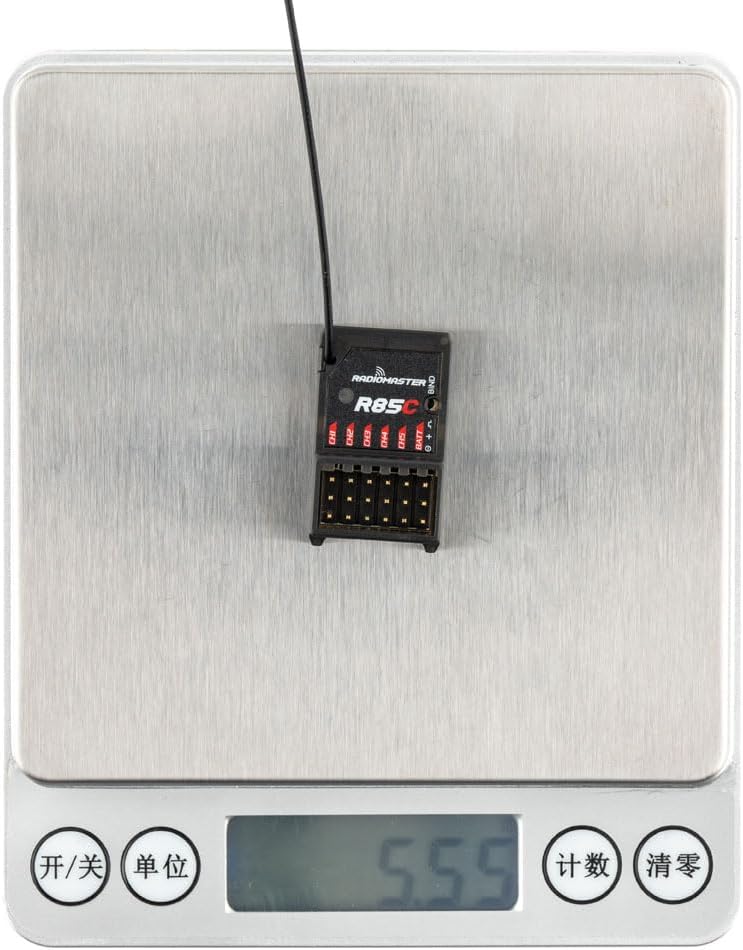
Figure 3.2: The Radiomaster R85C receiver placed on a digital scale, displaying a weight of 5.55 grams, confirming its lightweight design.
4. Setup and Binding
Before operating your R85C receiver, it must be properly connected and bound to your compatible transmitter. The R85C supports D8, D16, and SFHSS protocols.
4.1 Receiver Layout
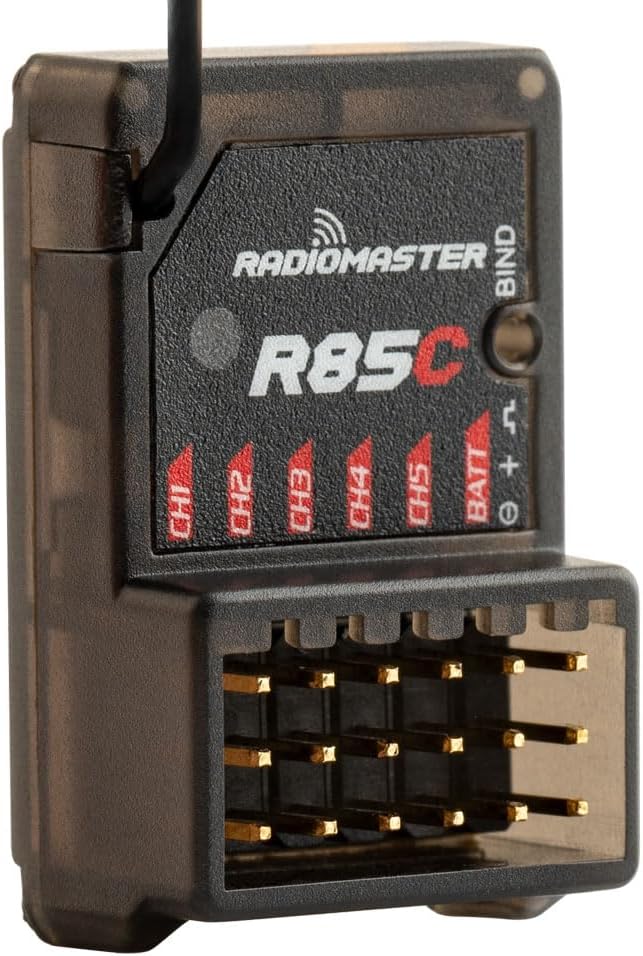
Figure 4.1: Top view of the Radiomaster R85C receiver, highlighting the five PWM output channels (CH1-CH5), battery input (BATT), and the bind button.

Figure 4.2: A detailed close-up of the Radiomaster R85C receiver's top surface, clearly showing the labels for channels CH1 through CH5, the BATT port, and the 'BIND' button.

Figure 4.3: An angled view of the Radiomaster R85C receiver, showcasing the gold-plated pin headers for connecting servos and power, along with the integrated antenna.
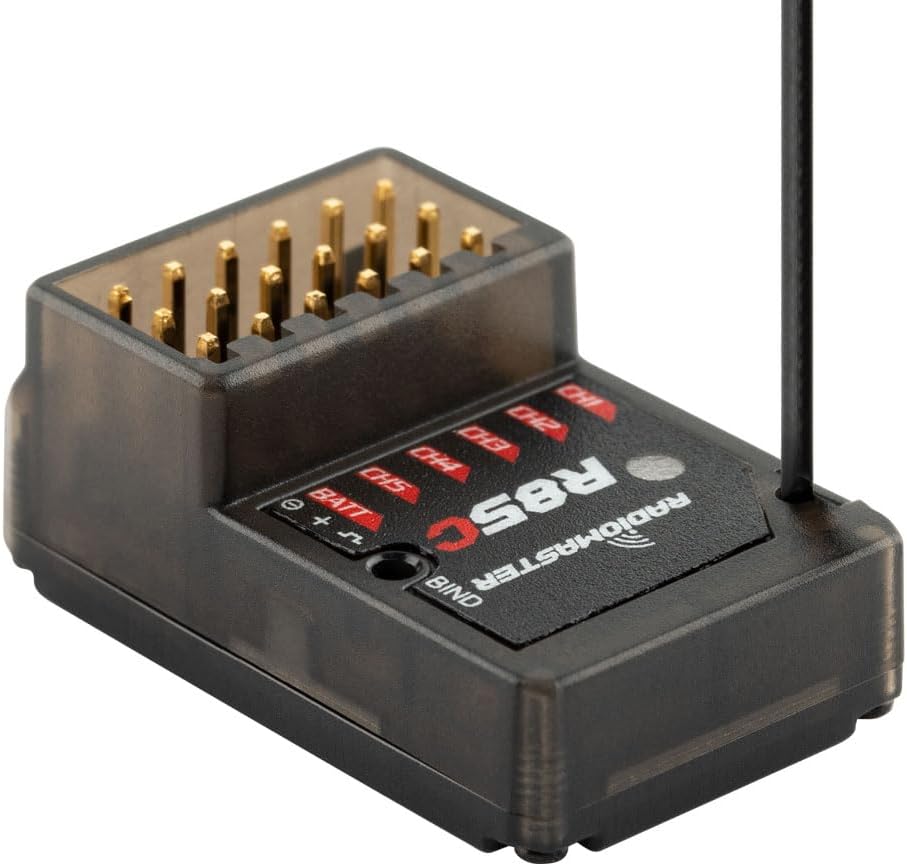
Figure 4.4: A different angled perspective of the Radiomaster R85C receiver, providing a clear view of its compact form factor and the external antenna extending from the unit.
4.2 Binding Procedure
Follow these steps to bind your R85C receiver to your transmitter:
- Power On Receiver in Bind Mode: While holding down the BIND button on the R85C receiver, connect power (4.5 - 8.4V) to the BATT port. The LED on the receiver should start flashing rapidly, indicating it is in bind mode.
- Set Transmitter to Bind Mode: On your compatible Radiomaster transmitter (or other D8/D16/SFHSS compatible transmitter), navigate to the model setup menu and select the appropriate protocol (D8, D16, or SFHSS). Initiate the binding process on the transmitter.
- Confirm Binding: Once the binding is successful, the LED on the R85C receiver will turn solid, indicating a successful connection.
- Test Connection: Disconnect power from the receiver and then reconnect it normally (without holding the BIND button). The LED should immediately turn solid. Test all channels by moving the sticks on your transmitter to ensure proper control of connected servos or ESCs.
Note: Ensure your transmitter's RF module is set to the correct protocol (D8, D16, or SFHSS) that matches the receiver's capabilities. For D16 protocol, ensure the correct sub-protocol (e.g., FCC or LBT) is selected if applicable.
5. Operation
Once bound, the R85C receiver is ready for operation. Connect your servos, ESCs, or other PWM-controlled devices to the corresponding channels (CH1-CH5) on the receiver.
- Channel Assignment: Refer to your RC model's documentation or your transmitter's channel mapping to correctly assign functions (e.g., throttle, aileron, elevator, rudder) to the receiver's channels.
- Power Connection: Ensure the power supply (4.5 - 8.4V) is connected to the BATT port. This can be from an ESC with a BEC, a dedicated receiver battery, or a UBEC.
- Antenna Placement: For optimal signal reception, position the external antenna away from carbon fiber, metal, or other conductive materials that could shield the signal. Ensure the antenna is extended and not coiled.
- Range Check: Always perform a range check before flying or operating your RC model to ensure reliable control. Follow your transmitter's instructions for performing a range check.

Figure 5.1: The Radiomaster R85C receiver with its external antenna fully extended, demonstrating the recommended orientation for optimal signal reception.
6. Maintenance and Care
Proper maintenance will extend the lifespan and ensure the reliability of your R85C receiver:
- Keep Dry: Protect the receiver from moisture and water. While designed for RC boats, direct water immersion should be avoided unless the receiver is housed in a waterproof enclosure.
- Cleanliness: Keep the receiver free from dust, dirt, and debris. Use a soft, dry brush or compressed air to clean if necessary.
- Physical Protection: Mount the receiver securely within your model to prevent vibrations and physical damage during operation.
- Antenna Inspection: Regularly inspect the antenna for any cuts, kinks, or damage. A damaged antenna can significantly reduce range and signal quality.
- Temperature: Avoid operating the receiver in extreme temperatures.
7. Troubleshooting
If you encounter issues with your R85C receiver, refer to the following common problems and solutions:
| Problem | Possible Cause | Solution |
|---|---|---|
| Receiver LED not lighting up. | No power or incorrect polarity. | Check power connection and ensure correct voltage (4.5 - 8.4V) and polarity. Test power source. |
| Receiver LED flashing rapidly, not binding. | Transmitter not in bind mode, incorrect protocol, or too far from receiver. | Ensure transmitter is in bind mode and set to the correct protocol (D8/D16/SFHSS). Bring transmitter closer to receiver. Re-attempt bind procedure. |
| No control response after binding. | Servos/ESCs incorrectly connected, incorrect channel mapping, or faulty component. | Verify servo/ESC connections to the correct channels. Check transmitter channel mapping. Test components individually if possible. |
| Reduced range or intermittent signal. | Damaged antenna, antenna shielded, or environmental interference. | Inspect antenna for damage and ensure proper placement away from conductive materials. Avoid operating near strong interference sources. |
8. Warranty and Support
For warranty information and technical support, please refer to the official Radiomaster website or contact your local dealer. Keep your purchase receipt as proof of purchase for warranty claims.
Official Website: www.radiomasterrc.com
Manufacturer: Hobbyporter RC
Related documentsR85C


Ask a question about this manual
Ask about setup, troubleshooting, compatibility, parts, safety, or missing instructions. Manuals+ will review the question and use this page’s manual context to help answer it.