
KiiBoom K75
Feker K75 Mechanical Keyboard User Manual
Model: K75 | Brand: KiiBoom
Introduction
This manual provides detailed instructions for the setup, operation, maintenance, and troubleshooting of your Feker K75 75% Gasket-Mounted Mechanical Keyboard. Designed for versatility and performance, the K75 features tri-mode connectivity (wired, 2.4GHz wireless, Bluetooth), a customizable TFT LCD screen, hot-swappable switches, and vibrant RGB backlighting. Please read this manual thoroughly to ensure optimal use and longevity of your device.
Product Overview
The Feker K75 is a compact 75% layout mechanical keyboard, offering an 83-key configuration. It is built with a high-quality PC material positioning plate and a multi-layered sound-shock absorbing internal structure for an enhanced typing experience.

Figure 1: Top-down view of the Feker K75 Mechanical Keyboard, showcasing its 75% layout with a rotary knob and LCD screen.
Key Features:
- 75% Compact Layout: 83-key design for functionality without excessive size.
- Tri-Mode Connectivity: Supports USB-C wired, 2.4GHz wireless, and Bluetooth 5.0 connections.
- TFT LCD Screen: Customizable 1.28-inch display for time, connection mode, lighting, and GIFs.
- Rotary Knob: Multi-functional knob for volume control and screen navigation.
- Hot-Swappable Sockets: Compatible with 3-pin and 5-pin mechanical switches for easy customization.
- RGB Backlighting: Multi-color customizable RGB lighting.
- 5000mAh Battery: High-capacity battery for extended wireless use.
- Gasket-Mounted Structure: Provides a flexible and comfortable typing feel.
- OEM Height PBT Keycaps: Durable and ergonomic keycaps.
Setup
1. Unboxing and Initial Inspection
Carefully remove all components from the packaging. Verify that the following items are included:
- Feker K75 Mechanical Keyboard
- USB-C Cable
- 2.4GHz Wireless Dongle (typically stored magnetically within the keyboard chassis)
- Keycap Puller
- Switch Puller (often included with keycap puller or as a separate tool)
- User Manual (this document)
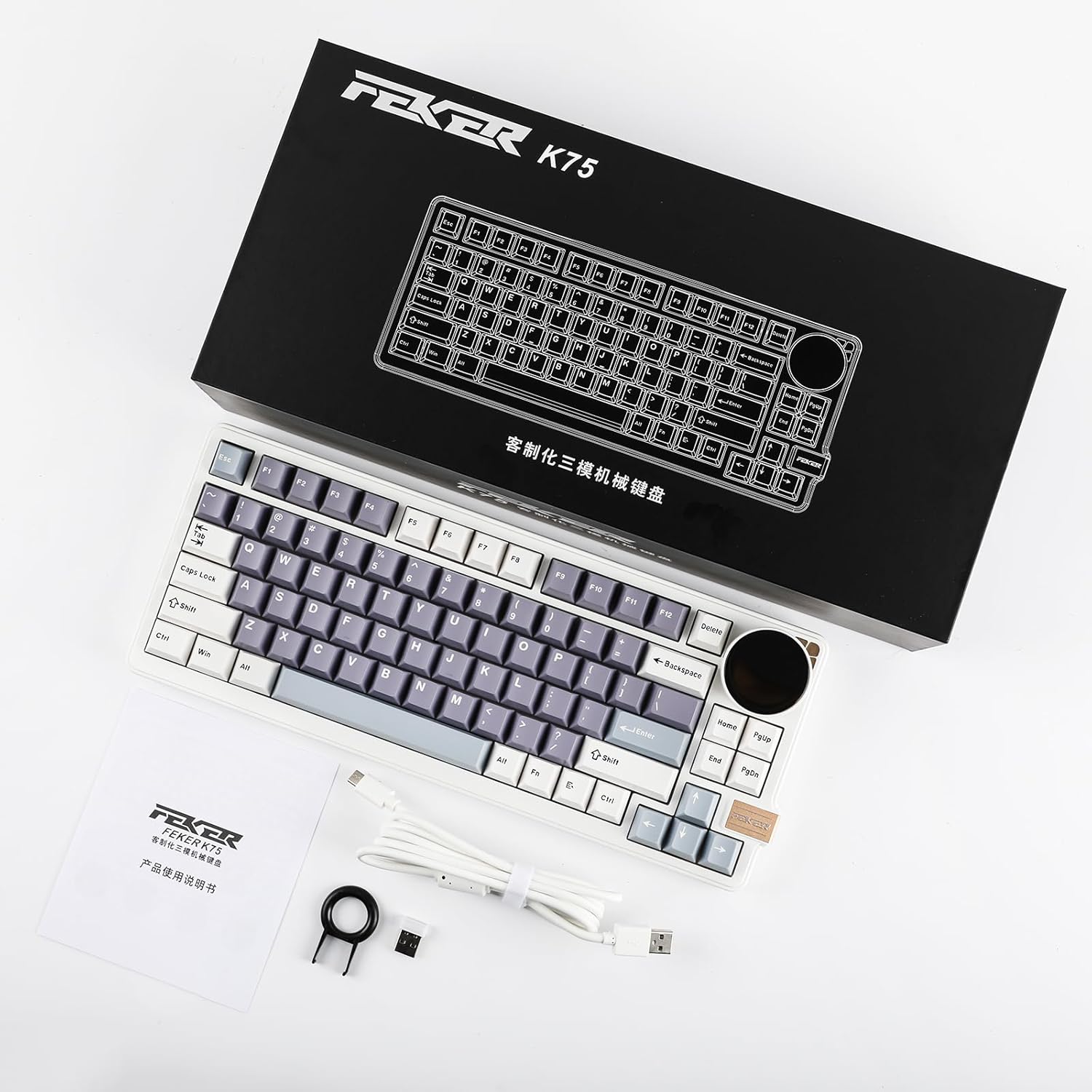
Figure 2: Contents of the Feker K75 package, including the keyboard, USB-C cable, and keycap puller.
2. Charging the Battery
Before first use, it is recommended to fully charge the keyboard's built-in 5000mAh battery. Connect the provided USB-C cable to the keyboard's USB-C port and the other end to a USB power source (e.g., computer USB port, wall adapter). The keyboard's indicator light or LCD screen may show charging status.

Figure 3: The Feker K75 keyboard highlighting its 5000mAh rechargeable battery. Press FN+Spacebar to check battery life (numbers 1-0 represent 10%-100%).
3. Connecting the Keyboard
The Feker K75 supports three connection modes:
- Wired Mode (USB-C):
Connect the USB-C cable directly from the keyboard to your computer's USB port. The keyboard will automatically switch to wired mode and begin charging.
- 2.4GHz Wireless Mode:
Locate the 2.4GHz USB dongle, typically stored magnetically within the keyboard chassis. Plug the dongle into an available USB port on your computer. Turn on the keyboard using the switch located on the back or side. The keyboard should automatically connect. Press FN + F4 to activate 2.4G mode if needed.
- Bluetooth 5.0 Mode:
The keyboard supports up to three Bluetooth devices. To enter Bluetooth pairing mode, press FN + F1, F2, or F3 for 3 seconds until the indicator light flashes rapidly. On your device (PC, laptop, smartphone, tablet), search for Bluetooth devices and select "Feker K75" (or similar name) to pair. Once paired, the indicator light will become solid. To switch between paired Bluetooth devices, simply press FN + the corresponding F1/F2/F3 key.

Figure 4: The Feker K75 keyboard demonstrating its versatile tri-mode connectivity options: Bluetooth, 2.4G wireless, and USB-C wired, compatible with various devices.
Operating Instructions
1. TFT LCD Screen and Rotary Knob
The Feker K75 features a 1.28-inch TFT LCD screen and a multi-functional rotary knob. By default, the knob controls volume and media playback:
- Rotate knob clockwise: Volume Up
- Rotate knob counter-clockwise: Volume Down
- Press knob: Play/Pause
To enter the screen control mode and access additional functions, press FN + Knob. In screen control mode, the knob can be used to navigate through various display options:
- Standby Screen: Displays time, date, and battery status.
- Keyboard Connection Mode: Shows current connection status (Wired, 2.4G, BT).
- Lights Control: Adjust RGB lighting effects.
- Clock Screensaver: Various clock display styles.
- GIF Image: Upload and display custom GIFs.

Figure 5: The Feker K75's 1.28-inch TFT LCD screen and rotary knob, illustrating the five main functions accessible via screen control mode.
2. RGB Backlight Shortcuts
Control the keyboard's RGB backlighting using the following FN key combinations:
| Key Combination | Function |
|---|---|
| FN + \ | Switch Backlight Mode (Cycle through various effects) |
| FN + Backspace | Switch Single Light & RGB (Toggle between single color and RGB modes) |
| FN + Enter | Turn Backlight On/Off |
| FN + ↑ | Brightness + (Increase backlight brightness) |
| FN + ↓ | Brightness - (Decrease backlight brightness) |
| FN + ← | Speed + (Increase backlight effect speed) |
| FN + → | Speed - (Decrease backlight effect speed) |

Figure 6: Visual guide to RGB backlight shortcuts on the Feker K75 keyboard.
3. Hot-Swappable Switches
The Feker K75 features hot-swappable sockets, allowing you to change mechanical switches without soldering. This keyboard is compatible with most 3-pin and 5-pin mechanical switches.
- Removing a Switch:
Use the provided switch puller. Align the prongs of the puller with the two clips on the top and bottom of the switch. Squeeze the clips firmly and gently pull the switch straight up and out of the socket.
- Installing a Switch:
Ensure the switch pins are straight. Align the pins with the holes on the PCB (Printed Circuit Board). Gently push the switch straight down until it clicks into place. Do not force the switch; if it doesn't go in easily, check for bent pins.

Figure 7: Demonstration of hot-swapping a mechanical switch on the Feker K75 keyboard.
4. Software Customization (VIA/Proprietary Software)
The Feker K75 keyboard is software programmable, allowing for advanced customization of key mappings, macros, and screen settings. While the product description mentions VIA compatibility, some users have reported issues with the proprietary software, particularly regarding language settings for the LCD screen. It is recommended to check the official KiiBoom website or community forums for the latest software and firmware updates.
The software typically allows you to:
- Screen Setting: Upload custom GIFs or images to the LCD screen.
- Keys Remap: Reassign functions to individual keys.
- Macro: Create and assign complex key sequences.
- Light: Fine-tune RGB lighting effects and colors.

Figure 8: The Feker K75 keyboard with a laptop displaying the customization software interface, allowing for key remapping and screen settings.
Maintenance
1. Cleaning the Keyboard
Regular cleaning helps maintain the keyboard's appearance and functionality.
- Keycaps: Use the keycap puller to remove keycaps. Clean them with mild soap and water, then dry thoroughly before reattaching.
- Keyboard Body: Use a soft, lint-free cloth dampened with a small amount of isopropyl alcohol or a gentle cleaning solution. Avoid excessive moisture.
- Between Keys: Use compressed air to blow out dust and debris. A small brush can also be used to dislodge stubborn particles.
2. Switch and Keycap Replacement
As detailed in the "Hot-Swappable Switches" section, switches and keycaps can be replaced. This allows for easy repair of faulty components or customization of typing feel and aesthetics. Ensure replacement switches are compatible (3-pin or 5-pin mechanical switches).
Troubleshooting
| Issue | Possible Cause | Solution |
|---|---|---|
| Keyboard not connecting (Wireless/Bluetooth) | Low battery, incorrect mode, dongle not plugged in, pairing issue. | Charge the keyboard. Ensure the correct mode (2.4G/BT) is selected via FN key combinations. Re-pair Bluetooth if necessary. Ensure 2.4G dongle is securely plugged in. |
| LCD Screen display issues (e.g., Chinese language, incorrect time) | Firmware/software issue, regional settings. | Check the official KiiBoom website for updated firmware or software that might address language or time synchronization issues. Some users have reported this as a known limitation. |
| Keys not responding or double-typing | Faulty switch, debris under keycap/switch. | Remove the keycap and switch. Clean the socket with compressed air. Reinstall the switch. If the issue persists, replace the switch with a new one. |
| RGB lighting not working or stuck | Software glitch, incorrect settings. | Try cycling through RGB modes using FN shortcuts. Restart the keyboard. Check the customization software for lighting settings. |
| Keyboard not charging | Faulty cable, power source, or keyboard port. | Try a different USB-C cable and a different USB power source. Ensure the cable is fully inserted into the keyboard's port. |
Specifications
| Feature | Detail |
|---|---|
| Product Dimensions | 13.7 x 6.4 x 1.83 inches (34.8 x 16.3 x 4.6 cm) |
| Item Weight | 3.54 pounds (1.6 kg) |
| Manufacturer | KiiBoom |
| Batteries | 1 Lithium Ion battery (included), 5000mAh |
| Connectivity Technology | Bluetooth 5.0, USB-C Wired, 2.4GHz Wireless |
| Compatible Devices | Laptop, PC, Smartphone, Tablet (Windows/Mac compatible) |
| Keyboard Description | Gaming Mechanical Keyboard |
| Special Features | Backlit (RGB), Customizable Display Keys (TFT LCD), Hot-Swappable, Rechargeable, Rotary Knob |
| Color | White (Corgi Switch variant) |
| Keyboard Layout | 75% (83-key) |
| Keycap Material | PBT (OEM Height) |
| Switch Type | Corgi Linear Switches (or Kailh Vanilla Ice Cream Switches, depending on variant) |
Warranty and Support
For warranty information and technical support, please refer to the official KiiBoom website or contact their customer service directly. Keep your purchase receipt as proof of purchase for any warranty claims.
Official KiiBoom Store: KiiBoom Amazon Store
Related documentsK75


Ask a question about this manual
Ask about setup, troubleshooting, compatibility, parts, safety, or missing instructions. Manuals+ will review the question and use this page’s manual context to help answer it.