
Introduction
This manual provides detailed instructions for the setup, operation, and maintenance of your Zenwire USB-C Hub 10-in-1 Adapter. Please read this manual thoroughly before using the device to ensure optimal performance and longevity.

Image: The Zenwire USB-C Hub, a compact gray device, is shown connected to various cables and accessories, including HDMI, USB, Ethernet, and SD cards, illustrating its multi-functionality.
Product Overview
The Zenwire USB-C Hub is a versatile 10-in-1 adapter designed to expand the connectivity of your USB-C enabled devices. It features a durable aluminum alloy shell for efficient heat dissipation.
Key Features and Ports:
- HDMI 2.1 Port: Supports resolutions up to 8K@30Hz or 4K@120Hz, with backward compatibility for lower resolutions.
- DisplayPort 1.4: Supports resolutions up to 8K@30Hz or 4K@120Hz, with backward compatibility for lower resolutions.
- USB-C Power Delivery (PD) 100W Port: Allows fast charging of your host device while using the hub, providing up to 100W power.
- 2x USB 3.0 Ports: Offers data transfer speeds up to 5 Gbps, 10 times faster than USB 2.0.
- SD Card Reader: Supports SD cards up to 2TB.
- MicroSD Card Reader: Supports MicroSD cards up to 2TB.
- RJ-45 Gigabit Ethernet Port: Provides a stable wired internet connection with speeds up to 1000 Mbps.
- 3.5mm Audio Jack: For connecting headphones, microphones, or external speakers.
- USB-C 3.1 / Thunderbolt 3.0 Host Connection: Connects the hub to your laptop or compatible device.

Image: A detailed view of the Zenwire USB-C Hub, highlighting its 10 ports including 3.5mm audio, Type-C PD100W, DP1.6, HDMI2.1, Gigabit Ethernet, USB3.0 5Gbps, SD, and MicroSD slots.

Image: A close-up of the Zenwire USB-C Hub, emphasizing its aluminum alloy shell designed for effective heat dissipation, ensuring the device remains cool during operation.
Setup
- Connect to Host Device: Plug the integrated USB-C cable of the Zenwire Hub into a compatible USB-C or Thunderbolt 3.0/4.0 port on your laptop, tablet, or smartphone. The hub is Plug & Play and typically requires no driver installation.
- Power Delivery (Optional): If your host device requires charging or if you are connecting power-intensive peripherals, connect your original USB-C power adapter to the USB-C PD 100W port on the hub.
- Connect Peripherals: Connect your desired devices (monitors, USB drives, Ethernet cable, SD/MicroSD cards, audio devices) to the corresponding ports on the hub.
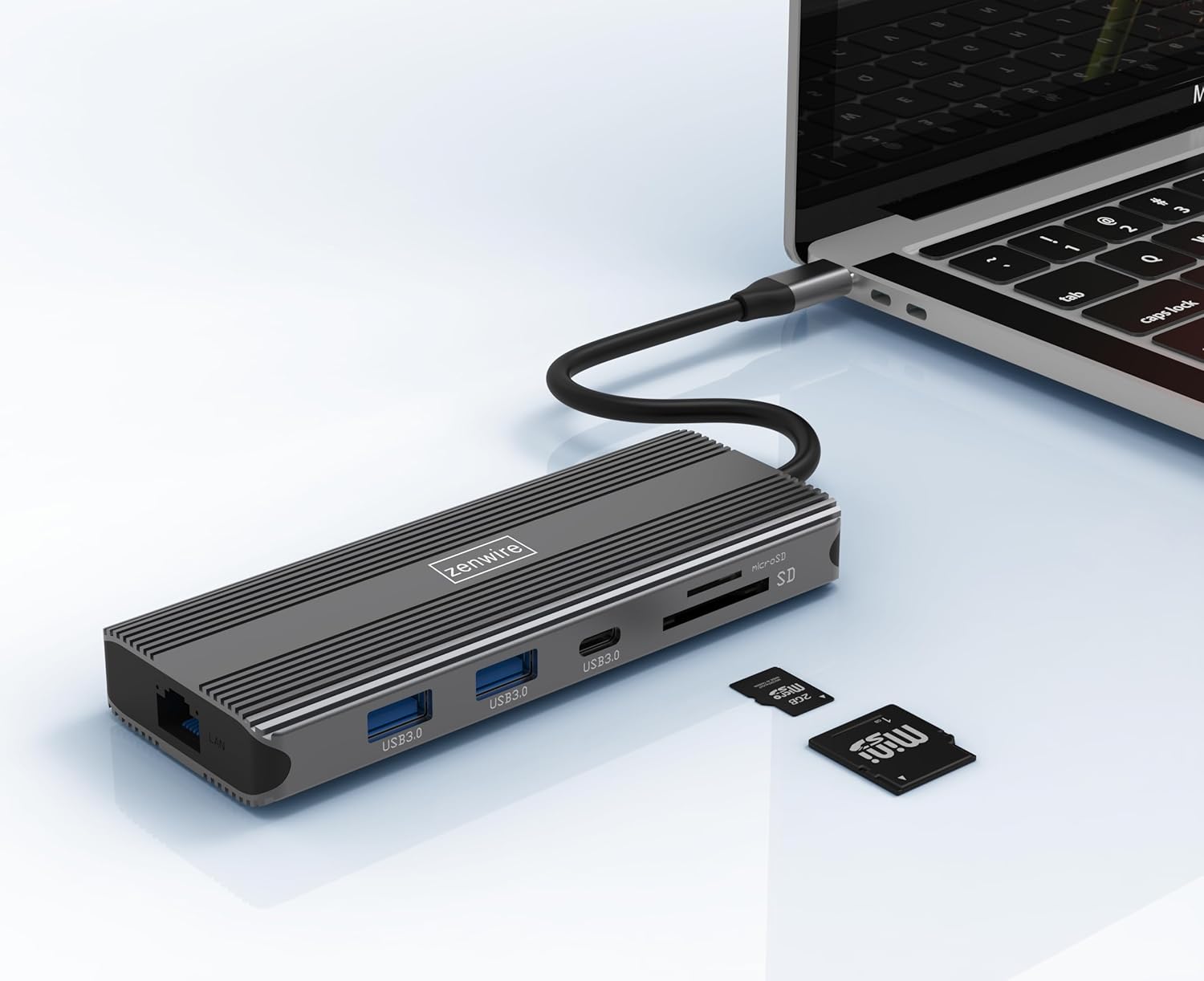
Image: The Zenwire USB-C Hub is shown connected to a laptop via its integrated USB-C cable, with SD and MicroSD cards placed nearby, illustrating a typical setup scenario.
Operating Instructions
Display Connectivity:
The hub supports connecting up to two external monitors simultaneously via its HDMI 2.1 and DisplayPort 1.4 interfaces. Both can display video in 4K@60Hz concurrently.
- Single Monitor: Connect your monitor to either the HDMI or DisplayPort.
- Dual Monitors: Connect one monitor to the HDMI port and another to the DisplayPort.

Image: A laptop is displayed connected to two larger external monitors, demonstrating the multi-display capability of the Zenwire USB-C Hub.
Multi-Display Modes (MacOS vs. Windows):
The behavior of multiple external displays can vary between operating systems.
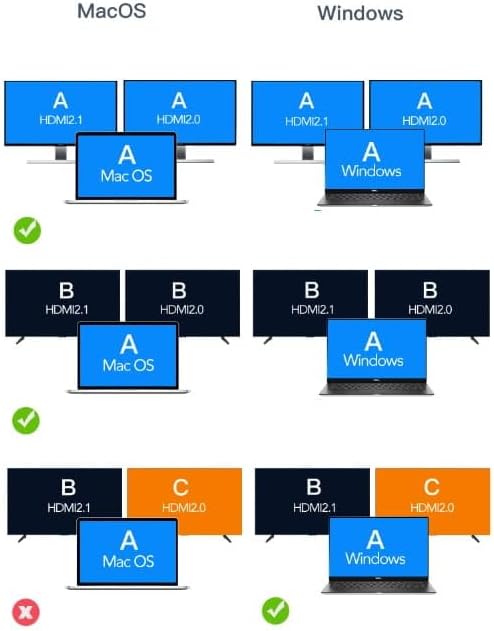
Image: A diagram illustrating different multi-display configurations for MacOS and Windows. It shows that MacOS typically supports extended desktop across two external monitors (A, B) and the laptop screen (A), while Windows can support extended desktop across three screens (A, B, C) or mirrored displays.
- MacOS: Typically supports extended desktop across two external monitors (A, B) and the laptop screen (A). Mirroring is also supported.
- Windows: Supports extended desktop across three screens (A, B, C) or mirrored displays, offering more flexibility for multi-monitor setups.
HDMI 2.1 and DisplayPort 1.4 Advanced Features:
These ports offer higher refresh rates and advanced features for an enhanced visual experience:
- High Transfer Speeds: Up to 48 Gbps for HDMI 2.1, ensuring high data throughput.
- eARC (Enhanced Audio Return Channel): For higher audio quality and support for object-based audio formats like Dolby Atmos and DTS-X.
- VRR (Variable Refresh Rate): Useful for gaming, where refresh rates are not constant.
- ALLM (Auto Low Latency Mode): Automatically detects content like games and switches the device to a low-latency mode.
- QMS (Quick Media Switching): The image on the screen changes immediately when switching between content.
- QFT (Quick Frame Transport): Reduces input lag further.
- Dynamic HDR: Adjusts the image parameters during content transmission for higher quality visuals. Supports HDR 10 and 10+.
Audio Connectivity:
The 3.5mm audio jack allows connection of various audio devices:
- Microphones
- Headphones
- Headphones with integrated microphone
- External speakers
Maintenance
- Cleaning: Use a soft, dry cloth to clean the hub. Avoid liquid cleaners or abrasive materials.
- Storage: Store the hub in a cool, dry place away from direct sunlight and extreme temperatures.
- Handling: Avoid dropping the device or subjecting it to strong impacts.
- Heat Dissipation: The aluminum alloy shell is designed for effective heat dissipation. Ensure the hub is placed in a well-ventilated area during prolonged use.
Troubleshooting
- No Display Output:
- Ensure the USB-C cable from the hub is securely connected to your host device.
- Verify that the HDMI/DisplayPort cable is firmly connected to both the hub and the monitor.
- Check your host device's display settings to ensure the external monitor is detected and configured correctly (e.g., extended, mirrored).
- Try a different HDMI/DisplayPort cable or monitor to rule out cable/monitor issues.
- No Power Delivery:
- Ensure your USB-C power adapter is connected to the hub's PD port and is functioning correctly.
- Verify that your host device supports USB-C Power Delivery.
- USB Devices Not Recognized:
- Reconnect the USB device to a different USB 3.0 port on the hub.
- Ensure the USB device is functioning correctly by connecting it directly to your host device.
- Some high-power USB devices may require external power if the hub's PD port is not utilized.
- Ethernet Connection Issues:
- Check if the Ethernet cable is securely connected to both the hub and your router/modem.
- Verify network settings on your host device.
- Ensure your router/modem is working correctly.
- SD/MicroSD Card Not Detected:
- Ensure the card is fully inserted into the correct slot.
- Check if the card is formatted correctly and readable by your operating system.
- Try a different card to rule out card issues.
Specifications
| Brand | Zenwire |
| Model | Zenwire USB-C Hub |
| Connectivity | USB-C 3.1 / Thunderbolt 3.0 (Host) |
| Ports |
|
| Data Transfer Speed | USB 3.0: 5 Gbps; Ethernet: 1000 Mbps |
| Power Delivery | Up to 100W |
| Material | Aluminum Alloy Shell |
| Dimensions (L x W x H) | 118 x 48 x 15 mm |
| Weight | 109 g |
| Cable Length | Approximately 15 cm |
| Operating System Compatibility | Windows 11/10/8/7, Apple macOS, Linux, Android, iPad Pro iOS (USB-C models) |

Image: An angled view of the Zenwire USB-C Hub, showcasing its compact design and the integrated USB-C host cable.
Warranty and Support
Zenwire products are designed for reliability and performance. For warranty information and technical support, please refer to the official Zenwire website or contact your retailer. Keep your purchase receipt for warranty claims.
For the latest software updates or driver information (if applicable), please visit the Zenwire support page. This device is designed to be Plug & Play, generally not requiring additional drivers.