
1. Important Safety Information
Read and understand all safety precautions and operating instructions before using this generator. Failure to follow these instructions can result in serious injury or death.
- Carbon Monoxide Hazard: Generators produce carbon monoxide (CO), a colorless, odorless, poisonous gas. Operate generators outdoors only, far away from windows, doors, and vents. Never operate in an enclosed space.
- Electrical Shock Hazard: Never operate the generator in wet conditions. Ensure all electrical connections are dry and properly grounded. Do not touch the generator with wet hands.
- Fire Hazard: Gasoline is highly flammable. Store fuel in an approved container in a well-ventilated area. Do not refuel the generator while it is running or hot. Keep fuel away from ignition sources.
- Hot Surfaces: The generator's engine and muffler become very hot during operation and remain hot for some time after shutdown. Avoid contact to prevent burns.
- Moving Parts: Keep hands, feet, hair, and clothing away from moving parts to prevent injury.
2. Product Overview
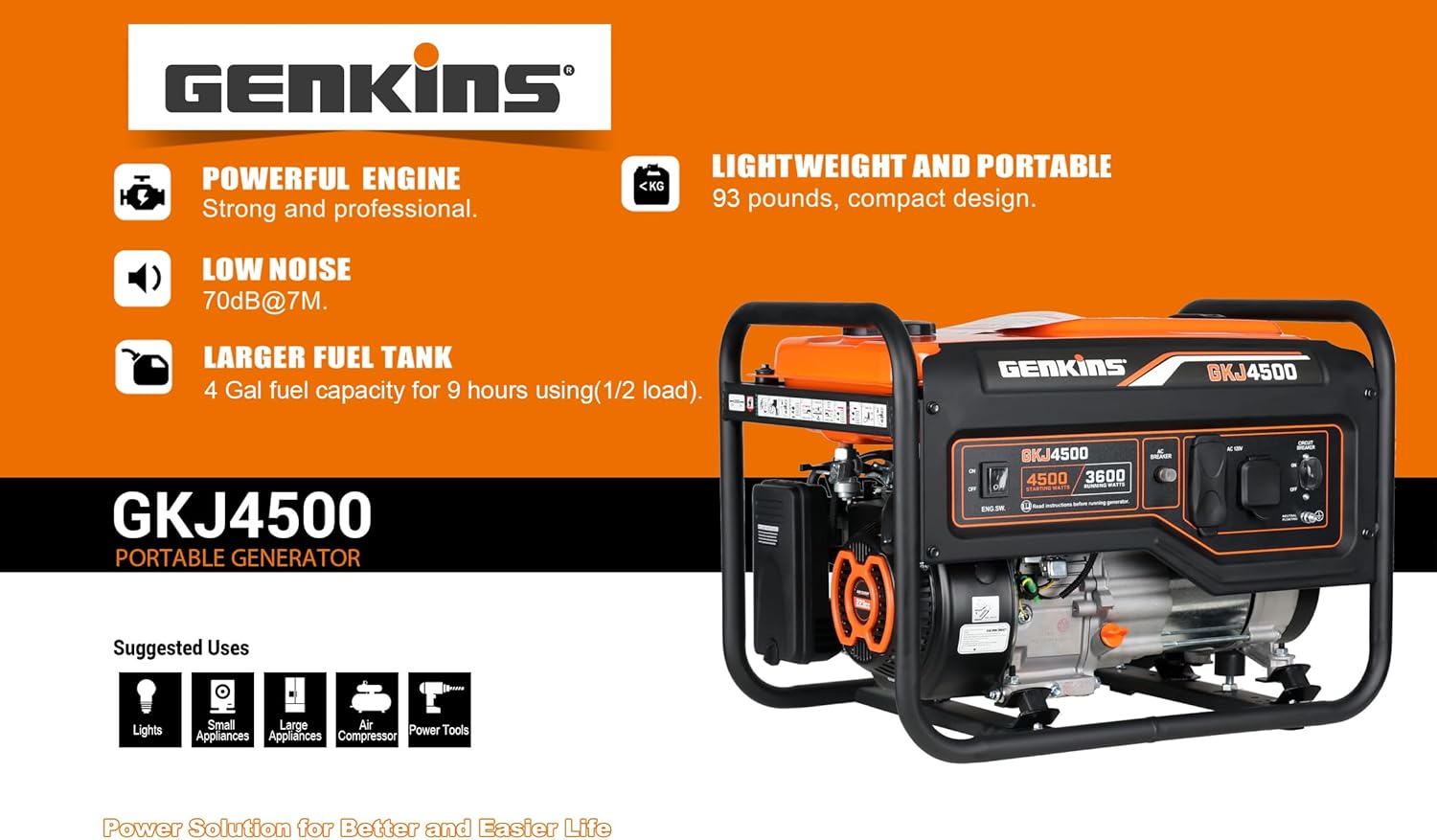
The Genkins GKJ4500 is a portable gasoline generator designed to provide reliable power for various applications. It features a 233cc 4-stroke engine, delivering 3600 running watts and 4500 starting watts.
Key Features:
- 4500 Peak Watt & 3600 Rated Watt output.
- Powered by Genkins Industrial 4 Stroke 233 cc Engine.
- 4 Gallon fuel tank for extended run times.
- Equipped with L5-20R 120V/20A (x2) and L5-30R 120V/30A receptacles.
- Low oil shutdown feature for engine protection.
- Open frame design for portability and cooling.
Component Identification:


3. Setup
Unpacking and Assembly:
- Carefully remove the generator from its packaging.
- Inspect for any shipping damage. Contact customer support if damage is found.
- Attach any included components such as feet or handles, if not pre-assembled. Refer to the quick guide for specific assembly steps.
Adding Engine Oil:
The generator is shipped without engine oil. It is critical to add the correct amount and type of oil before first use.
- Place the generator on a level surface.
- Remove the oil fill cap/dipstick.
- Add approximately 1.16 pints (0.55 liters) of SAE 10W-40 engine oil (Recommended Oil: SJ 10W-40). Do not overfill.
- Reinstall the oil fill cap/dipstick securely.
Adding Fuel:
Use only fresh, unleaded gasoline with an octane rating of 87 or higher.
- Ensure the generator is turned off and cool before refueling.
- Open the fuel tank cap.
- Carefully pour gasoline into the fuel tank, up to the fill limit (approximately 4 gallons). Do not overfill.
- Securely close the fuel tank cap.
4. Operating Instructions
Starting the Generator:
- Ensure the generator is on a level, outdoor surface, away from any obstructions.
- Turn the engine switch to the 'ON' position.
- Move the choke lever to the 'CHOKE' position (cold start). For a warm engine, the choke may not be necessary.
- Pull the recoil starter handle firmly and steadily until the engine starts. Do not let the rope snap back.
- Once the engine starts, slowly move the choke lever to the 'RUN' position.
- Allow the engine to warm up for a few minutes before connecting electrical loads.
Connecting Electrical Loads:
- Ensure the generator is running smoothly.
- Plug your appliances or extension cords into the appropriate AC receptacles (L5-20R 120V/20A or L5-30R 120V/30A).
- Do not overload the generator. The total running wattage of all connected devices should not exceed 3600W.
- If an overload occurs, the circuit breaker will trip. Disconnect some loads, then reset the circuit breaker.
Stopping the Generator:
- Disconnect all electrical loads from the generator.
- Allow the generator to run for a few minutes without load to cool down.
- Turn the engine switch to the 'OFF' position.
- Close the fuel valve (if equipped) to prevent fuel flow.
5. Maintenance
Regular maintenance ensures the longevity and reliable operation of your generator. Always perform maintenance with the engine off and cool, and the spark plug wire disconnected.
Maintenance Schedule:
- Before Each Use: Check engine oil level, inspect for loose fasteners or damage.
- Every 25 Hours or Annually: Change engine oil.
- Every 50 Hours or Annually: Clean/inspect air filter, inspect spark plug.
- Every 100 Hours or Annually: Replace spark plug, clean fuel filter (if applicable), inspect fuel lines.
Engine Oil Change:
- Run the engine for a few minutes to warm the oil.
- Turn off the engine and disconnect the spark plug wire.
- Place a drain pan under the oil drain plug.
- Remove the oil drain plug and oil fill cap/dipstick to allow oil to drain completely.
- Reinstall the drain plug.
- Refill with 1.16 pints of fresh SAE 10W-40 oil.
- Reinstall the oil fill cap/dipstick and reconnect the spark plug wire.
Air Filter Maintenance:
A dirty air filter can reduce engine performance and lifespan.
- Remove the air filter cover.
- Remove the foam air filter element.
- Wash the foam element in warm, soapy water, rinse thoroughly, and allow to air dry completely.
- Lightly oil the foam element with engine oil, then squeeze out excess oil.
- Reinstall the air filter element and cover.
6. Troubleshooting
This section provides solutions for common operational issues. If you encounter a problem not listed here, contact customer support.
| Problem | Possible Cause | Solution |
|---|---|---|
| Engine will not start | No fuel Low oil level Engine switch OFF Choke incorrect Spark plug issue | Add fresh gasoline Add engine oil Turn engine switch ON Adjust choke lever Inspect/clean/replace spark plug |
| No power output | Circuit breaker tripped Overload Faulty connection | Reset circuit breaker Reduce connected loads Check all connections |
| Engine runs rough | Stale fuel Dirty air filter Spark plug issue | Drain and refill with fresh fuel Clean/replace air filter Inspect/clean/replace spark plug |
7. Specifications
Technical specifications for the Genkins GKJ4500 Portable Gasoline Generator.
| Specification | Detail |
|---|---|
| Model Number | GKJ4500 |
| Rated Output | 3600W |
| Max. Output | 4500W |
| Rated Voltage & Frequency | 120V/60HZ |
| Running VAC Amperage | 30 A |
| Engine Type | OHV, 4-stroke |
| Engine Displacement | 223 cc |
| Recommended Oil | SJ 10W-40 |
| Oil Volume | 1.16 pt |
| Fuel Type | Gasoline |
| Fuel Tank Capacity | 4 gal |
| Full Load Run Time | 6.5 h |
| 1/2 Load Run Time | 9 h |
| Starting Method | Recoil start |
| Noise Level (7m) | 70dB |
| Net Weight | 93 lb |
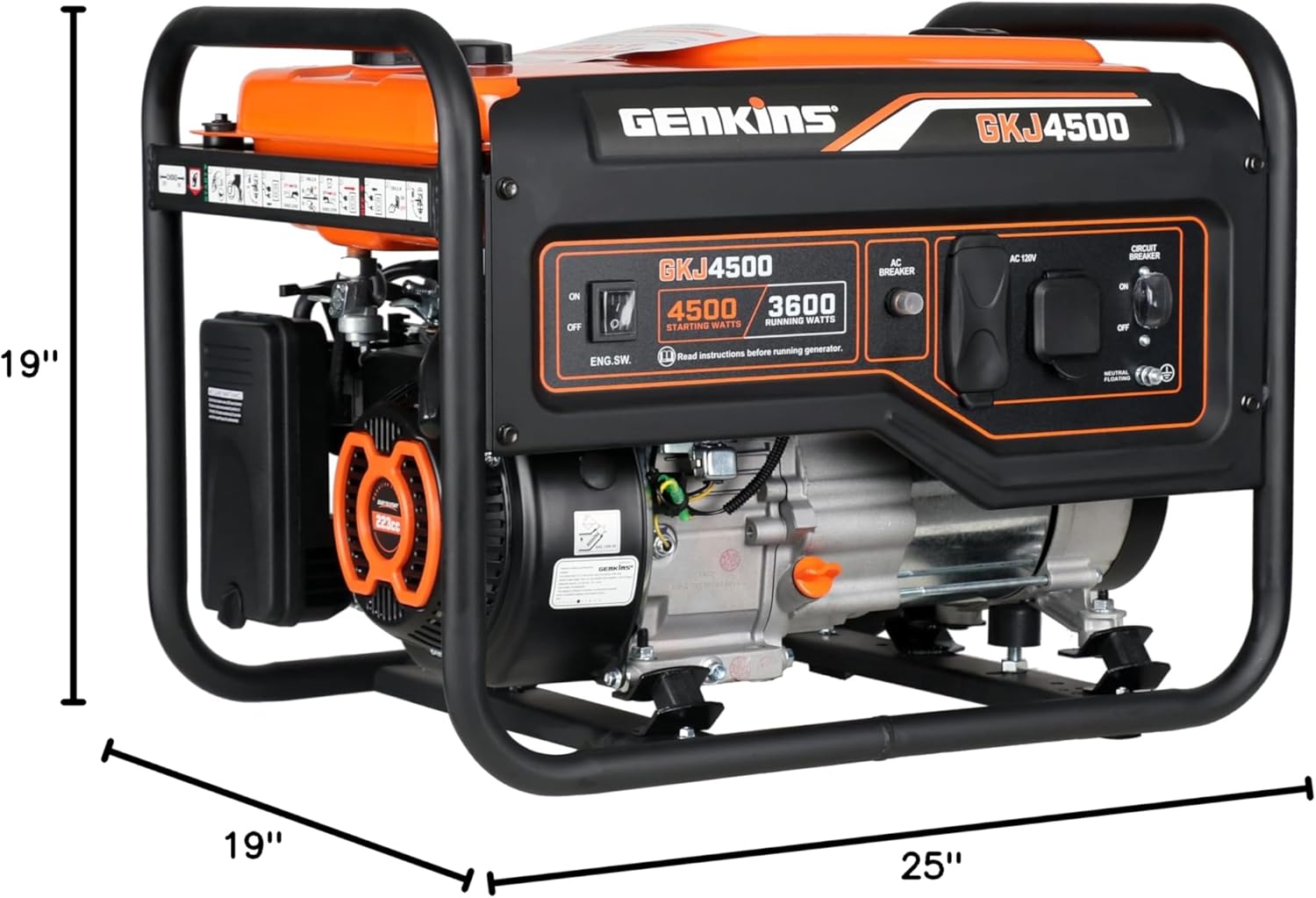
| Assembly Dimensions (L*W*H) | 23.2 x 17.3 x 17.7 inches |
| Receptacles | L5-20R 120V/20A (x2), L5-30R 120V/30A |
8. Warranty and Support
Warranty Information:
This Genkins generator comes with a 1-Year Manufacturer Warranty. This warranty covers defects in materials and workmanship under normal use. Parts and service are provided by Genkins after the first year of purchase.
Please retain your proof of purchase for warranty claims.
Customer Support:
For technical assistance, troubleshooting not covered in this manual, or warranty inquiries, please contact Genkins Direct customer support.
Contact information can typically be found on the Genkins official website or through your purchase platform.
