
1. Introduction and Product Overview
The 3DMaterials SuperRigid 3D Printer Resin is an advanced photopolymer resin engineered for industrial-grade prototyping. It is formulated with 40% nano-micro ceramic powder, providing exceptional stiffness and a ceramic-like texture. This resin is designed to produce highly rigid and durable parts with excellent dimensional stability.

Image: SuperRigid 3D Printer Resin bottle alongside a complex 3D printed component, showcasing the resin's white color and ability to produce detailed parts.
2. Key Features
- 40% Nano-Micro Ceramic Powder Filled: Contains 40% of nano-micron ceramic powder for strong industrial grade ceramic-like prototypes.
- High Modulus Ceramic-Like: Achieves 6.0GPa tensile and 8.0GPa flexural modules, simulating the stiffness of ceramic.
- Ceramic Like Texture: Produces high density and surface texture that simulates ceramic, stone, or cement.
- ISO 10993-5 Certified: Properly cleaned and fully post-cured SuperRigid prints pass the ISO 10993-5 test, indicating biocompatibility.
- Broad Compatibility: Unique photosensitization technology ensures SuperRigid is compatible with all types of LCD 3D printers.
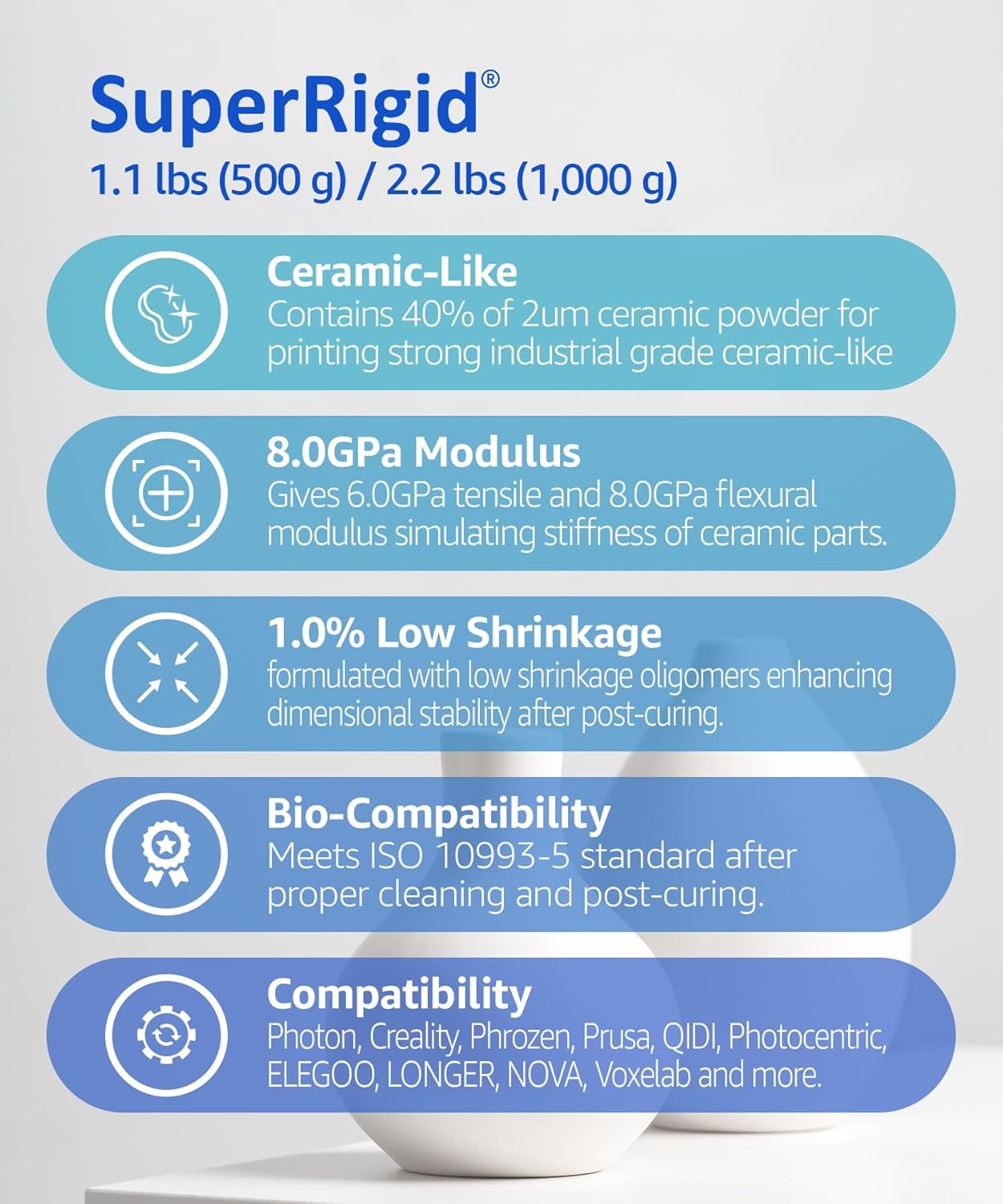
Image: An infographic highlighting the key features of SuperRigid resin, including its ceramic-like properties, 8.0GPa modulus, 1.0% low shrinkage, bio-compatibility, and broad compatibility with various 3D printer brands.

Image: SuperRigid resin being poured into a 3D printer vat, accompanied by a list of its beneficial properties such as rapid curing, flawless texture, high precision, minimal shrinkage, excellent fluidity, light scent, ease of use, and broad compatibility.
3. Mechanical Properties
The following table outlines the typical mechanical properties of SuperRigid resin after proper post-curing. These properties may vary depending on part geometry, printing orientation, and specific print settings.

Image: A detailed table presenting the mechanical properties of SuperRigid resin, including Tensile Strength at Break, Secant Modulus, and Elongation at Break in both Metric and Imperial units, along with the testing methods.
| Property | Metric Value | Imperial Value |
|---|---|---|
| Tensile Strength at Break | 59 MPa | 8,557 psi |
| Secant Modulus | 5,547 MPa | 805 ksi |
| Elongation at Break | < 1.3 % | < 1.3 % |
4. Compatibility
SuperRigid resin is designed for broad compatibility with a wide range of LCD 3D printers. Its unique photosensitization technology ensures optimal performance across various mono and RGB LCD models.

Image: A circular diagram illustrating the compatibility of 3DMaterials resins with various 3D printer brands, including Photon, Creality, Phrozen, Prusa, QIDI, Photocentric, ELEGOO, LONGER, NOVA, Voxelab, Anycubic, Zortrax, and EPAX.
Compatible brands include, but are not limited to:
- Anycubic
- Creality
- ELEGOO
- EPAX
- LONGER
- Nova3D
- Photocentric
- Phrozen
- Prusa
- Qidi Tech
- Voxelab
- Zortrax
5. Preparation for Use
Before using SuperRigid resin, ensure proper preparation to achieve optimal print quality and safety.

Image: The back label of the SuperRigid resin bottle, displaying detailed instructions for preparation, usage, storage, and safety precautions.
- Always wear protective gloves when handling the product.
- Keep the product away from direct sunlight or other light sources.
- Read this manual carefully before using the product.
6. How to Use
Follow these steps for effective use of SuperRigid resin:
- Shake the product well before use to ensure proper mixing of components.
- Check the recommended exposure conditions for your specific 3D printer model. Refer to the exposure setting charts below or visit www.3dmaterials.com for detailed settings.
- Use isopropyl alcohol (IPA) or any suitable type of alcohol to remove excess resin from the printing.
- Dry the printings completely before post-curing.
- Post-cure the printings with sunlight or a dedicated post-curing unit until fully hardened.
7. Storage
Proper storage is crucial for maintaining resin quality and shelf life.
- Store the product at 10-25°C (50-77°F) in a dry, dark room.
- Keep the product away from direct sunlight or other light sources.
- Do not use the product after the expiration date indicated on the label.
- This product is not harmful to the environment when it is solid. After printing, residual products should be disposed of in accordance with waste management regulations.
8. Precautions for Use
Adhere to the following safety precautions:
- Skin and Eye Contact: If contact with eyes occurs, do not rub your eyes. Immediately flush eyes with plenty of water for at least 15 minutes and call a doctor. If contact with skin occurs, flush skin with plenty of water for at least 15 minutes and remove contaminated clothes and shoes. Go to the hospital immediately if symptoms (inflammation, irritation) occur.
- Inhalation: If inhaled, move to a location with clean air.
- Ingestion: If ingested, rinse your mouth with water immediately and seek medical advice.
- Allergic Reactions: Talk to a doctor immediately if allergic signs are shown.
9. Setup and Initial Configuration
Before starting your first print with SuperRigid resin, ensure your 3D printer is properly set up and calibrated.
- Printer Leveling: Ensure your build plate is perfectly leveled according to your printer's manufacturer guidelines. An unlevel plate can lead to print failures, especially with high-viscosity resins.
- Vat Cleaning: Thoroughly clean the resin vat and FEP film before adding new resin. Residue from previous prints or other resins can affect print quality and adhesion.
- Resin Temperature: SuperRigid resin is highly viscous. For best results, ensure the resin is at room temperature (20-25°C / 68-77°F) or slightly warmer. Some users report better results with temperatures up to 38°C (100°F) for improved flow and reduced suction issues.
10. Operating Instructions
Optimal exposure settings are crucial for successful prints with SuperRigid resin. The following tables provide recommended settings for various popular LCD 3D printers at 50µm slicing. These are starting points and may require fine-tuning based on your specific printer, environment, and desired print quality.

Image: A table showing recommended exposure settings for SuperRigid R42L White resin on various Anycubic and Creality 3D printer models, including bottom layer exposure and normal layer exposure times for 50µm slicing.

Image: A table showing recommended exposure settings for SuperRigid R42L White resin on additional Creality and Elegoo 3D printer models, including bottom layer exposure and normal layer exposure times for 50µm slicing.

Image: A table showing recommended exposure settings for SuperRigid R42L White resin on more Elegoo, Phrozen, and Nova3D printer models, including bottom layer exposure and normal layer exposure times for 50µm slicing.
Note: These are maximum times. Shorten the Exposure Time if thin film forms on the vat film. Recommended pigment drops per 100mL of clear resins for standard color and exposure time.
For a comprehensive and up-to-date setting chart, please scan the QR code on the product bottle or visit the official 3DMaterials website.
11. Maintenance
Proper maintenance of your resin and printer can extend their lifespan and ensure consistent print quality.
- Resin Filtration: Due to its high viscosity, SuperRigid resin can be challenging to filter after a failed print. Use a coarse filter (like screen door material) to remove larger cured particles. For finer filtration, specialized resin filters may be required.
- Vat Agitation: If the resin has been sitting in the vat for an extended period (e.g., overnight), gently agitate the material with a soft object or gloved hand to re-mix any settled ceramic powder before starting a new print. This prevents material separation and ensures consistent print properties.
- FEP/PFA Film Care: After each print, inspect the FEP or PFA film for any cured resin stuck to it. Clean the vat thoroughly to prevent issues with subsequent prints, as cured resin on the film can block UV light transmission and cause adhesion problems.
12. Troubleshooting
Here are some common issues and potential solutions when working with SuperRigid resin:
- Prints Not Sticking to Build Plate:
- Increase bottom layer exposure time.
- Ensure resin temperature is adequate (warm it up if too cold).
- Verify build plate leveling and surface preparation.
- Check for cured resin stuck to the FEP/PFA film in the vat.
- Parts are Brittle or Shatter Easily:
- Ensure prints are fully post-cured. Insufficient curing can lead to brittleness.
- Review normal layer exposure times; underexposure can result in weaker parts.
- Resin is Too Viscous/Hard to Filter:
- Warm the resin slightly before use to reduce viscosity.
- Use a coarser filter (e.g., screen door material) for initial filtration, then a finer one if necessary.
- Uncured Resin in Small Openings:
- Due to high viscosity, uncured resin can be difficult to remove from small features. Consider design adjustments or alternative cleaning methods like ultrasonic cleaning for such parts.
13. Specifications
Detailed product specifications for SuperRigid 3D Printer Resin (ENGR-R42L).
| Specification | Value |
|---|---|
| Product Dimensions | 2.76 x 2.76 x 7.48 inches |
| Item Weight | 1.1 Pounds (500g) |
| Model Number | ENGR-R42L |
| Manufacturer | 3DMaterials Co., Ltd. |
| Country of Origin | Korea, Republic of |
14. Official Product Videos
Explore these official videos from 3DMaterials for more insights into the product's capabilities and applications.
3DMaterials: Where Innovation Takes Place
Video: This video provides an overview of 3DMaterials' commitment to innovation, showcasing their research and development processes, including oligomer synthesis, properties testing, and various printing tests with different resin types like SuperFast 8K, SuperPP, SuperPCS 8K, SuperRigid, SuperCast, SuperHDT, SuperFlex, SuperElastic, and SuperESD. It also highlights their FEP film and resin filters.
4cm 3D Printed Lattice Can Support Mercedes S-500
Video: Demonstrates the incredible strength of a 4cm x 4cm 3D printed lattice made with SuperRigid resin, showing it successfully supporting the weight of a 2,000kg (4,410 lbs) Mercedes S-500 car. The video highlights the resin's extreme compressive strength and durability.
SuperRigid: How Much Load Can Support
Video: This video illustrates the superior compression strength of SuperRigid resin compared to standard tough resins. It shows a 25mm x 25mm lattice printed with SuperRigid resin withstanding over 5000N (510Kgf) of load, demonstrating its ability to handle 23 times higher compression than typical tough resins.
15. Additional Resources
- User Guide (PDF): For a downloadable PDF version of the user guide, please refer to the official document provided by 3DMaterials: Download User Guide PDF
- Setting Chart: For the most current and detailed exposure setting charts for various printers, please visit: SuperRigid Setting Chart
16. Warranty and Support
For any product-related inquiries, technical support, or warranty information, please contact 3DMaterials directly through their official website or the contact details provided on the product packaging. 3DMaterials is committed to providing high-quality products and customer satisfaction.
