
1. Introduction
The SMSL DO400 is a high-performance Digital-to-Analog Converter (DAC) and Headphone Amplifier designed to deliver exceptional audio fidelity. It features advanced components and versatile connectivity options, making it suitable for a wide range of audio setups. This manual provides detailed instructions for setting up, operating, and maintaining your DO400 unit.
2. Product Features
- High-End Audio Quality: Equipped with the ES9039MSPRO DAC chip, supporting 32-bit/768kHz PCM and DSD512 for ultra-high resolution audio playback.
- Versatile Connectivity: Offers six input options including USB, IIS, AES, Optical, and Coaxial. Features multiple headphone outputs (4.4mm, 6.35mm, 4-XLR) and two line outputs (RCA, XLR) for diverse audio configurations.
- Enhanced Signal Processing: Incorporates the 3rd-generation XMOS XU-316 chip and PLFC ultra-low distortion circuitry for exceptional sound clarity and depth.
- MQA Decoding: Provides full MQA decoder support, preserving studio-grade sound quality and handling MQA-CDs.
- User-Friendly Design: Features a suspended display window, a retro control knob, and a full-featured remote control. Customizable tone modes and dimming settings are available.
3. Package Contents
Upon unpacking your SMSL DO400, please ensure all the following items are present:
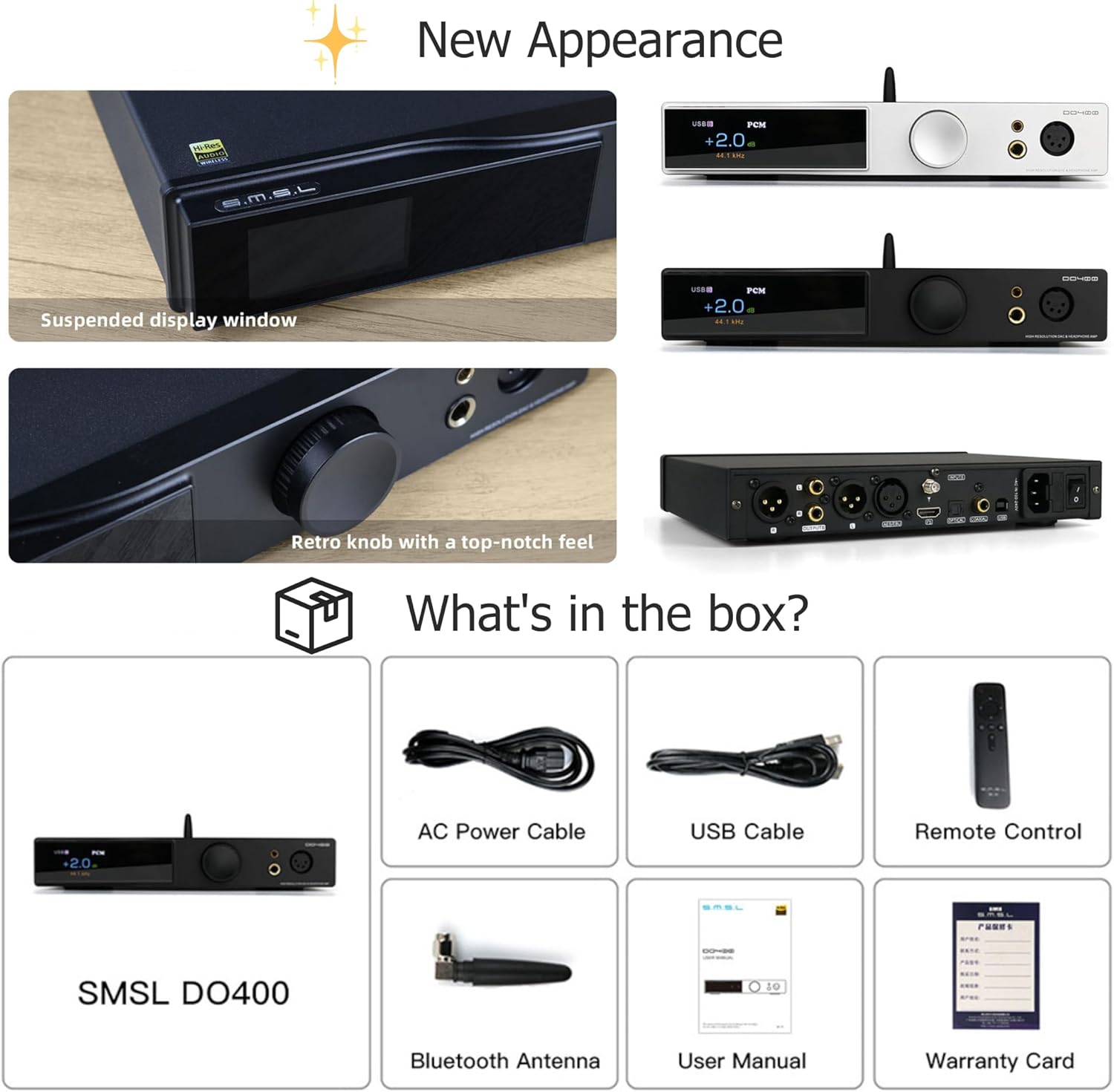
Image: SMSL DO400 unit with its accessories including power cable, USB cable, remote, Bluetooth antenna, user manual, and product card.
- SMSL DO400 Unit
- AC Power Cable
- USB Cable
- Remote Control
- Bluetooth Antenna
- User Manual
- Product Card (Warranty Card)
4. Controls and Connections

Image: Front and rear panel layout of the SMSL DO400, highlighting all physical controls and connection ports.
4.1 Front Panel
- Display: Shows current input, sample rate, volume level, and other settings.
- Control Knob: Used for volume adjustment, menu navigation, and selection.
- Headphone Outputs: Includes 6.35mm single-ended, 4.4mm balanced, and 4-pin XLR balanced headphone jacks.
4.2 Rear Panel
- Analog Outputs: Balanced XLR and unbalanced RCA stereo outputs.
- Digital Inputs: USB, IIS (HDMI), AES/EBU, Optical, and Coaxial inputs.
- Bluetooth Antenna Port: For connecting the included Bluetooth antenna.
- AC Power Input: For connecting the power cable.
- Power Switch: To turn the unit on or off.
5. Setup
Follow these steps to set up your SMSL DO400:
- Connect Power: Connect the AC power cable to the DO400's rear panel and then to a power outlet.
- Connect Bluetooth Antenna: Screw the provided Bluetooth antenna into its designated port on the rear panel.
- Connect Audio Source: Choose your desired input method (e.g., USB, Optical, Coaxial) and connect your audio source device (e.g., computer, CD player, streamer) to the corresponding input port on the DO400. For USB connection to a computer, you may need to install specific drivers. Refer to the official SMSL website for the latest drivers.
- Connect Output Device: Connect your headphones to one of the front panel headphone outputs (6.35mm, 4.4mm, or 4-pin XLR). Alternatively, connect the RCA or XLR line outputs to an external amplifier or powered speakers.
- Power On: Flip the power switch on the rear panel to turn on the DO400.
6. Operation
6.1 Basic Functions
- Volume Control: Rotate the front panel knob or use the volume buttons on the remote control to adjust the output volume.
- Input Selection: Press the input selection button on the remote or navigate through the menu using the knob to select your desired audio input source.
6.2 Menu Navigation
Press the front panel knob to enter the menu. Rotate the knob to scroll through options and press again to select. The remote control also provides basic navigation and function keys.
Menu Options:
- Inputs: Select between USB, Bluetooth, Optical, Coaxial, AES/EBU, and I2S (HDMI).
- Outputs: Configure output mode (All Line Out, Headphone Out, Balanced, Unbalanced).
- PCM Filter: Choose from various digital filters (Off, Minimum Phase, Apodizing, Fast Linear, Slow Linear, Fast Minimum, Slow Minimum, Low Dispersion).
- DSD Filter: Select DSD filter settings.
- HPA Gain: Adjust headphone amplifier gain (Low, High) for different headphone impedances.
- Sound Color: Apply different sound characteristics (Standard, Rich 1/2/3, Tube 1/2/3, Crystal 1/2/3).
- Preamp Mode: Set the volume control behavior (Variable for adjustable volume, Fixed for maximum output level).
- FN Key: Assign a custom function to the FN button on the remote (e.g., Line/Headphone output toggle, Bluetooth, Phase).
- DPLL: Adjust Digital Phase-Locked Loop settings (15 levels) to mitigate jitter, especially with low-quality audio sources.
- I2S Mode: Configure I2S signal phase (Normal, Inverted).
- Audio Phase: Adjust overall audio phase (Normal, Inverted).
- Dimmer: Set the display auto-off time (5-60 seconds).
- Brightness: Adjust display brightness.
- Factory Reset: Restore all settings to their default values.
7. Bluetooth Connectivity
The SMSL DO400 features Bluetooth 5.1 for wireless audio streaming. It supports high-quality codecs including LDAC (24bit/96kHz), APTX/HD (24bit/48kHz), SBC, and AAC.
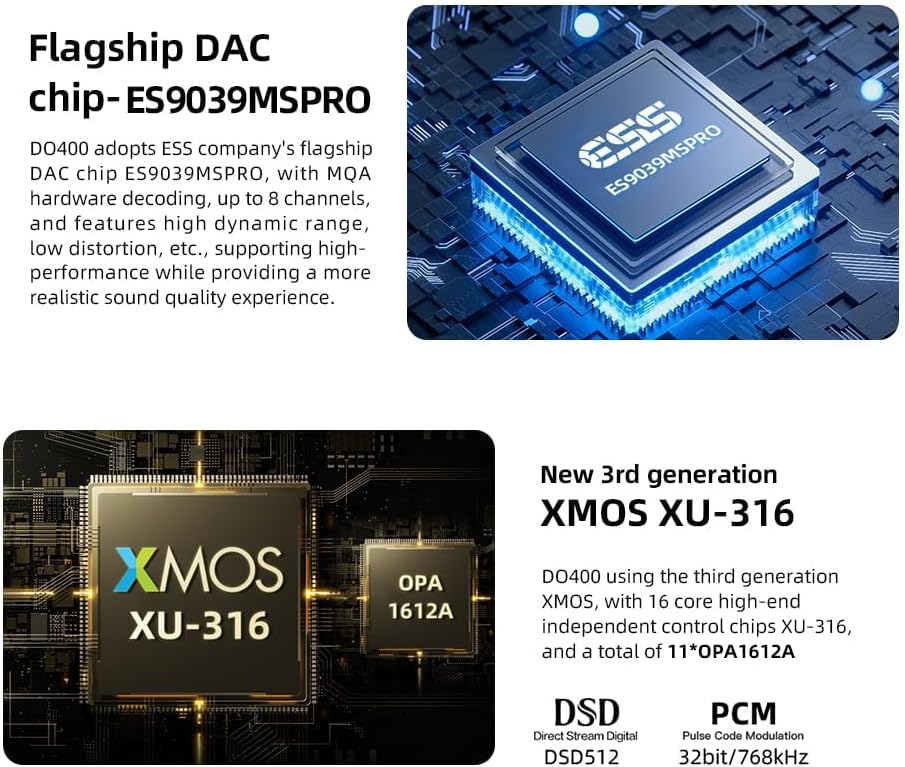
Image: The SMSL DO400 wirelessly connected to a smartphone via Bluetooth, illustrating its Bluetooth 5.1 capabilities and supported audio codecs.
To connect via Bluetooth:
- Ensure the Bluetooth antenna is connected to the DO400.
- Select 'Bluetooth' as the input source on the DO400.
- Enable Bluetooth on your smartphone or other transmitting device and search for 'SMSL DO400'.
- Pair with the device. Once connected, audio will stream wirelessly to the DO400.
8. MQA Decoding
The SMSL DO400 supports MQA (Master Quality Authenticated) full decoding, allowing for playback of high-resolution audio files as intended by the artist. It also supports MQA-CD playback via Coaxial, AES, and Optical inputs.

Image: Visual representation of MQA-CD support through Coaxial, AES, and Optical inputs, highlighting the advanced encoding technology.
When playing MQA content, the DO400 will automatically detect and decode the MQA stream, indicated on the display. For MQA-CDs, ensure the played disc is a genuine MQA-CD and that the fiber optic or coaxial signal output by the CD player is unprocessed source code.
9. Specifications
Below are the technical specifications for the SMSL DO400:

Image: Detailed product specifications and parameters for the SMSL DO400.
| Feature | Specification |
|---|---|
| Model | SMSL DO400 |
| DAC Chip | ES9039MSPRO |
| USB Processor | XMOS XU-316 (3rd Gen) |
| Inputs | USB, Optical, Coaxial, Bluetooth, IIS, AES |
| Outputs | RCA, XLR, 4.4mm Headphone, 6.35mm Headphone, 4-Pin XLR Headphone |
| USB Transmission | USB2.0 (Asynchronization) |
| USB Compatibility | Windows 7/8/8.1/10/11 (Needs Driver), Mac OSX10.6 or later (Driverless), Linux (Driverless) |
| Sampling Rate & Bit Width (USB) | PCM: 44.1-768kHz (32bit), DSD: 2.8224-22.5792MHz (1bit) |
| Sampling Rate & Bit Width (Opt/Coax) | PCM: 44.1-192kHz (24bit), DoP: DoP64 |
| MQA Decoder | USB / Optical / Coaxial / AES |
| MQA-CD Decoder | Optical / Coaxial / AES |
| Bluetooth Specification | 5.1 (Support SBC, AAC, aptX, aptX HD, LDAC) |
| Line Out Amplitude (XLR) | 5.2Vrms |
| Line Out Amplitude (RCA) | 2.5Vrms |
| Headphone Output Power (16Ω) | 6000mW x 2 |
| Headphone Output Power (32Ω) | 3000mW x 2 |
| Headphone Output Power (300Ω) | 700mW x 2 |
| Headphone Output Power (600Ω) | 350mW x 2 |
| THD+N (XLR) | 0.00006% (-123dB, WTDI) |
| THD+N (RCA) | 0.00006% (-123dB, WTDI) |
| THD+N (HPA) | 0.00009% (-120dB, WTDI) |
| Dynamic Range (XLR) | 133dB |
| Dynamic Range (RCA) | 128dB |
| Dynamic Range (HPA) | 128dB |
| SNR (XLR) | 133dB |
| SNR (RCA) | 128dB |
| SNR (HPA) | 128dB |
| Output Impedance | Near 0Ω |
| HPA Gain (Balanced) | +20dB |
| HPA Gain (Unbalanced) | +14dB |
| Power Consumption | <40W |
| Standby Power | <0.5W |
| Dimensions (L x W x H) | 245 x 186 x 42 mm |
| Weight | 1.45kg (3.20lbs) |
10. Troubleshooting
If you encounter issues with your SMSL DO400, refer to the following common problems and solutions:
- No Sound Output:
- Verify that the correct input source is selected on the DO400.
- Check the volume level; ensure it is not muted or set too low.
- Confirm that your headphones or speakers are properly connected and functional.
- For USB input, ensure the necessary drivers are installed on your computer and the DO400 is recognized as an audio device.
- Crackling or Popping Sounds:
- Update the DO400 firmware to the latest version. Instructions for firmware updates are typically available on the SMSL official website.
- For Windows users, consider uninstalling specific XMOS drivers if crackling persists, as some users have reported improved stability with generic drivers or specific driver versions.
- Adjust the DPLL setting in the menu to a higher value to reduce jitter, especially with lower quality audio sources.
- Ensure all cables are securely connected and not damaged.
- USB Connection Issues (Device Not Recognized/Unstable):
- Reinstall the USB drivers from the SMSL website.
- Try a different USB port on your computer.
- Use a different USB cable.
- Perform a factory reset on the DO400.
- I2S (HDMI) Input Not Receiving Signal:
- Ensure your source device (TV, PC) is configured to output audio in PCM format via HDMI, rather than 'Auto' or bitstream formats, as the DO400's IIS input expects a specific signal.
- Try different HDMI cables.
11. Maintenance
To ensure the longevity and optimal performance of your SMSL DO400, follow these maintenance guidelines:
- Cleaning: Use a soft, dry cloth to clean the exterior of the unit. Avoid using abrasive cleaners, solvents, or chemical sprays, as these can damage the finish.
- Ventilation: Ensure the unit has adequate ventilation. Do not block any ventilation openings.
- Environment: Operate the DO400 in a clean, dry environment, away from direct sunlight, excessive heat, humidity, and dust.
- Power Off: Always power off the unit before disconnecting cables or moving it.
12. Warranty and Support
The SMSL DO400 comes with a standard manufacturer's warranty. Please refer to the included Product Card or contact your retailer for specific warranty terms and conditions. For technical support, firmware updates, or service inquiries, please visit the official SMSL website or contact their customer service department.


