1. Introduction
This manual provides essential information for the safe and effective operation, maintenance, and troubleshooting of your Bosch Professional GKS 130 Circular Saw. Please read all instructions carefully before using the tool to ensure your safety and prolong the life of the product.
The GKS 130 Professional circular saw is designed for rough cutting applications. Its 1300 W motor provides sufficient cutting performance for various tasks, including those performed by construction workers, carpenters, and renovation contractors. The tool can be used with a dust extractor for a cleaner working environment.
Key Features:
- Reliable design for continuous cutting.
- Fast cutting speed with a powerful 1300W motor.
- Suitable for cutting various materials such as plywood, softwood, MDF, and OSB board types.
- Integrated dust blower function for a clear cutting line.
- Expandable with the GKS 190 dust extractor.
- Comfortable auxiliary handle for secure tool holding.
- Easy operating depth adjustment via a Quick-lock switch.
2. Safety Instructions
WARNING: Read all safety warnings, instructions, illustrations, and specifications provided with this power tool. Failure to follow all instructions listed below may result in electric shock, fire, and/or serious injury.
General Power Tool Safety:
- Work Area Safety: Keep work area clean and well-lit. Cluttered or dark areas invite accidents. Do not operate power tools in explosive atmospheres, such as in the presence of flammable liquids, gases, or dust.
- Electrical Safety: Power tool plugs must match the outlet. Never modify the plug in any way. Avoid body contact with earthed or grounded surfaces.
- Personal Safety: Always wear eye protection, hearing protection, and a dust mask. Dress properly; avoid loose clothing or jewelry. Secure long hair.
- Tool Use and Care: Do not force the power tool. Use the correct power tool for your application. Disconnect the plug from the power source before making any adjustments, changing accessories, or storing power tools.
Circular Saw Specific Safety:
- Hold the tool by insulated gripping surfaces when performing an operation where the cutting accessory may contact hidden wiring or its own cord.
- Keep hands away from the cutting area and the blade. Keep your second hand on the auxiliary handle, or motor housing. If both hands are holding the saw, they cannot be cut by the blade.
- Do not reach underneath the workpiece. The guard cannot protect you from the blade below the workpiece.
- Adjust the cutting depth to the thickness of the workpiece. Less than a full tooth of the blade should be visible below the workpiece.
- Never hold the workpiece in your hands or across your leg while cutting. Secure the workpiece to a stable platform.
- Always use the correct size and type of blade for the material being cut.
- Ensure the lower guard is functioning correctly and retracts smoothly.
3. Product Components
Familiarize yourself with the various parts of your Bosch Professional GKS 130 Circular Saw for safe and efficient operation.

Figure 3.1: Bosch GKS 130 Circular Saw with key dimensions. The saw measures approximately 352 mm in length, 232 mm in width, and 241 mm in height.

Figure 3.2: Diagram illustrating key functions: Air Blower for a dust-free view of the workpiece and cutting line, and Spindle Lock for easy disc/tool changes and direct dust extraction into a bag or via an all-purpose dust extractor.
4. Setup
4.1 Unpacking and Inspection
- Carefully remove the circular saw and all accessories from the packaging.
- Inspect the tool for any damage that may have occurred during shipping. Do not operate a damaged tool.
- Verify that all included components are present. The product typically includes attachments.
4.2 Blade Installation and Removal
WARNING: Always disconnect the saw from the power supply before installing or removing the blade.
- Press and hold the spindle lock button to prevent the blade from rotating.
- Use the appropriate wrench (usually included) to loosen the blade retaining screw. Turn the screw in the direction indicated on the saw (often opposite to normal threading).
- Lift the lower blade guard and carefully remove the old blade.
- Clean the blade flanges and ensure they are free of debris.
- Place the new blade onto the spindle, ensuring the teeth are pointing in the correct direction of rotation (indicated by an arrow on the saw and blade).
- Re-attach the outer blade flange and tighten the blade retaining screw firmly while holding the spindle lock button. Do not overtighten.
4.3 Adjusting Cutting Depth
The cutting depth can be easily adjusted using the Quick-lock switch.
- Loosen the depth adjustment lever/knob.
- Move the saw base up or down to achieve the desired cutting depth. Ensure that only a small portion of the blade (less than a full tooth) extends below the workpiece.
- Tighten the depth adjustment lever/knob securely.
4.4 Bevel Angle Adjustment
The saw allows for bevel cuts. To adjust the bevel angle:
- Loosen the bevel adjustment lever/knob, typically located at the front of the saw base.
- Tilt the saw base to the desired angle, indicated on the bevel scale.
- Tighten the bevel adjustment lever/knob firmly.
5. Operating Instructions
5.1 Powering On/Off
- To start the saw, press the trigger switch. Some models may have a safety lock-off button that must be pressed first.
- To stop the saw, release the trigger switch.
5.2 Making a Cut
WARNING: Always ensure the workpiece is securely clamped before cutting.
- Mark your cutting line clearly on the workpiece.
- Position the saw base flat on the workpiece, with the blade aligned to the cutting line. Ensure the blade is not touching the workpiece before starting the motor.
- Start the saw and allow the blade to reach full speed before beginning the cut.
- Slowly and steadily push the saw forward through the workpiece. Maintain a firm grip with both hands.
- Allow the saw to complete the cut naturally. Do not force the saw.
- Once the cut is complete, release the trigger and allow the blade to stop completely before lifting the saw from the workpiece.

Figure 5.1: Proper technique for using the circular saw to cut wood, ensuring a stable workpiece and firm grip.

Figure 5.2: The saw in action, demonstrating its cutting capability and the generation of sawdust during operation.

Figure 5.3: A user operating the circular saw to cut a wooden beam, highlighting the blade guard mechanism.

Figure 5.4: The circular saw being used to cut through a wooden pallet, showcasing its versatility for various wood types.
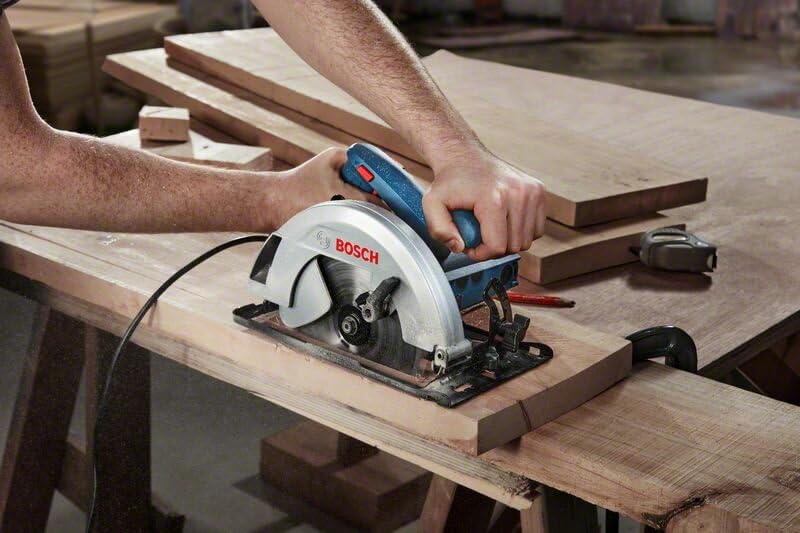
Figure 5.5: The circular saw positioned on a workbench, ready for cutting, with additional wood pieces and a measuring tape nearby.

Figure 5.6: A worker wearing safety gear, including a hard hat and safety glasses, operating the circular saw on a large sheet of material.
5.3 Dust Management
The GKS 130 features an integrated dust blower to keep the cutting line clear. For more comprehensive dust management:
- Connect a suitable dust extractor, such as the GKS 190 dust extractor, to the saw's dust port.
- Ensure the dust extractor is properly attached and functioning before starting the saw.
6. Maintenance
Regular maintenance ensures the longevity and safe operation of your circular saw.
6.1 Cleaning
- Always disconnect the tool from the power supply before cleaning.
- Clean the ventilation openings regularly to prevent motor overheating.
- Remove sawdust and debris from the blade guard, base plate, and depth adjustment mechanism. A brush or compressed air can be used.
- Keep the main handle and auxiliary handle clean and free of grease or oil.
6.2 Blade Care
- Inspect the saw blade before each use for sharpness, cracks, or missing teeth. Replace damaged blades immediately.
- Ensure the blade is clean. Resin and pitch buildup can affect cutting performance and increase kickback risk. Use a suitable blade cleaner.
6.3 Carbon Brushes
The motor is equipped with carbon brushes. When the carbon brushes wear out, the motor will automatically shut off. Have the carbon brushes replaced by an authorized Bosch service center.
7. Troubleshooting
This section addresses common issues you might encounter with your circular saw.
| Problem | Possible Cause | Solution |
|---|---|---|
| Saw does not start | No power supply; Faulty switch; Worn carbon brushes | Check power connection; Test outlet; Contact service for switch/brush replacement. |
| Poor cutting performance / Blade binds | Dull or dirty blade; Incorrect blade for material; Improper cutting depth; Workpiece not secured | Replace/clean blade; Use correct blade; Adjust cutting depth; Secure workpiece firmly. |
| Excessive vibration | Damaged or unbalanced blade; Loose blade retaining screw | Replace blade; Tighten blade screw. |
| Lower blade guard sticks | Sawdust buildup; Damaged guard mechanism | Clean guard area thoroughly; Contact service if damaged. |
8. Technical Specifications
The following specifications apply to the Bosch Professional GKS 130 Circular Saw:
| Specification | Value |
|---|---|
| Brand | Bosch |
| Model Number | GKS130 |
| Power Source | Corded Electric |
| Wattage | 1300 Watts |
| Speed | 6380 RPM |
| Blade Length | 184 Millimetres |
| Number of Teeth | 24 |
| Blade Material | Alloy Steel |
| Surface Recommendation | Wood |
| Special Feature | Depth Adjustment |
| Product Dimensions | 35L x 24.5W x 20H Centimeters |
| Item Weight | 4.69 Kilograms |
| Handle Material | Metal Alloy |
| Included Components | Attachments |
| Country of Origin | China |
9. Warranty and Customer Support
For warranty information, service, or technical support, please refer to the warranty card included with your product or visit the official Bosch Professional website. Keep your purchase receipt as proof of purchase for any warranty claims.
Bosch is committed to providing high-quality tools and support. Do not attempt to repair the tool yourself; always contact an authorized service center for repairs to ensure safety and maintain warranty validity.