
1. Introduction
This manual provides essential information for the safe and efficient operation of your Acekool Portable Air Conditioner. This 3-in-1 unit offers cooling, fan, and dehumidification functions, designed to provide comfort in various indoor environments. Please read this manual thoroughly before installation and use, and retain it for future reference.
2. Safety Information
To prevent injury to the user or other people and property damage, the following instructions must be followed. Incorrect operation due to ignoring instructions may cause harm or damage.
- Electrical Safety: Ensure the power supply matches the unit's requirements (220 Volts). Do not operate with a damaged power cord or plug. Do not share the electrical outlet with other appliances. Always unplug the unit before cleaning or servicing.
- Refrigerant (R290): This appliance contains R290 refrigerant, which is flammable. Keep the unit away from open flames, heat sources, and ignition sources. Do not puncture or burn the refrigerant circuit.
- Placement: Place the unit on a flat, stable surface. Maintain a minimum distance of 20 cm from walls or other objects to ensure proper airflow. Do not block air inlets or outlets.
- Children and Pets: Keep children and pets away from the unit. Do not allow children to play with the appliance or its controls.
- Water Drainage: Ensure proper drainage of condensed water, especially during dehumidification mode, to prevent water overflow and damage.
- Maintenance: Only perform maintenance as described in this manual. For repairs, contact qualified service personnel.
3. What's in the Box
Carefully unpack the box and ensure all items are present and undamaged. If any items are missing or damaged, contact customer support.
- Portable Air Conditioner Unit (x1)
- Remote Control (x1)
- Exhaust Hose (x1)
- Window Sealing Kit (x1)
- Drain Hose (x1)
- User Manual (x1)

Image: All components included in the product package, clearly labeled with numbers for identification.
4. Setup
Follow these steps to set up your portable air conditioner for optimal performance.
4.1 Unit Placement
- Place the unit on a firm, level surface in the desired room.
- Ensure there is at least 20 cm of space around the unit for proper air circulation.
- Position the unit near a window or door for exhaust hose installation.
4.2 Exhaust Hose Installation
- Attach the exhaust hose connector to the back of the air conditioner unit.
- Extend the exhaust hose and attach the window kit adapter to the other end.
- Adjust the window sealing plate to fit your window opening. Secure it in place.
- Insert the window kit adapter into the opening of the window sealing plate.
- Ensure the exhaust hose is as straight and short as possible to maximize efficiency. Avoid kinks or sharp bends.

Image: Visual instructions demonstrating the process of connecting the exhaust hose to the unit and installing it in a window.

Image: Detailed view of the exhaust hose connection points, highlighting the ease of installation.
4.3 Power Connection
Plug the power cord into a grounded electrical outlet (220V). Do not use extension cords or adapters.
5. Operating Instructions
Your Acekool Portable Air Conditioner can be operated using the control panel on the unit or the included remote control.
5.1 Control Panel Overview
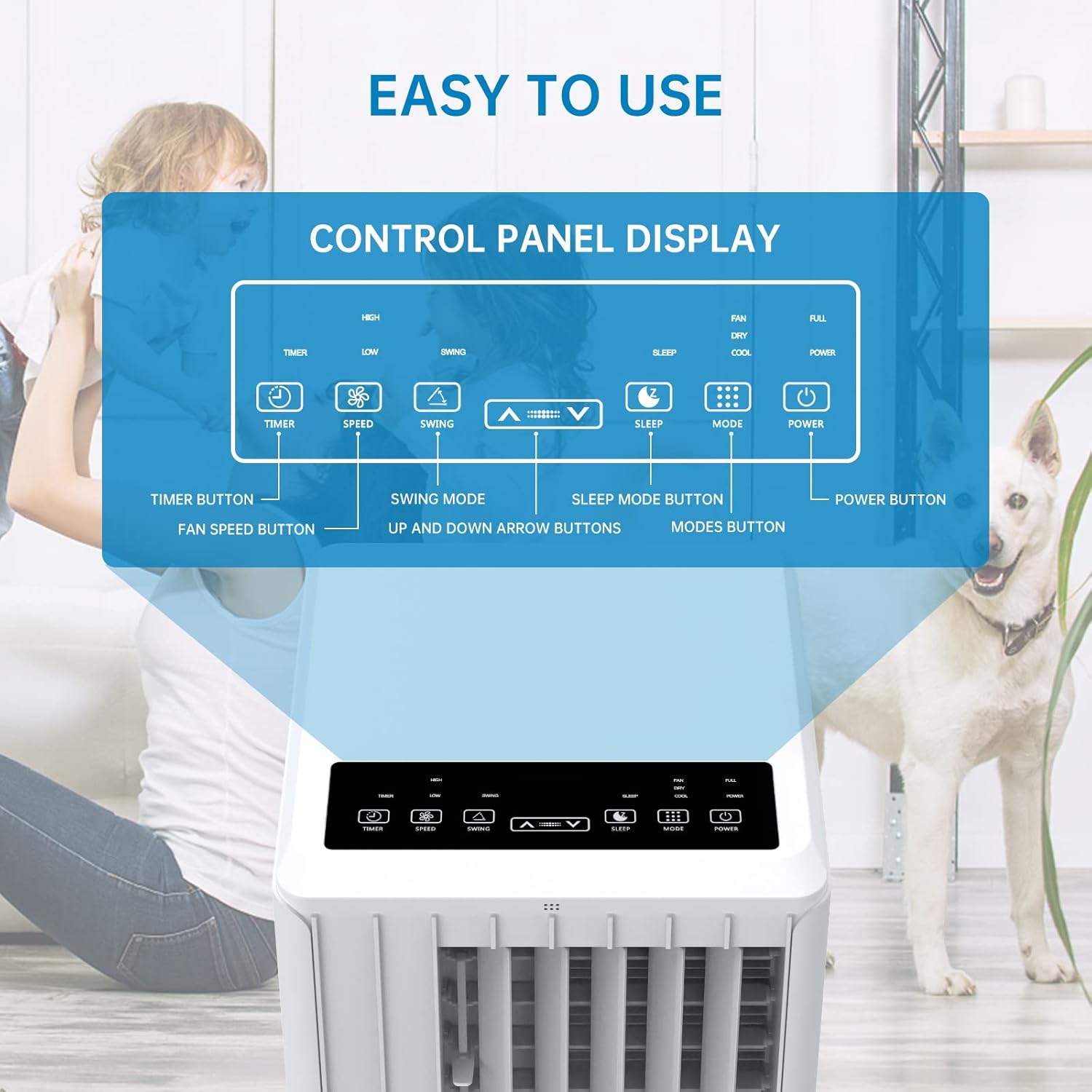
Image: A detailed diagram illustrating the control panel buttons and their functions, including Timer, Speed, Swing, Sleep, Mode, and Power.

Image: A user interacting with the touch-sensitive control panel, demonstrating its intuitive design.
- Power Button: Turns the unit ON or OFF.
- Mode Button: Cycles through Cooling, Fan, and Dehumidification modes.
- Speed Button: Adjusts fan speed (Low, Medium, High).
- Timer Button: Sets the auto ON/OFF timer (up to 24 hours).
- Swing Button: Activates or deactivates the automatic louver swing for wider air distribution.
- Up/Down Arrows: Adjusts temperature settings or timer duration.
- Sleep Button: Activates Sleep Mode for quiet operation and energy saving during sleep.
5.2 Remote Control
The remote control provides convenient operation from a distance. Ensure there are no obstructions between the remote and the unit's receiver.

Image: The portable air conditioner unit alongside its remote control, demonstrating the convenience of remote operation and the air swing feature.
5.3 Operating Modes
The unit offers three primary operating modes:

Image: A graphic illustrating the three distinct modes of operation: Cooling, Dehumidifying, and Fan, with their respective visual effects.
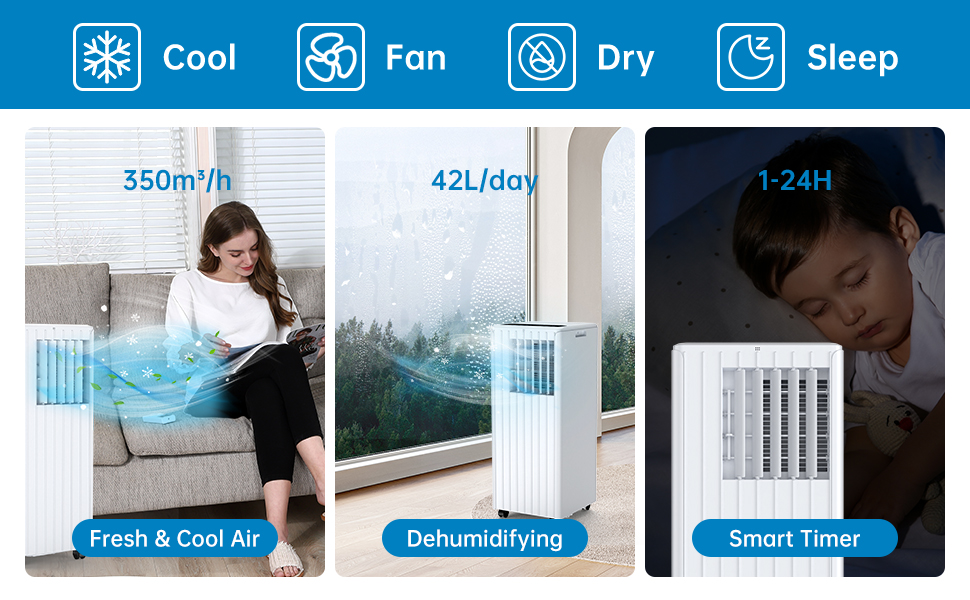
Image: A comprehensive display of the unit's modes, including cooling, fan, dry (dehumidifying), and sleep, along with performance metrics.
- Cooling Mode: Provides powerful cooling. Set your desired temperature using the Up/Down arrows. The unit will cool until the room reaches the set temperature.
- Fan Mode: Circulates air without cooling. Choose from Low, Medium, or High fan speeds.
- Dehumidification Mode: Removes excess moisture from the air. The unit will operate at a low fan speed. Ensure the continuous drainage hose is connected for prolonged use in this mode.
5.4 Sleep Mode
Activate Sleep Mode for quiet operation and energy efficiency during nighttime. In this mode, the fan speed is reduced, and the temperature may gradually increase to ensure comfortable sleep.

Image: The portable air conditioner in a bedroom setting, illustrating its quiet operation and features like automatic shut-off and 24-hour smart timer for undisturbed sleep.

Image: A graph depicting the temperature adjustment curve in Sleep Mode, showing how the temperature gradually rises over several hours to maintain comfort.
6. Maintenance
Regular maintenance ensures the longevity and efficient operation of your air conditioner.
6.1 Air Filter Cleaning
The air filter should be cleaned every two weeks or more frequently depending on usage and air quality. A dirty filter can reduce cooling efficiency and airflow.
- Unplug the unit from the power outlet.
- Locate and remove the air filter from the back or side of the unit.
- Wash the filter under running water (warm, not hot) or use a vacuum cleaner to remove dust.
- Allow the filter to dry completely before reinserting it into the unit. Do not expose to direct sunlight.

Image: A close-up view of the washable filter being easily removed from the unit for maintenance.
6.2 Water Drainage
The unit has an internal water collection tank. When the tank is full, the unit will stop operating and display an indicator. You will need to drain the water manually.
- Unplug the unit.
- Place a shallow pan or bucket under the drainage outlet at the bottom rear of the unit.
- Remove the drainage plug and allow the water to drain completely.
- Replace the drainage plug firmly.
For continuous drainage in dehumidification mode, connect the provided drain hose to the continuous drainage outlet.
6.3 General Cleaning
Wipe the exterior of the unit with a soft, damp cloth. Do not use harsh chemicals, abrasives, or solvents.
6.4 Storage
Before storing the unit for an extended period:
- Drain all condensed water.
- Clean the air filter.
- Unplug the power cord and coil it neatly.
- Store the unit in a dry, cool place, away from direct sunlight and extreme temperatures.
7. Troubleshooting
If you encounter issues with your air conditioner, refer to the table below for common problems and solutions.
| Problem | Possible Cause | Solution |
|---|---|---|
| Unit does not turn on | No power supply Water tank full Overheat protection activated | Check power plug and outlet Drain the water tank Allow unit to cool down for 30 minutes |
| Insufficient cooling | Air filter dirty Exhaust hose blocked or kinked Room size too large Windows/doors open Temperature setting too high | Clean air filter Check and clear exhaust hose Ensure unit is suitable for room size Close all windows and doors Lower the set temperature |
| Water leakage | Drain plug loose Unit not level Continuous drain hose improperly connected | Secure drain plug Place unit on a level surface Ensure drain hose is properly attached and sloped downwards |
| Unit is noisy | Unit not on a level surface Internal components vibrating | Place unit on a flat, stable surface This may be normal operation noise, especially at high fan speeds. Ensure no obstructions. |
| Remote control not working | Batteries dead or incorrectly inserted Obstruction between remote and unit | Replace batteries, check polarity Remove any obstructions, ensure direct line of sight |
8. Specifications
Technical specifications for the Acekool Portable Air Conditioner Model PAC-M09.
| Feature | Specification |
|---|---|
| Model Number | PAC-M09 |
| Brand | Acekool |
| Cooling Capacity | 9000 BTUs |
| Refrigerant | R290 |
| Power Supply | 220 Volts |
| Maximum Noise Level | 55 dB(A) |
| Product Dimensions (L x W x H) | 38.2 x 35 x 88.5 cm |
| Product Weight | 26 kg |
| Dehumidification Capacity | 42 L/Day |
| Energy Efficiency Rating | Class A |
| SEER | 2.8 |
| Recommended Coverage Area | 30-40 m² |
9. Warranty and Support
For warranty information, technical support, or service inquiries, please refer to the warranty card included with your product or contact Acekool customer service through their official website or the retailer where the product was purchased. Please have your model number (PAC-M09) and purchase date ready when contacting support.


