
SHALUO SX440
SHALUO SX440 Automatic Voltage Regulator User Manual
Model: SX440
Brand: SHALUO
Introduction
This manual provides detailed instructions for the installation, operation, and maintenance of the SHALUO SX440 Automatic Voltage Regulator (AVR). The SX440 is designed to regulate the output voltage of an alternator, ensuring stable power generation. It features robust design and precise control capabilities for various generator applications.
Key features include:
- Voltage Build-up: Residual volts at AVR terminal > 5 VAC.
- EMI Suppression: Internal Electromagnetic Interference Filtering.
- Exciter Resistor: DC Resistance 20~100 Ω.
- Analogue Input: Max. Input ±5 VDC, Input Resistance 1 KΩ, 1V for 5% generator volts.
- Unit Power Dissipation: Max. 12 Watt.
Product Overview

Figure 1: Top view of the SHALUO SX440 Automatic Voltage Regulator, showing the main circuit board, components, and connection terminals. A warning label for electrical shock risk is visible.

Figure 2: Angled perspective of the SX440 AVR, highlighting the various potentiometers and connection points for fine-tuning and integration.

Figure 3: Bottom view of the SX440 AVR, showing the mounting points and a label with model information and serial number.
Setup and Installation
Important Safety Information: Before proceeding with installation, ensure that all power sources are disconnected. Installation should only be performed by qualified personnel. Observe all local electrical codes and safety regulations.
Mounting the AVR
The AVR can be mounted directly on the engine, genset, switchgear, control panel, or any position that will not affect its operation. Refer to the outline drawing for dimensions and mounting hole locations.
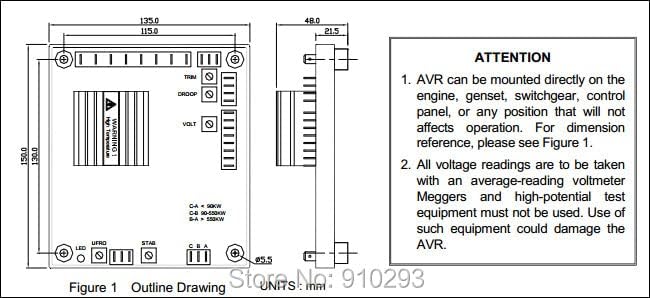
Figure 4: Outline Drawing (Figure 1 from source) of the SX440 AVR, showing its physical dimensions in millimeters and mounting hole positions. This diagram is essential for planning the installation space.
Wiring Connections
Carefully follow the wiring diagram for proper connection to the alternator and control system. Incorrect wiring can damage the AVR or the generator.
- Sensing Input: Connect to the generator output terminals.
- 0-110V: 90~150V AC
- 0-220V: 175~260V AC
- 0-380V: 350~520V AC
- Power Input: 100~264 VAC, Single Phase.
- Output Voltage: Max. 90 VDC at 207 VAC.
- Current: Continuous 4 ADC, Intermittent 10A for 10 sec.
- DROOP Input: Max. input 0.33A, Burden 10 Ω, 0.07A for 5% droop (PF=0).
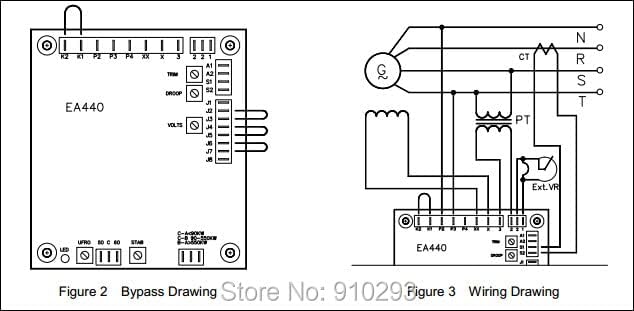
Figure 5: Wiring Diagram (Figure 3 from source) for the SX440 AVR, illustrating the connections to the generator, sensing inputs, and power input. This diagram is critical for correct electrical installation.
Note: All voltage readings are to be taken with an average-reading voltmeter. Meggers and high-potential test equipment must not be used, as their use could damage the AVR.
Operating the AVR
The SX440 AVR is designed for automatic voltage regulation. Once properly installed and powered, it will maintain the generator's output voltage within specified limits. Adjustments can be made using the onboard potentiometers.
AVR Controls and Functions
| Control | Function |
|---|---|
| VOLT | Voltage Adjustment: Used to set the desired output voltage level. |
| STAB | Stability Adjustment: Controls the response speed and stability of the voltage regulation. |
| U/F | Under Frequency Protection (UFRO) Knee Point Set: Adjusts the frequency threshold at which the voltage is reduced to prevent engine overload at low speeds (45~60 Hz). |
| DROOP | Droop Adjustment: Used for parallel operation of generators to ensure proper load sharing. |
| TRIM | Analogue Input Adjustment: For fine-tuning voltage via an external signal. |
| DIP | U/V Rate Set: Adjusts the rate of voltage change with respect to frequency. |
Voltage Regulation: The SX440 maintains voltage regulation at less than ±1% (with 4% engine governing). External voltage adjustment is possible at ±8% @ 1 KΩ.
Maintenance
The SHALUO SX440 AVR is designed for reliable operation with minimal maintenance. However, periodic checks can help ensure its longevity and optimal performance.
- Environmental Conditions: Ensure the operating environment adheres to the specified conditions:
- Relative Humidity: < 95%
- Operating Temperature: -40~60 °C
- Storage Temperature: -40~85 °C
- Vibration: The unit is rated for vibration at 1.5 G @ 5~30 Hz and 5.0 G @ 30~500 Hz. Ensure it is securely mounted to minimize excessive vibration.
- Cleanliness: Keep the AVR free from dust, dirt, and moisture. Use a soft, dry cloth for cleaning. Do not use solvents or abrasive cleaners.
- Connections: Periodically inspect all wiring connections to ensure they are secure and free from corrosion. Loose connections can lead to unstable operation or damage.
No user-serviceable parts are inside the sealed unit. In case of malfunction, contact qualified service personnel.
Troubleshooting
This section provides general guidance for common issues. For complex problems, consult a qualified technician.
| Problem | Possible Cause | Solution |
|---|---|---|
| No Voltage Output / Low Voltage |
|
|
| Unstable Voltage Output |
|
|
| Overvoltage / Undervoltage |
|
|
Specifications
Detailed technical specifications for the SHALUO SX440 Automatic Voltage Regulator.
| Parameter | Value |
|---|---|
| Sensing Input Terminal 0-110V | 90~150V AC |
| Sensing Input Terminal 0-220V | 175~260V AC |
| Sensing Input Terminal 0-380V | 350~520V AC |
| Power Input Voltage | 100~264 VAC, Single Phase |
| Output Voltage (Max.) | 90 VDC at 207 VAC |
| Output Current (Continuous) | 4 ADC |
| Output Current (Intermittent) | 10A for 10 sec. |
| Thermal Drift | 0.05% per °C change in AVR ambient |
| DROOP Input (Max.) | 0.33A |
| DROOP Burden | 10 Ω, 0.07A for 5% droop (PF=0) |
| Under Frequency Protection (U/F Potentiometer) | 45~60 Hz |
| Voltage Regulation | <± 1% (with 4% engine governing) |
| External Volts Adjustment | ±8% @ 1 KΩ |
| Voltage Build-up | Residual volts at AVR terminal > 5 VAC |
| EMI Suppression | Internal Electromagnetic Interference Filtering |
| Exciter Resistor DC Resistance | 20~100 Ω |
| Analogue Input (Max.) | ±5 VDC |
| Analogue Input Resistance | 1 KΩ, 1V for 5% generator volts |
| Unit Power Dissipation (Max.) | 12 Watt |
| Vibration | 1.5 G @ 5~30 Hz, 5.0 G @ 30~500 Hz |
| Relative Humidity | < 95% |
| Operating Temperature | -40~60 °C |
| Storage Temperature | -40~85 °C |
| Product Dimensions | 6.29"L x 4.33"W x 3.93"H |
| Model Name | SX440 |
Warranty and Support
Specific warranty terms and support contact information are typically provided by the seller or manufacturer at the time of purchase. Please refer to your purchase documentation or contact SHALUO directly for details regarding warranty coverage, technical support, and service options for your SX440 Automatic Voltage Regulator.
For further assistance, please visit the official SHALUO website or contact their customer service department.
Ask a question about this manual
Ask about setup, troubleshooting, compatibility, parts, safety, or missing instructions. Manuals+ will review the question and use this page’s manual context to help answer it.