
NOYAFA NF-8209S
NOYAFA NF-8209S Network Cable Tester User Manual
Model: NF-8209S | Brand: NOYAFA
1. Introduction
The NOYAFA NF-8209S is a multi-functional network cable tester designed for professionals and enthusiasts. It provides comprehensive testing capabilities for network cables, including continuity, length measurement, PoE testing, port blinking, and crystal head crimp quality checks. Equipped with a lithium battery for convenience, this device is an essential tool for network installation, maintenance, and troubleshooting.
2. Product Overview
2.1 Components
The NF-8209S system typically includes the main tester unit, a receiver unit, and various accessories for different testing scenarios.

Figure 2.1: Main components of the NOYAFA NF-8209S Network Cable Tester, including the main unit, receiver, and various cables and adapters.
2.2 Key Features
- Multi-function Test Modes: Supports LAN line open, short, cross, and STP line testing without calibration.
- Line Sequence Diagram Function: Accurately measures cable length from 1-500m in normal or anti-jamming modes.
- Port Flashing/Blink Test: Locates network ports by flashing lights on Hub/Switch (10M/100M/1000M compatible).
- PoE Test: Tests power supply voltage, PoE standard/non-standard, and physical state of STP/UTP LAN cables.
- NCV/QC Test: Checks crystal head crimp quality and tests AC voltage (50V-1000V, range 70V-1000V 50/60Hz).
- Rechargeable Battery: Features a 1400mAh USB-C rechargeable lithium battery.
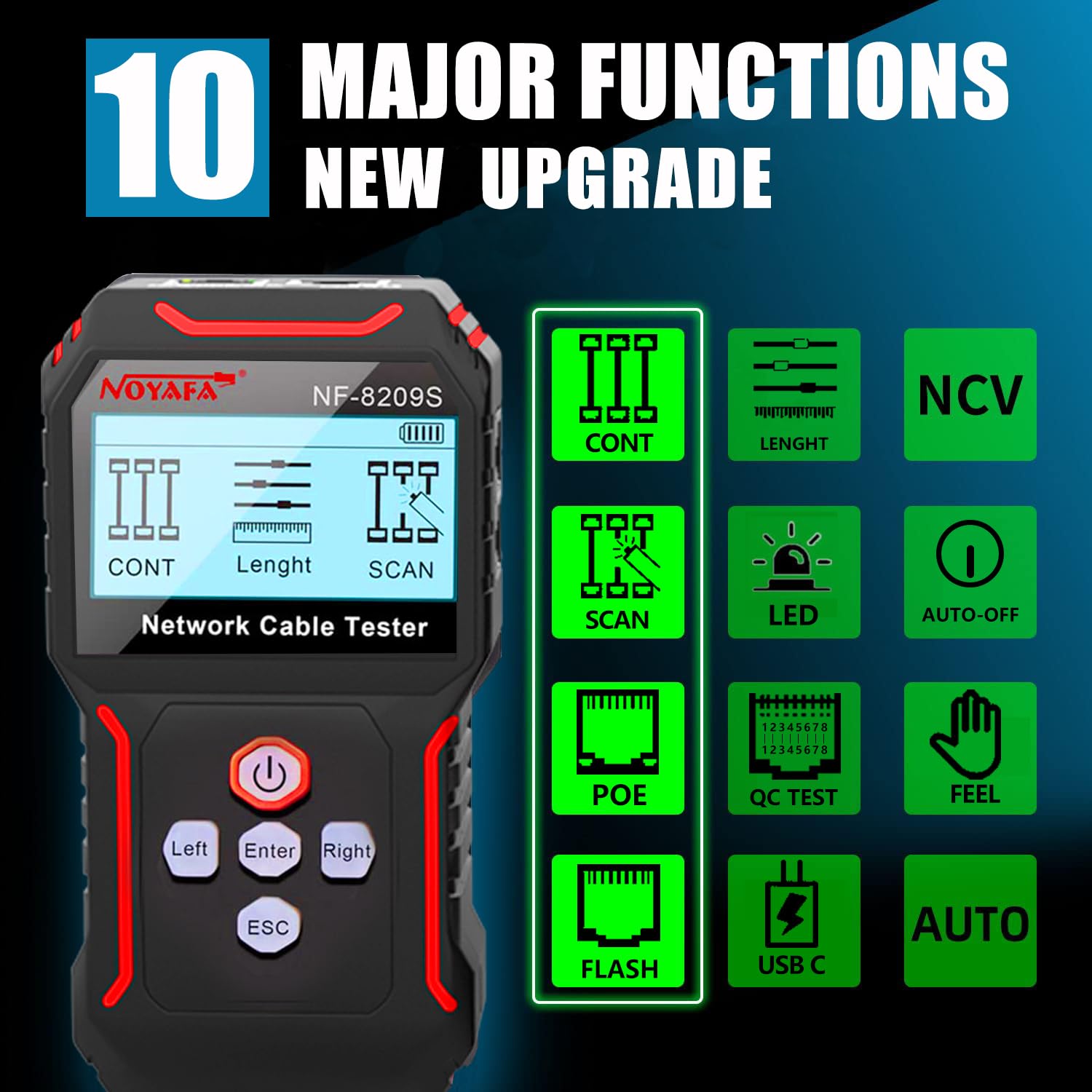
Figure 2.2: Visual representation of the 10 major functions of the NF-8209S, including Continuity, Length, Scan, PoE, Flash, QC Test, NCV, LED, Type-C charging, and Feel (sensitivity).
3. Setup
Before first use, ensure the device is fully charged. Connect the main unit to a USB power source using the provided USB-C cable. The battery indicator on the display will show charging status.
- Charge the Device: Connect the main unit to a USB power adapter using the USB-C cable. The 1400mAh lithium battery will charge.
- Power On: Press and hold the power button on the main unit to turn it on.
- Receiver Power: The receiver unit typically has a separate power switch or is activated when scanning.

Figure 3.1: The NF-8209S main unit connected to a USB power source for charging, highlighting its rechargeable lithium battery.
4. Operating Instructions
4.1 Continuity Test (CONT)
This mode tests for open circuits, short circuits, and cross-overs in network cables, including shielded (STP) lines.
- Connect one end of the network cable to the RJ45 port on the main unit.
- Connect the other end of the cable to the RJ45 port on the receiver unit.
- Select "CONT" mode on the main unit. The display will show the wiring sequence and identify any faults.

Figure 4.1: The NF-8209S main unit and receiver connected to a network cable, displaying continuity test results for open, short, and cross-over conditions.
4.2 Length Measurement (LENGTH)
Measure the length of network cables accurately without calibration, ranging from 1 to 500 meters.
- Connect one end of the network cable to the RJ45 port on the main unit. The other end should be open (not connected to anything).
- Select "LENGTH" mode. The device will automatically measure and display the cable length.

Figure 4.2: The NF-8209S main unit connected to a coiled network cable, showing the measured length on its display.
4.3 Port Flashing/Blink Test (FLASH)
Identify the corresponding network port on a switch or router by observing the flashing link light.
- Connect the network cable to be tested to the transmitter (main unit).
- Connect the other end of the cable to a port on the Hub/Switch.
- Select "FLASH" mode. The indicator light of the connected port on the switch/router will flash at the same frequency, allowing for easy identification.

Figure 4.3: The NF-8209S main unit connected to a network cable, which is then plugged into a switch, demonstrating how the device identifies the active port by making its LED blink.
4.4 PoE Test (POE)
Test Power over Ethernet (PoE) information, including voltage, polarity, power supply mode, and PSE type (af or at standard).
- Connect the network cable from the PoE source to the RJ45 port on the main unit.
- Select "POE" mode. The display will show detailed PoE information.
4.5 Crystal Head Crimp Test (QC TEST)
Accurately and quickly test whether the crystal head (RJ45 connector) is crimped in good condition.
- Insert the crimped RJ45 connector into the QC test port on the main unit.
- Select "QC TEST" mode. The device will indicate if the crimp is successful or if there are issues.

Figure 4.4: The NF-8209S main unit with an RJ45 connector inserted into its QC test port, showing the results of the crimp quality test on the display.
4.6 Wire Tracing / Scan Mode (SCAN)
Locate specific cables among bundles using the receiver unit. Supports both normal and anti-jamming modes.
- Connect one end of the cable to be traced to the main unit.
- Turn on the receiver unit and select "SCAN" mode.
- Move the receiver along the cable path. The receiver will emit an audible tone when it detects the signal from the main unit, indicating the target cable.
- Switch between normal mode (analog signal, strong discrimination) and anti-interference mode (digital signal, no noise interference, high sensitivity) as needed.
Video 4.1: Demonstration of the NOYAFA NF-8209S performing various tests including continuity, length measurement, PoE testing, port blinking, crystal head crimp test, and wire tracing (scan mode). This video highlights the device's multi-functional capabilities in a practical setting.

Figure 4.5: The receiver unit of the NF-8209S being used to scan and identify a specific network cable within a bundle, demonstrating its wire tracing capability.
4.7 NCV (Non-Contact Voltage) Function
The receiver unit features a Non-Contact Voltage (NCV) function to detect AC voltage (50V-1000V, 50/60Hz) without direct contact, enhancing safety.
- Activate the NCV function on the receiver unit.
- Bring the NCV sensor close to an AC voltage source (e.g., power outlet, live wire). The device will indicate the presence of voltage with an audible alert and/or visual indicator.

Figure 4.6: The NF-8209S receiver unit being used to detect non-contact voltage, showing its safety feature for identifying live electrical sources.
5. Maintenance
- Cleaning: Use a soft, dry cloth to clean the device. Do not use abrasive cleaners or solvents.
- Storage: Store the device in a cool, dry place away from direct sunlight and extreme temperatures.
- Battery Care: Recharge the battery regularly, even if not in frequent use, to maintain battery health. Avoid fully discharging the battery for extended periods.
6. Troubleshooting
| Problem | Possible Cause | Solution |
|---|---|---|
| Device does not power on. | Low battery or power button not pressed correctly. | Charge the device using the USB-C cable. Ensure the power button is pressed and held until the device turns on. |
| Inaccurate length measurement. | Cable not properly connected or damaged. | Ensure the cable is securely connected to the main unit and the other end is open. Check the cable for visible damage. |
| Scan function not detecting cable. | Interference or incorrect mode. | Switch to anti-interference mode. Ensure the main unit is transmitting a signal and the receiver is close to the cable. |
| PoE test shows no data. | No PoE power or non-standard PoE. | Verify that the connected port is indeed a PoE port and is active. The device supports standard PoE (af/at). |
7. Specifications
- Model: NF-8209S
- Brand: NOYAFA
- Product Dimensions: 7.87 x 4.72 x 1.57 inches
- Item Weight: 10 Ounces
- Power Source: Battery Powered (1400mAh Lithium Battery, USB-C Charge)
- Color: Black
- Cable Length Measurement Range: 1-500m (approx. 3-1640 feet)
- AC Voltage Detection (NCV): 50V-1000V (70V-1000V 50/60Hz operating range)
- PoE Standards Supported: af/at
- Port Compatibility: RJ45 (for network cables), RJ11 (for telephone lines)

Figure 7.1: Detailed view of the NF-8209S main unit and receiver, showing their dimensions and various ports and controls.
8. Warranty and Support
NOYAFA is committed to providing high-quality products. For warranty information, technical support, or service inquiries, please refer to the official NOYAFA website or contact their customer service directly. Keep your purchase receipt for warranty claims.
For more information, visit the NOYAFA Store on Amazon.
Related documentsNF-8209S


Ask a question about this manual
Ask about setup, troubleshooting, compatibility, parts, safety, or missing instructions. Manuals+ will review the question and use this page’s manual context to help answer it.