
AMD AMD Ryzen 7 7800X3D
AMD Ryzen 7 7800X3D Desktop Processor User Manual
Model: AMD Ryzen 7 7800X3D
Brand: AMD
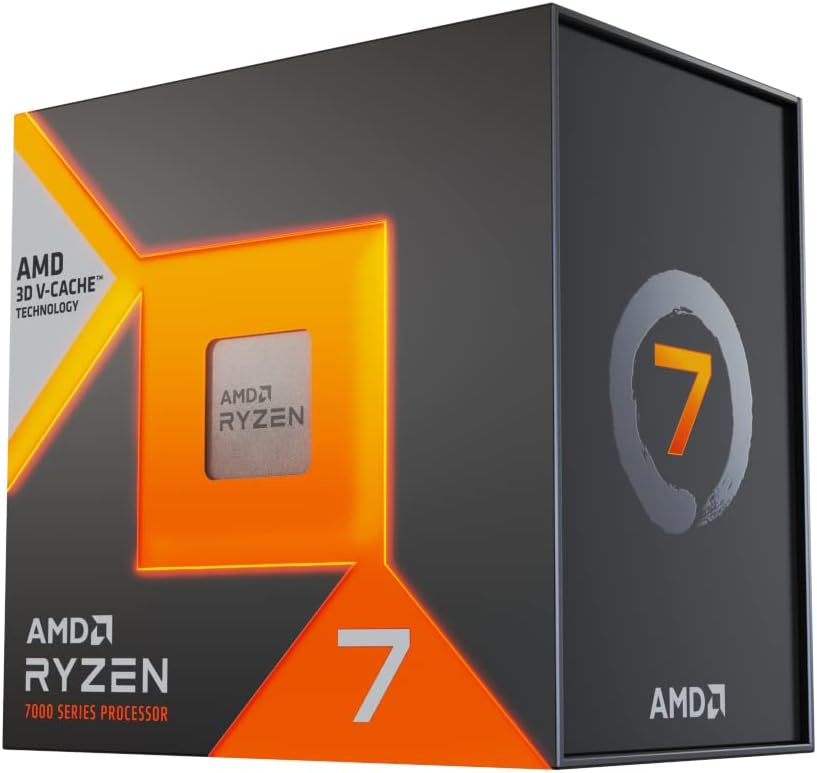
Image: Front view of the AMD Ryzen 7 7800X3D processor retail box.
1. Introduction
Welcome to the new era of performance with the AMD Ryzen 7 7800X3D Desktop Processor. This processor ushers in the speed of "Zen 4" architecture, designed for gamers and creators, featuring massive built-in memory for ultimate game performance. It provides dependable and fast execution of tasks with maximum efficiency, thanks to its 8-core, 16-thread design and 5 nm process technology. The integrated AMD Radeon Graphics controller also ensures amazing graphics output.
2. Safety Information
Please read and understand all safety precautions before handling or installing your processor. Improper handling can lead to damage to the component or personal injury.
- Electrostatic Discharge (ESD) Prevention: Always handle the processor by its edges. Wear an anti-static wrist strap connected to a grounded surface when working inside your computer. Avoid touching the gold contacts or pins on the processor.
- Power Off: Ensure your computer system is completely powered off and unplugged from the wall outlet before beginning installation.
- Thermal Paste: Use thermal paste as directed. Avoid excessive application, which can lead to poor thermal transfer or short circuits if it's electrically conductive.
- Sharp Edges: Be aware of sharp edges inside the computer case and on other components.
- Ventilation: Ensure adequate ventilation for your system. Overheating can damage components and reduce system stability.
3. Package Contents
Verify that all items are present in your AMD Ryzen 7 7800X3D processor package:
- AMD Ryzen 7 7800X3D Desktop Processor
- Documentation (e.g., Quick Start Guide, Warranty Information)
- Note: This processor model does not include a stock CPU cooler. A compatible aftermarket CPU cooler (air or liquid) is required for operation.
4. Setup and Installation
Follow these steps carefully to install your AMD Ryzen 7 7800X3D processor:
- Prepare Your Motherboard:
- Ensure your motherboard has an AM5 socket and is compatible with Ryzen 7000 series processors. Refer to your motherboard's manual for specific compatibility.
- Update your motherboard's BIOS to the latest version if necessary, as older BIOS versions may not support the Ryzen 7 7800X3D.
- Open the CPU retention lever on the motherboard's AM5 socket.
- Install the Processor:
- Carefully align the triangular arrow on the processor with the corresponding arrow on the motherboard's CPU socket.
- Gently lower the processor straight down into the socket. Do not force it. If it doesn't seat easily, re-check alignment.
- Close the CPU retention lever to secure the processor in place.
- Apply Thermal Paste:
- Apply a small amount (pea-sized or a thin line) of high-quality thermal paste to the center of the processor's Integrated Heat Spreader (IHS).
- Do not spread the paste manually; the pressure from the cooler will spread it evenly.
- Install CPU Cooler:
- Mount your chosen aftermarket CPU cooler (air or liquid AIO) according to its manufacturer's instructions. Ensure firm and even pressure for optimal thermal contact.
- Connect the CPU cooler's fan and pump (if AIO) cables to the appropriate headers on your motherboard (e.g., CPU_FAN, AIO_PUMP).
- Install RAM and Other Components:
- Install DDR5 RAM modules into the motherboard's DIMM slots, ensuring they are fully seated.
- Install your graphics card and any other necessary expansion cards.
- Connect all power supply cables to the motherboard (24-pin ATX, 8-pin CPU) and other components.
- Initial Boot and Driver Installation:
- Connect your monitor, keyboard, and mouse. Power on the system.
- Access the BIOS/UEFI to verify the CPU is recognized and to configure basic settings.
- Install your operating system.
- Download and install the latest AMD Chipset Drivers from the official AMD website (www.amd.com/en/support).
- Install the latest graphics drivers for your GPU.
5. Operating Your Processor
Once installed, your AMD Ryzen 7 7800X3D processor will automatically manage its performance based on workload. For optimal experience, consider the following:
- Software Updates: Regularly update your operating system, motherboard BIOS, and AMD chipset drivers to ensure stability, performance, and security.
- Performance Monitoring: Use AMD's Ryzen Master utility or other third-party software to monitor CPU temperatures, clock speeds, and utilization. This helps ensure your system is running efficiently and within safe thermal limits.
- Gaming & Productivity: The Ryzen 7 7800X3D excels in gaming due to its 3D V-Cache technology, providing high frame rates and smooth gameplay. It also offers strong performance for content creation and multitasking.
6. Maintenance
Proper maintenance helps prolong the life and performance of your processor:
- Dust Cleaning: Periodically clean dust from your CPU cooler and computer case fans using compressed air. Dust buildup can impede airflow and lead to higher temperatures.
- Thermal Paste Reapplication: If you replace your CPU cooler or notice consistently high temperatures, consider reapplying thermal paste. Carefully clean off old thermal paste from both the CPU IHS and the cooler's cold plate before applying new paste.
- Temperature Monitoring: Continuously monitor CPU temperatures, especially under heavy load, to ensure they remain within safe operating limits (Tjmax: 89°C).
7. Troubleshooting
If you encounter issues with your AMD Ryzen 7 7800X3D processor, try the following common troubleshooting steps:
- No Display/No Boot:
- Ensure all power cables (24-pin ATX, 8-pin CPU) are securely connected.
- Verify the CPU is correctly seated in the socket and the retention lever is locked.
- Check RAM modules are properly seated in the correct slots according to your motherboard manual.
- Confirm your monitor is connected to the graphics card (or motherboard if using integrated graphics for initial setup).
- Clear CMOS (Complementary Metal-Oxide-Semiconductor) on your motherboard.
- Overheating Issues:
- Ensure the CPU cooler is properly installed and making good contact with the CPU IHS.
- Verify thermal paste was applied correctly and is not too old or dried out.
- Check that CPU cooler fans are spinning and connected to the correct headers.
- Ensure adequate airflow within your PC case.
- System Instability/Crashes:
- Update motherboard BIOS and chipset drivers to the latest versions.
- Run memory diagnostic tools to check for RAM issues.
- Ensure your power supply unit (PSU) has sufficient wattage for all components.
8. Specifications
Key technical specifications for the AMD Ryzen 7 7800X3D Desktop Processor:
| Feature | Specification |
|---|---|
| Processor Model | AMD Ryzen 7 7800X3D |
| CPU Cores / Threads | 8 Cores / 16 Threads |
| Base Clock Speed | 4.2 GHz |
| Max Boost Clock | Up to 5.0 GHz |
| L2 Cache | 8 MB |
| L3 Cache | 96 MB (with 3D V-Cache) |
| Default TDP | 120W |
| Processor Technology | 5 nm "Zen 4" |
| CPU Socket | AM5 |
| Integrated Graphics | AMD Radeon Graphics |
| Max Operating Temperature (Tjmax) | 89°C |

Image: Back view of the AMD Ryzen 7 7800X3D processor retail box, showing key features and specifications.
9. Warranty and Support
Your AMD Ryzen 7 7800X3D processor is covered by AMD's standard limited warranty. Please refer to the warranty information included in your product packaging for full terms and conditions.
For technical support, driver downloads, and additional resources, please visit the official AMD Support website:
You can also find community forums and FAQs on the AMD website to assist with common questions and issues.
Related documentsAMD Ryzen 7 7800X3D


Ask a question about this manual
Ask about setup, troubleshooting, compatibility, parts, safety, or missing instructions. Manuals+ will review the question and use this page’s manual context to help answer it.