
ENGINDOT W4T-01PR-1
ENGINDOT Dishwasher User Manual
Model: W4T-01PR-1 / PPT20
1. Product Overview
Thank you for choosing the ENGINDOT Dishwasher. This compact, tabletop dishwasher is designed for convenience and efficiency, suitable for approximately 4 place settings. It features multiple wash cycles and advanced cleaning capabilities to ensure your dishes are spotless.

Front view of the ENGINDOT Dishwasher, showcasing its compact design and control panel.

The ENGINDOT Dishwasher integrated into a kitchen environment, highlighting its tabletop placement.
Key Features:
- Compact & Portable: Self-standing design, no complex installation required for basic use.
- Powerful Cleaning: Utilizes 60°C to 80°C high-temperature water spray and strong water pressure for effective cleaning, removing stubborn grease and food residue.
- 7 Wash Courses: Offers a variety of cycles including Strong, Energy Saving, Standard, Quick, Baby Care, Soft, and Rinse, to suit different dishwashing needs.
- Dual Water Supply Options: Can be connected to a faucet using a split valve or manually filled.
- Safety Functions: Equipped with E1 (water overflow/insufficient water) and E4 (water leakage) alarms, and a child lock function.
- Water & Energy Efficient: Uses 3.8 to 8 liters of water per cycle and 0.005 to 0.7 kWh of energy.
2. Safety Instructions
Please read all safety instructions carefully before operating the dishwasher to prevent injury or damage. Keep this manual for future reference.
General Safety:
- Ensure the dishwasher is placed on a stable, level surface.
- Do not operate the dishwasher if the power cord or plug is damaged.
- Keep children away from the dishwasher during operation. The unit features a child lock function for added safety.
- Only use dishwasher-specific detergents.
- Do not touch the heating element during or immediately after operation.
- In case of water leakage, the E4 alarm will activate, and the water supply will be automatically cut off.
- If E1 alarm (water overflow or insufficient water) activates, check water supply and drainage.

The dishwasher is equipped with a child lock function to prevent accidental operation by children.
3. Setup and Installation
The ENGINDOT Dishwasher is designed for easy setup. It can be used as a self-standing unit without complex installation, or connected to a water supply.
Package Contents:
- Dishwasher Unit x1
- Water Inlet Hose x1
- Drain Hose x1
- Power Cord x1
- Dish Basket x1
- Valve x1
- Split Valve (3-way) x1
- Instruction Manual x1
Water Supply Connection:
There are two primary methods for water supply:
- Manual Water Filling: For simple use, water can be manually poured into the top opening of the dishwasher.
- Faucet Connection: For continuous water supply, connect the dishwasher to a faucet using the provided hoses and split valve.

Illustration of two water supply methods: direct faucet connection (Method 1) and connection via a split valve (Method 2).

Detailed diagram showing the steps for connecting the water supply hose to a faucet using the provided accessories.
For faucet connection, ensure the faucet type is compatible with the provided split valve. If your faucet is not compatible, a separate adapter may be required.
4. Operation
Operating your ENGINDOT Dishwasher is straightforward. Follow these steps for optimal cleaning results.
Loading Dishes:
Proper loading ensures effective cleaning. Arrange dishes to allow water spray to reach all surfaces.

An illustration of the dishwasher's capacity, showing how approximately 4 place settings can be arranged.

Top-down view demonstrating the optimal arrangement of dishes and utensils inside the dishwasher basket.
- Place larger items and pots at the bottom.
- Ensure dishes do not block the spray arms.
- Load bowls and plates facing the center.
- Utensils should be placed in the utensil basket with handles down for forks and spoons, and handles up for knives.
Wash Cycles:
The dishwasher offers 7 wash courses to choose from, depending on the level of dirt and type of dishes.

The control panel with cycle selection buttons and a table detailing each wash course.
| Course | Description | Max Water Temp (°C) | Operating Time (min) | Water Usage (L) |
|---|---|---|---|---|
| Strong | Best for heavily soiled dishes. | 70 | 108 | 8 |
| Energy Saving | For general daily use, saves water and energy. | 68 | 98 | 6 |
| Standard | For general dirt after daily use. | 66 | 58 | 6.8 |
| Quick | For lightly soiled dishes (e.g., after breakfast). | 65 | 28 | 3.8 |
| Baby Care | For quick cleaning and sterilization of baby dishes. | 73 | 38 | 3.8 |
| Soft | For plastic dishes or those with heat resistance below 65-90°C. | 70 | 48 | 5.3 |
| Rinse | For quickly rinsing clean dishes. | Water supply temp | 12 | 3.8 |
Starting a Wash Cycle:
- Load dishes according to guidelines.
- Add appropriate dishwasher detergent to the dispenser.
- Close the top door securely.
- Press the Power button to turn on the unit.
- Select your desired wash course using the program selection buttons.
- Press the Start/Pause button to begin the cycle.
5. Cleaning and Maintenance
Regular cleaning and maintenance will ensure the longevity and optimal performance of your dishwasher.
Cleaning the Interior:
- After each use, wipe down the interior and door seal with a damp cloth to remove any food residue.
- Periodically clean the filter system at the bottom of the dishwasher to prevent blockages and odors.
- For thorough cleaning, run a cycle with a dishwasher cleaner or a cup of white vinegar.
Drying Function:
This dishwasher primarily uses fan drying. For best drying results, open the door slightly after the cycle finishes to allow steam to escape and facilitate natural air drying.
6. Troubleshooting
Refer to this section for common issues and their solutions.
| Problem | Possible Cause | Solution |
|---|---|---|
| Dishwasher does not start. | Power cord not plugged in; Door not closed properly; Power outage. | Check power connection; Ensure door is latched; Check household circuit breaker. |
| E1 Alarm (Water related). | Water overflow or insufficient water supply. | Check water inlet hose for kinks; Ensure water supply is on; Check for blockages in drain hose. |
| E4 Alarm (Water leakage). | Water leakage detected. | Immediately turn off power and water supply; Contact customer support. |
| Dishes not clean. | Improper loading; Insufficient detergent; Clogged spray arms/filter. | Reload dishes correctly; Add more detergent; Clean spray arms and filter. |
| Poor drying performance. | No dedicated heating dry function; Dishes too crowded. | Open door slightly after cycle for air drying; Ensure proper dish loading. |
If the problem persists after attempting these solutions, please contact customer support.
7. Specifications
Detailed technical specifications for the ENGINDOT Dishwasher.
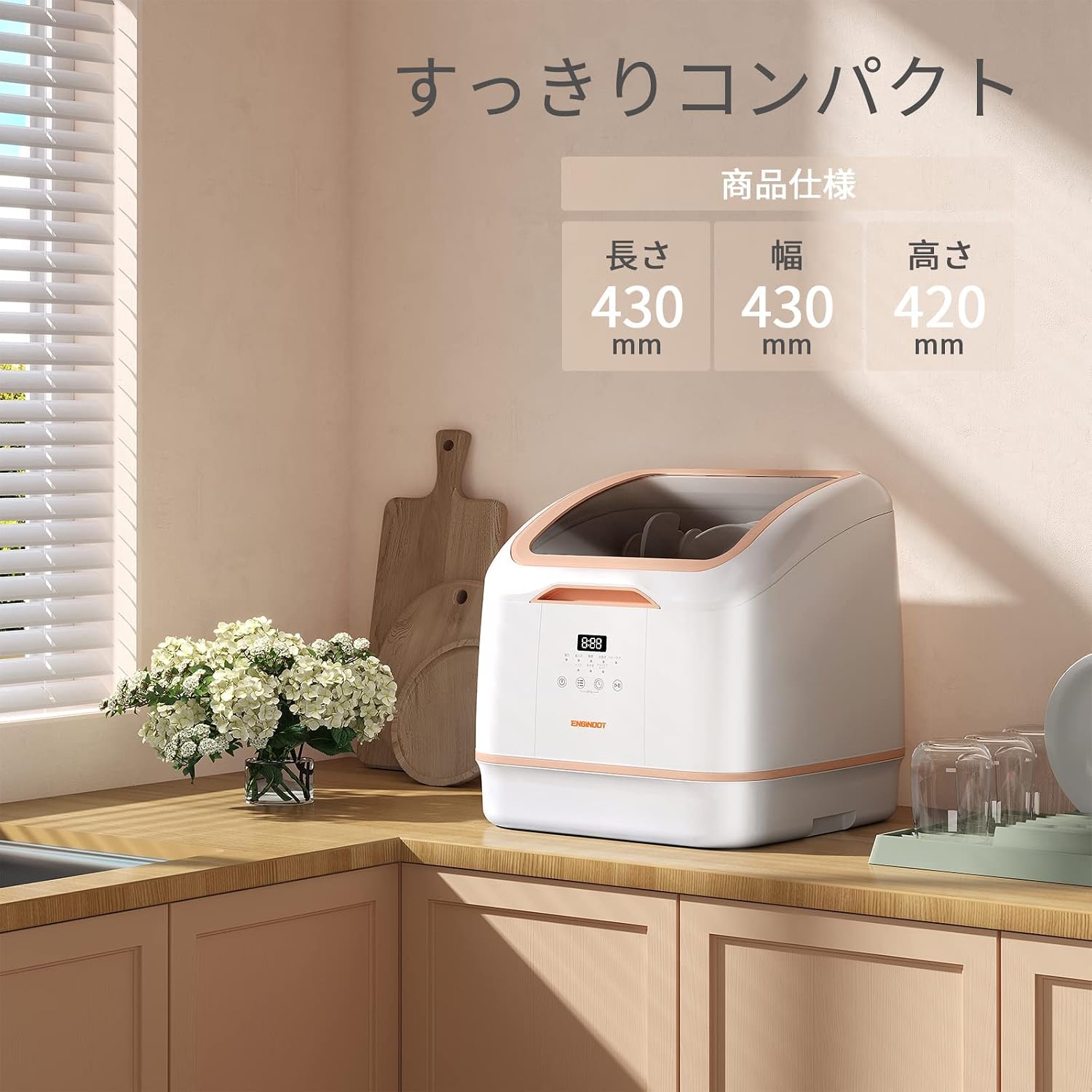
Diagram illustrating the compact dimensions of the ENGINDOT Dishwasher: Length 430mm, Width 430mm, Height 420mm.
| Feature | Detail |
|---|---|
| Model Number | W4T-01PR-1 / PPT20 |
| Dimensions (W x D x H) | 43 cm x 43 cm x 42 cm |
| Weight | 11.5 kg |
| Capacity | Approx. 4 place settings / 12 Liters |
| Voltage | 100 V (AC) |
| Frequency | 50 Hz |
| Power Consumption | 680 W |
| Water Consumption (per cycle) | 3.8 - 8 L (average 6.8 L) |
| Noise Level (during wash) | 49 dB |
| Material | ABS PPT20 |
| Control Type | Touch |
| Door Opening Type | Top-opening |
| Special Features | Dishwashing function, Anti-leakage function |
8. Warranty and Support
For warranty information and customer support, please refer to the contact details provided with your purchase or visit the official ENGINDOT website.
Please retain your proof of purchase for any warranty claims.
Related documentsW4T-01PR-1


Ask a question about this manual
Ask about setup, troubleshooting, compatibility, parts, safety, or missing instructions. Manuals+ will review the question and use this page’s manual context to help answer it.