
1. Introduction
This instruction manual provides essential information for the assembly, operation, and maintenance of your Dancing Wings Hobby 600mm Savage Bobber RC Airplane Kit, Model E3206-154E. This kit requires assembly and is designed for experienced hobbyists. Please read this manual thoroughly before beginning assembly or operation to ensure safe and correct use of the product.
The Savage Bobber is a 600mm wingspan micro RC airplane featuring a cockpit. The fuselage is constructed from 0.5mm fiberglass, and the wings are made from balsawood and PP foam, offering a lightweight yet durable structure. This specific kit, E3206-154E, includes the E32 Savage Bobber KIT, MC1108 4000KV Motor, 5030 Propeller, 4x 2.0g Servos, RX154E (DSXM/2 & 7A/2S ESC) receiver, and a 2S 150mAh battery.
2. Safety Information
Operating a radio-controlled aircraft requires caution and adherence to safety guidelines. Failure to follow these instructions can result in injury or property damage.
- Always operate your RC airplane in open areas, away from people, buildings, and power lines.
- Ensure all components are correctly assembled and secured before each flight.
- Verify battery charge levels for both the aircraft and the transmitter before flying.
- Never fly near airports or restricted airspace.
- Keep hands and loose clothing away from the propeller when the motor is active.
- Adult supervision is recommended for users under 18 years of age.
- Understand and comply with all local regulations regarding RC aircraft operation.
3. Package Contents
Upon opening your Dancing Wings Hobby Savage Bobber kit, please verify that all components are present and undamaged. The E3206-154E package typically includes the following:
- E32 Savage Bobber Airframe Kit (balsawood, PP foam, fiberglass parts)
- MC1108 4000KV Brushless Motor
- 5030 Propeller
- 4x 2.0g Servos
- RX154E Receiver with integrated 7A/2S Brushless ESC (DSXM/2 compatible)
- 2S 150mAh LiPo Battery
- Assembly Hardware (rods, connectors, landing gear components)
- Instruction Manual (this document)
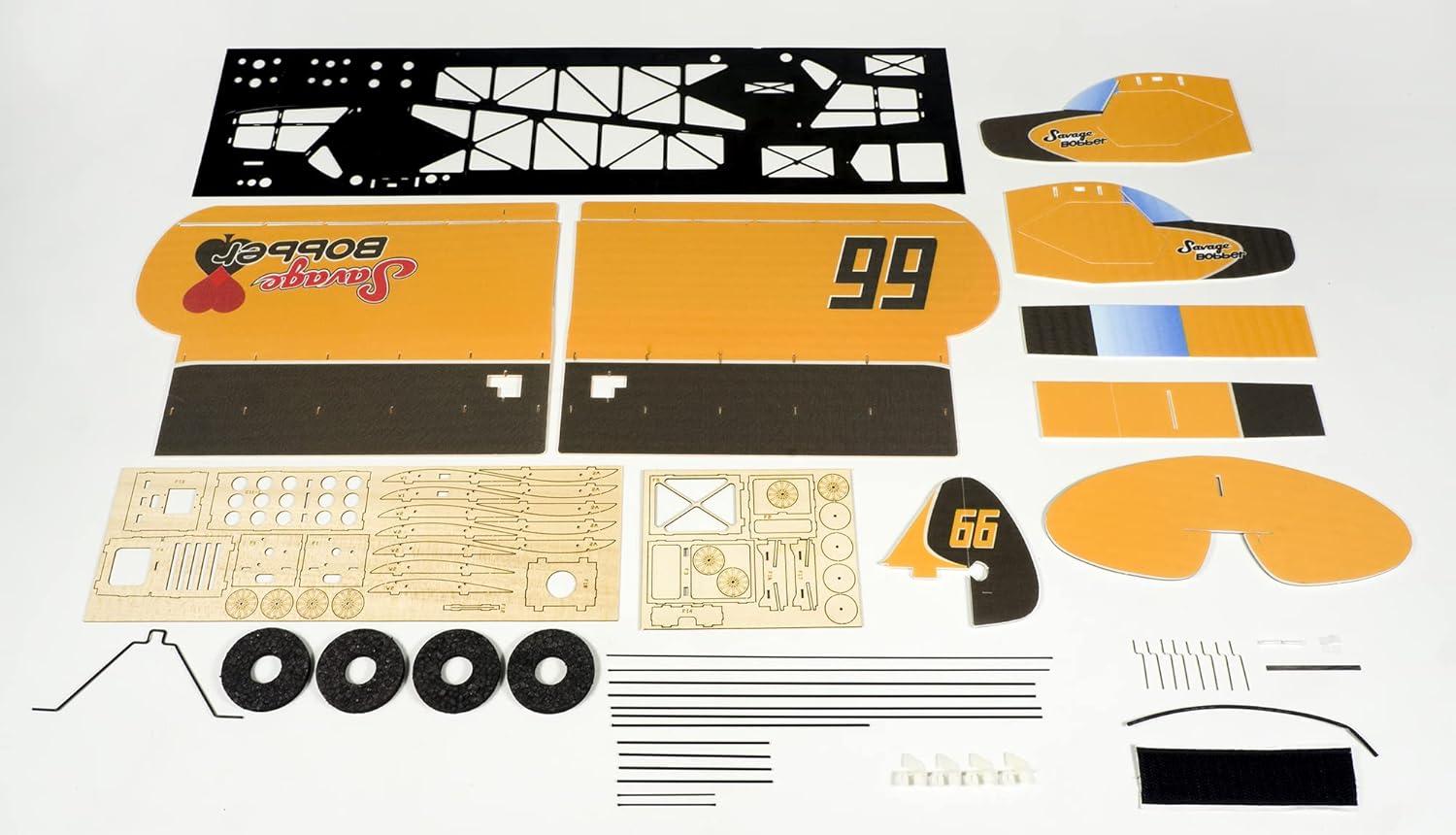
Image: Overview of the E3206-154E kit, showing the assembled plane and included electronic components like motor, servos, receiver, and battery.
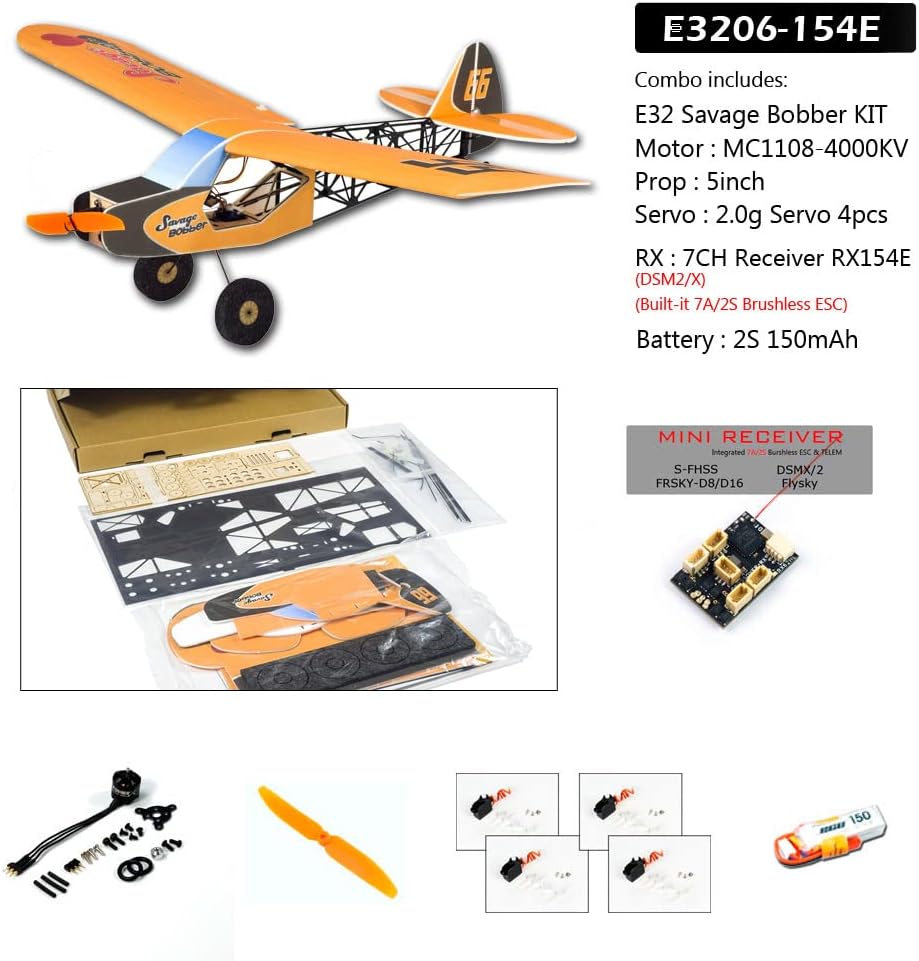
Image: Detailed view of the laser-cut balsawood and PP foam parts, along with other kit components, ready for assembly.
4. Specifications
| Feature | Specification |
|---|---|
| Model Name | E3206-154E |
| Wingspan | 600mm (23.6 inches) |
| Length | 418mm (16.5 inches) |
| Flying Weight | Approximately 98g |
| Motor | MC1108 4000KV Brushless |
| ESC | Integrated 7A/2S Brushless (part of RX154E) |
| Servos | 4x 2.0g |
| Propeller | 5030 |
| Battery | 2S 150mAh LiPo |
| Receiver | RX154E (DSXM/2 compatible) |
| Material | Balsawood, PP foam, 0.5mm Fiberglass (fuselage) |
| Assembly Required | Yes |
| Recommended Age | Adult (16+ years) |

Image: Infographic summarizing key specifications of the E32 600mm Savage Bobber PP Airplane.
5. Assembly and Setup
The Savage Bobber is a kit that requires careful assembly. Please follow the detailed instructions provided in the separate assembly manual that accompanies your kit. This section provides a general overview and important considerations.
5.1 Tools and Materials Required (Not Included)
- Hobby knife or sharp blade
- CA glue (cyanoacrylate) and accelerator
- Epoxy glue (5-minute or 30-minute, depending on preference)
- Small screwdrivers
- Pliers
- Sanding paper
- Heat shrink tubing (for wiring)
- Soldering iron and solder (if custom wiring is needed)
5.2 General Assembly Steps
- Wing Assembly: Carefully assemble the balsawood and PP foam wing sections. Ensure proper alignment and secure bonding.
- Fuselage Construction: Assemble the fiberglass fuselage components. Pay close attention to the orientation of parts.
- Tail Section: Attach the horizontal and vertical stabilizers to the fuselage. Ensure they are perpendicular and aligned for stable flight.
- Landing Gear Installation: Securely attach the landing gear.
- Motor and Propeller: Mount the MC1108 4000KV motor to the motor mount. Attach the 5030 propeller, ensuring it is balanced and correctly oriented for thrust.
- Servo Installation: Install the four 2.0g servos into their designated locations for ailerons, elevator, and rudder. Connect them to the control surfaces using the provided pushrods.
- Receiver and ESC: Install the RX154E receiver/ESC unit. Connect the motor to the ESC and the servos to the appropriate channels on the receiver.
- Battery Placement: Secure the 2S 150mAh LiPo battery in the designated compartment, ensuring it does not shift during flight. Proper battery placement is crucial for achieving the correct Center of Gravity (CG).
- Control Surface Setup: Connect your transmitter to the receiver. Calibrate and test all control surfaces (ailerons, elevator, rudder) to ensure they move freely and in the correct direction relative to your stick inputs. Adjust control throws as recommended in the detailed assembly manual.

Image: The Savage Bobber kit components neatly packaged in their box, illustrating the unassembled state.

Image: The packaging box for the Savage Bobber kit, showing its dimensions (390mm x 210mm x 40mm) and a weight of 378g.
6. Operating Instructions
Once your Savage Bobber is fully assembled and all pre-flight checks are complete, you are ready for flight. Always choose a suitable flying location and be aware of your surroundings.
6.1 Pre-Flight Checks
- Battery Check: Ensure the flight battery is fully charged and securely installed.
- Transmitter Check: Power on your transmitter and ensure its battery is charged.
- Control Surface Test: With the aircraft powered on, verify that all control surfaces (ailerons, elevator, rudder) respond correctly to transmitter inputs and move freely.
- Motor Test: Briefly test the motor at low throttle to ensure the propeller spins freely and in the correct direction.
- Center of Gravity (CG): Confirm the aircraft's CG is within the recommended range. Adjust battery position if necessary.
6.2 First Flight Tips
- Launch: For hand launching, hold the aircraft firmly and apply full throttle, then gently push it forward into the wind. For ground take-off, slowly increase throttle while maintaining directional control with the rudder.
- Trim: Once airborne, make small trim adjustments on your transmitter to achieve stable, level flight without constant stick input.
- Control Inputs: Use smooth and gentle control inputs, especially during initial flights. Over-controlling can lead to loss of control.
- Altitude: Gain sufficient altitude before attempting any maneuvers.
- Landing: Approach the landing area into the wind. Reduce throttle and gradually decrease altitude, using elevator for pitch control. Aim for a gentle touchdown.

Image: A fully assembled Savage Bobber RC airplane, showcasing its side profile and landing gear.

Image: A top-down view of the assembled Savage Bobber, highlighting its wingspan and overall design.

Image: Multiple views of the Savage Bobber RC airplane in flight, demonstrating its aerial capabilities.
Video: An official flight demonstration of the 600mm micro Savage Bobber, showcasing its flight characteristics and performance.
7. Maintenance
Regular maintenance will extend the life of your Savage Bobber and ensure consistent performance.
- Post-Flight Inspection: After each flight, inspect the airframe for any damage, loose connections, or worn parts. Check control surfaces, hinges, and landing gear.
- Motor and Propeller: Ensure the motor mount is secure and the propeller is free from nicks or cracks. Replace damaged propellers immediately.
- Electronics: Check all wiring for fraying or damage. Ensure servo connections are firm.
- Battery Care: Store LiPo batteries in a cool, dry place at storage voltage. Do not overcharge or over-discharge.
- Cleaning: Clean the aircraft with a soft, dry cloth. Avoid using harsh chemicals that could damage the foam or paint.
8. Troubleshooting
This section addresses common issues you might encounter with your Savage Bobber RC airplane.
8.1 Common Issues and Solutions
- Aircraft does not respond to controls:
- Check if the transmitter and receiver are powered on and bound correctly.
- Verify all servo connections to the receiver.
- Ensure the flight battery is charged and properly connected.
- Motor not spinning:
- Check motor and ESC connections.
- Ensure the throttle trim is at its lowest setting and the throttle stick is at zero.
- Verify the flight battery is charged.
- Aircraft flies erratically or is difficult to control:
- Re-check the Center of Gravity (CG).
- Ensure all control surfaces are moving in the correct direction and have appropriate throws.
- Inspect for any physical damage to the airframe or control linkages.
- Servo Connector Incompatibility (Specific to RX154E DSXM/2):
- Some users have reported that the included servo connectors may not directly fit the RX154E receiver motherboard.
- Solution: If you encounter this issue, carefully inspect the connector types. It may be necessary to source compatible servo connectors or adapt the existing ones. Extreme care should be taken if attempting to modify wiring due to the small gauge of the wires. Consult with an experienced hobbyist or the manufacturer for guidance.
9. Warranty and Support
For warranty information, technical support, or replacement parts, please contact Dancing Wings Hobby directly through their official website or the retailer where the product was purchased. Keep your proof of purchase for any warranty claims.
Manufacturer Contact: Refer to the packaging or official Dancing Wings Hobby website for the most current contact information.


