
1. Introduction
The PQWT GT-150A is an advanced geophysical instrument designed for the detection and analysis of underground water sources. Utilizing natural electric field frequency selection, this device provides automatic mapping, data processing, and analysis capabilities to identify groundwater locations and geological structures up to a depth of 150 meters. It is suitable for various applications including well drilling, geological surveys, and mineral exploration.
2. Product Components
The PQWT GT-150A system includes the following main components:

Image: PQWT GT-150A main unit and accessories.
- Host Machine: The central unit for data collection, processing, and display.
- Tool Bag: For convenient storage and transport of tools and accessories.
- Electrode Rods: Used to connect the cable to the ground for testing.
- Battery (built-in): Provides power to the host machine.
- Cable: Connects the host machine to the electrode rods.
- Power Adapter: For charging the host machine.
- Universal Conversion Plug: Adapts to various national power outlets.
- Data Cable: Connects the host machine to a computer for data transfer.
- Strap: For carrying the host machine.
- Sub-line Clamp: Connects the cable and electrode rod.
3. Setup Instructions
Follow these steps for initial setup of the PQWT GT-150A:
- Charge the Device: Ensure the host machine's built-in battery is fully charged using the provided power adapter.
- Connect Cables: Connect the main cable to the aviation port on the host machine.
- Attach Electrodes: Connect the electrode rods to the cable using the sub-line clamps. Ensure secure connections.
- Position Electrodes: Place the electrode rods into the ground at the desired survey points. The system is designed to collect data from 18 points with a single wiring setup.
- Power On: Press the self-locking switch button to turn on the host machine.
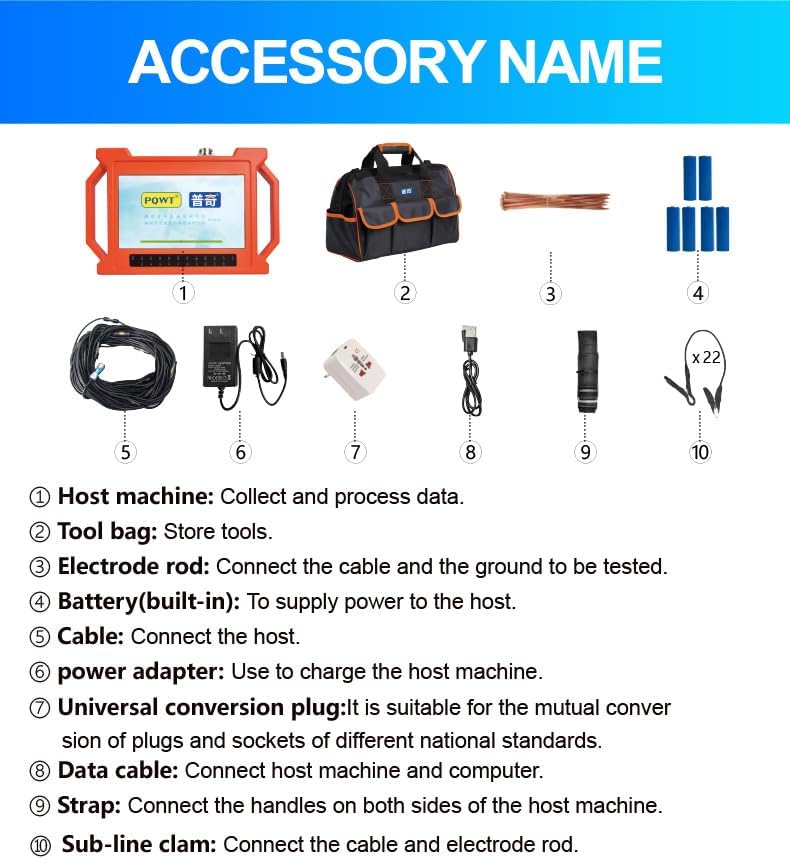
Image: User connecting cables to the PQWT GT-150A water detector.
4. Operating Instructions
The PQWT GT-150A operates using an intuitive interface, controlled via an app. The process involves data acquisition, processing, and analysis.
4.1. Data Acquisition
Once the electrodes are properly positioned and the device is powered on, initiate the data collection process through the device's interface. The system can collect data from 18 points simultaneously, enabling fast detection.

Image: PQWT GT-150A in operation during a field survey.
4.2. Data Processing and Mapping
The device automatically processes the collected data. It generates curve maps, profile maps, and 3D renderings in real-time. This automatic mapping feature simplifies the interpretation of underground geological structures.

Image: Screen view of the PQWT GT-150A displaying collected data and mapping.
4.3. Data Storage
The PQWT GT-150A can store data for over 999 survey lines, including curve maps, profile maps, and 3D renderings. This facilitates the creation of comprehensive well water drilling reports and long-term data management.
4.4. Supplementary Measurement Function
The device supports supplementary measurements to analyze the extension of geological structures. This function allows for additional data collection in front and behind the main survey line to gain a more complete understanding of the subsurface.
5. Application Scenarios
The PQWT GT-150A is suitable for a wide range of applications:

Image: Diverse application scenarios for the PQWT GT-150A.
- Groundwater Source Detection
- Geological Structure Analysis
- Mineral Exploration
- Mine Tunnel Detection
- Cavity and Cave Detection
- Dam Piping Assessment
- Engineering Exploration
- Gob Detection
- Landslide Risk Assessment
- Underground Archaeology
6. Data Analysis and Interpretation
The PQWT GT-150A integrates an auxiliary analysis system to help interpret the collected data. This system automatically analyzes abnormal areas and provides a scientific basis for understanding geological structures.

Image: Assistant Analysis screen providing suggested points.
The device's automatic mapping system generates visual representations of the subsurface, including 3D renderings, which are crucial for identifying potential water-bearing zones.

Image: Example of a 3D rendering of underground data.
7. Maintenance
To ensure the longevity and optimal performance of your PQWT GT-150A, observe the following maintenance guidelines:
- Cleaning: Regularly clean the host machine and accessories with a soft, dry cloth. Avoid using abrasive cleaners or solvents.
- Storage: Store the device in its protective case in a cool, dry place when not in use. Avoid extreme temperatures and humidity.
- Battery Care: Fully charge the battery before long-term storage and recharge it every few months to maintain battery health.
- Cable Inspection: Periodically inspect all cables for signs of wear, cuts, or damage. Replace damaged cables immediately to prevent operational issues.
8. Troubleshooting
If you encounter issues with your PQWT GT-150A, consider the following basic troubleshooting steps:
- Device Not Powering On: Ensure the battery is charged. Check the power button for proper engagement.
- No Data Acquisition: Verify all cables are securely connected to the host machine and electrode rods. Ensure electrode rods are properly inserted into the ground.
- Inaccurate Readings: Check for proper electrode placement and ground contact. Environmental factors can sometimes influence readings; try re-testing in a different area if possible.
- Software Issues: If the app or device software is unresponsive, try restarting the device. Ensure the device firmware is up to date.
For persistent issues, please contact PQWT customer support.
9. Specifications
Key technical specifications for the PQWT GT-150A:

Image: Product parameters comparison.
| Feature | Specification |
|---|---|
| Model Number | GT150A |
| Control Method | App |
| Sensor Technology | Electric Field Sensor |
| Maximum Depth | 150 meters |
| Measuring Time | 5-6 minutes |
| Maximum Number of Channels | 18 channels |
| Minimum Resolution | 0.001mV |
| Points Selection | 1-18 points optional |
| Controller | 32-bit high-speed CPU |
| AD Conversion | 16 bits 1Msps |
| Working Temperature | -20°C ~ 50°C |
| Power Consumption | 9W |
| Measurement Data Unit | Electric field components of different frequencies of magnetotelluric field Vs (mV) |
| Display Screen Unit | 10.1 inch industrial-level high-definition display (resolution 1024*600) |
| Standby Time | 8 hours |
| Cable | 2.5m point pitch, 10m line pitch, 54.7m in total length |
| Electrode | Standard with 22 pieces |
| Host Weight | 1.95kg |
| Product Dimensions | 7.87 x 15.75 x 18.11 inches |
| Item Weight | 36.7 pounds |
| Batteries | 2 Lithium Ion batteries required (included) |

Image: PQWT GT series model specifications overview.
10. Warranty and Support
PQWT provides the following warranty coverage for the GT-150A:
- Host Machine: Two (2) years warranty.
- Cables: One (1) year warranty.
- Charger and Charging Stand: One (1) month warranty.
For technical support, warranty claims, or further assistance, please contact PQWT customer service through the official channels provided at the time of purchase.


